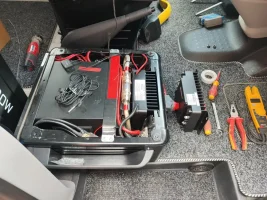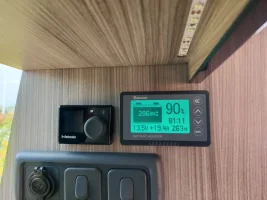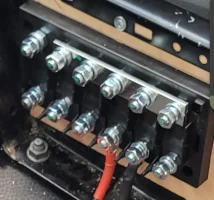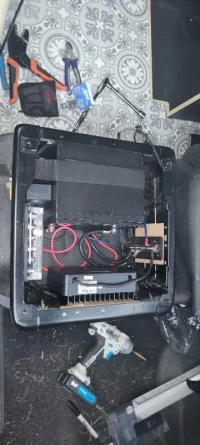
Seat Base Electric + EHU + Solar Install + Charger + DC-DC -- How We Done it --

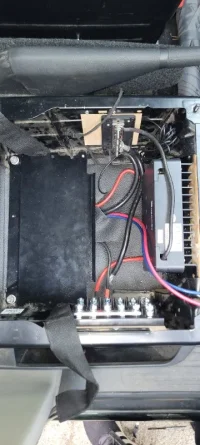
I took all my neutrals including the Victron mains charger to a short neutral bar then a single "0" guage to the shunt and on to the battery negative again in "0" guage.
We were in France this year through that 35C plus hot period and the current model Renogy DCC50S with the deeper cooling fins didn't melt despite the whole 4 weeks being off EHU, happy bunny.:geek:
IMG20240504133344.jpg
IMG20240605152409.jpg
@Badjamin take your EHU mains charger to a 30A fuse (if it's a 30A charger) on the same multi Mega and Maxi fuse board as your other live inputs and outputs to the isolated side of the leisure battery positive.
 
Last edited:
And just one follow up please, is it the same with 12v charger +ve?
Yes you can either take the 12v charger +ve direct to the battery or via a busbar. The battery should have a proper MRBF fuse and then an Isolator switch before any connection to protect the whole system and so you can isolate it. Both of these should be proper BlueSea not cheap Bolatis or whatever shit from amazon or the CFM fuses fogstar sell. All +ve cables should be appropriately fused to protect the cable in addition to the main battery fuse. Common to use the Mega - Midi fuse boxes as this combines both busbar and fuses neatly.

If not already done so it would be a good idea to post up your wiring diagram as people can use that to help you.
 
Last edited:
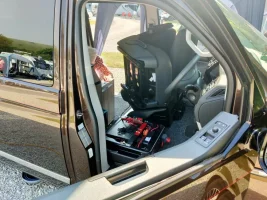
Have to point out that I would have struggled to get one of those battery post fuses on my Roamer seatbase battery hence the 300A beauty sitting across the install.
I only ever did a fag packet sketch of my original setup as realistically these systems have a habit of continually evolving, generally getting larger in capacity with more and more domestic appliances going on tour too. 🥸
As for fuses, fuse holders and switches it's pretty hard to tell the quality of an item from the phone screen but it pays to shop around as there does seem to be an enormous variation on popular stuff, I generally fall for the stuff with the ludicrous specification and hope it's not more CCA labelled as pure copper, for lugs I tend to use the nearest decent electrical wholesaler.
 
  • Like
Reactions: CAB
Have to point out that I would have struggled to get one of those battery post fuses on my Roamer seatbase battery hence the 300A beauty sitting across the install.
I only ever did a fag packet sketch of my original setup as realistically these systems have a habit of continually evolving, generally getting larger in capacity with more and more domestic appliances going on tour too. 🥸
As for fuses, fuse holders and switches it's pretty hard to tell the quality of an item from the phone screen but it pays to shop around as there does seem to be an enormous variation on popular stuff, I generally fall for the stuff with the ludicrous specification and hope it's not more CCA labelled as pure copper, for lugs I tend to use the nearest decent electrical wholesaler.
The facebook campervan electrics & build pages are rife with pictures of unknown brand switches and fuses melting, and also identical fake copies of the branded stuff, which is why I ripped out my cheap copies and bought the Bluesea kit from a reliable source (not amazon). Just dont think its worth the risk.

(Clever install that Frosty)
 
  • Like
Reactions: CAB
Cheers, it's tight under there 🤫
The 2 KW inverter sits low on the side of the fridge cupboard and I have cut into the cabinet :whistle: to allow the inverter to sit about 25mm into the recessed footprint, the Victron mains charger sits alongside.
This was done to keep cable sizes manageable as at low voltages the currents are pretty big, the inverter feeds are 4 guage in parallel each time.
 
Yes you can either take the 12v charger +ve direct to the battery or via a busbar. The battery should have a proper MRBF fuse and then an Isolator switch before any connection to protect the whole system and so you can isolate it. Both of these should be proper BlueSea not cheap Bolatis or whatever shit from amazon or the CFM fuses fogstar sell. All +ve cables should be appropriately fused to protect the cable in addition to the main battery fuse. Common to use the Mega - Midi fuse boxes as this combines both busbar and fuses neatly.

If not already done so it would be a good idea to post up your wiring diagram as people can use that to help you.

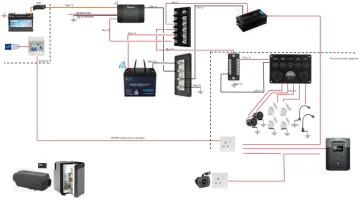
This took me an age to sort, sorry for the delay. I'm gonna have to install an isolater at a later date and a LB fuse on the +ve pole in addition potentially.

The below is pretty much how things are or will be soon at the moment.

This weekend I hope to sort the below
Renogy ignition live to wire in and -ve to connect
Fuses for positive Busbar fuseboard (mega fuses) to work out
Cupboard fuse board to install
Control unit for appliances to install - fed from fuseboard (fuse size to figure out).
Appliances to install (lights still to buy)


1755169520266.webp
 
I took all my neutrals including the Victron mains charger to a short neutral bar then a single "0" guage to the shunt and on to the battery negative again in "0" guage.
We were in France this year through that 35C plus hot period and the current model Renogy DCC50S with the deeper cooling fins didn't melt despite the whole 4 weeks being off EHU, happy bunny.:geek:
View attachment 298772
View attachment 298774
@Badjamin take your EHU mains charger to a 30A fuse (if it's a 30A charger) on the same multi Mega and Maxi fuse board as your other live inputs and outputs to the isolated side of the leisure battery positive.
It's a 20A charger so will pick up a 20A mega fuse cheers
 
I can't find a 20a megafuse or midifuse for AC charger so may have to go 30A. Or I might need to use a midi in line fuse somehow. Perhaps this grrt big mega fuse panel was the wrong choice 🤣
 
Last edited:
This took me an age to sort, sorry for the delay. I'm gonna have to install an isolater at a later date and a LB fuse on the +ve pole in addition potentially.

The below is pretty much how things are or will be soon at the moment.

This weekend I hope to sort the below
Renogy ignition live to wire in and -ve to connect
Fuses for positive Busbar fuseboard (mega fuses) to work out
Cupboard fuse board to install
Control unit for appliances to install - fed from fuseboard (fuse size to figure out).
Appliances to install (lights still to buy)


View attachment 299425
Looks good. Sorry, am away so difficult to read on my phone. Particularly the wire sizing. Doing a diagram is as much about clarifying your own thoughts as well as getting feedback. Some basic principles to follow:
- All your 12v red positive wires need to be fused, as close to the power source as possible. Obvs thats done for the lights etc by the blade fuse box, but apart from the Starter Battery I cant see any fuses for the core system wires? The 240v is covered by the consumer unit under the bonnet.
- Each red wire (and corresponding black wire) should be sized to the maximum current being drawn so your 20A charger may draw twice that at start. Also factor in voltage drop on anything over 1 mtr (12 volt planet have a calculator).
- The fuse is there to stop each red wire becoming a fuse itself so should be sized to 75% of the current capacity of the wire. Eg if you decide a charger needs 16mm2 cable, which has a current capacity of 120A then a 90A fuse is needed, but you might want to go lower if thats way above the max a charger can pull.

Greg Virgoe's you tube videos are superb for this, have a look at his other videos as well.

I am no expert so anyone reading this please correct me if wrong? Hopefully others will help as well?
 
Looks good. Sorry, am away so difficult to read on my phone. Particularly the wire sizing. Doing a diagram is as much about clarifying your own thoughts as well as getting feedback. Some basic principles to follow:
- All your 12v red positive wires need to be fused, as close to the power source as possible. Obvs thats done for the lights etc by the blade fuse box, but apart from the Starter Battery I cant see any fuses for the core system wires? The 240v is covered by the consumer unit under the bonnet.
- Each red wire (and corresponding black wire) should be sized to the maximum current being drawn so your 20A charger may draw twice that at start. Also factor in voltage drop on anything over 1 mtr (12 volt planet have a calculator).
- The fuse is there to stop each red wire becoming a fuse itself so should be sized to 75% of the current capacity of the wire. Eg if you decide a charger needs 16mm2 cable, which has a current capacity of 120A then a 90A fuse is needed, but you might want to go lower if thats way above the max a charger can pull.

Greg Virgoe's you tube videos are superb for this, have a look at his other videos as well.

I am no expert so anyone reading this please correct me if wrong? Hopefully others will help as well?

Everything is goin through a megafuse busbar for under seat leccy. Although i may be regretting buying that for this application

Screenshot_20250814_221638_Gallery.webp


The control board is fused from fuse board adjacent and each appliance has an inline fuse as i wont have time to be wiring all of those into the panel - sorry I ran out of time and space to add that info on diagram. Thanks very much for response and kind input. 🙂🙂🙂
 
ooh I like that!

Also on the Switches etc be wary of anything with an LED light - they are f***** annoying at night 😁

The other thing to consider is cable protection. When I started my T5.1 conversion in 2017 this was literally the first thing google returned when I typed VW transporter DIY Leisure battery install 😱 (High current cable was trapped under the battery on install).
 
ooh I like that!

Also on the Switches etc be wary of anything with an LED light - they are f***** annoying at night 😁

The other thing to consider is cable protection. When I started my T5.1 conversion in 2017 this was literally the first thing google returned when I typed VW transporter DIY Leisure battery install 😱 (High current cable was trapped under the battery on install).
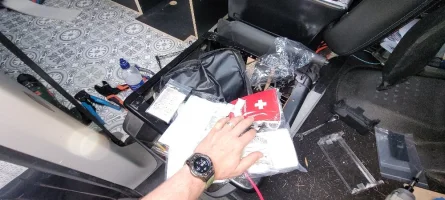
Wow... that post is scary AF. Well I have quite a bit of cable protection going on already with plans for a little more. I have a gland where my feed to the rear distribution goes through a hole I drilled. Lots of conduit going all through the rear voids travelled. I have a battery tray now as shown in below link so no lateral movement on the supply from starter battery.


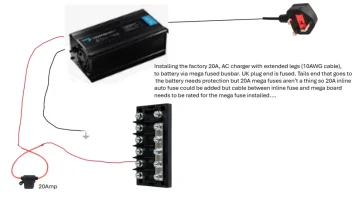
Fuses... well I need to figure out how I'm going to fuse the AC charger for LB. It's a 20A charger so I guess if I can find an inline 20A fuse I can wire in to the cable then that would be an option. It sill needs to be connected to the big megafuse busbar so A 20A inline prior to that and then the smallest megafuse to complete the circuit... maybe?

Am stumped.

1755236184556.webp
 
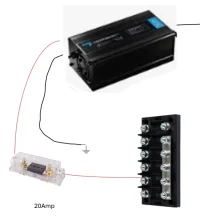
Surely you can get 20A ANL fuses for that live busbar and fuse array but if not, as you say, whack in an inline fuse and holder.
Pretty tidy install and I reckon if you mount the DCC50S the other way around on the base front then you'll be able to see the charger state LEDs and get a second battery in that base.:thumbsup::whistle:
 
Surely you can get 20A ANL fuses for that live busbar and fuse array but if not, as you say, whack in an inline fuse and holder.
Pretty tidy install and I reckon if you mount the DCC50S the other way around on the base front then you'll be able to see the charger state LEDs and get a second battery in that base.:thumbsup::whistle:
I think I will go with the ANL fuse idea. Good call. I shouldn't need to upgrade the short length of cable between the fuse array as the 20A ANL fuse will protect it. I'll bung a 30 or 40 amp mega fuse in the array to make it live. Cool

1755245254967.png

With regards to the DCC50S being the other way around... If it comes to the point that I need more power I'll consider a second battery option, but I won't be pulling much from the battery I don't reckon. As far as being able to see the charger LED's I've got a sneaky plan for that.
 
@Badjamin don't get me wrong as my DCC50S is facing the same as your's but with so little space that's the way it went. This is my second DCC50S after the first one conked out and the inability to see the LEDs is a ball ache but thinking logically the fault would or should have shown on the Renogy BT app, I spotted something was up from the shunt display.
 
If you're blazing a trail to energy independence there's bound to be the odd bit of destruction, in the case of the first DCC50S there wasn't any drama or horrendous explosion, it just withdrew it's labour and when I could see the LEDs they were showing the wrong colours. 🤕
If you want proper ballache stories then getting to our campsite in Brighton and blowing the inverter 80A fuse because our 1kw unit was trying to power a 1.2kw load... yep out with the skt set and the drivers seat hurled (gently) onto the passenger side to replace the fuse... keep spares in all sizes!
IMG20230612162330.jpg
:whistle:
 
If you're blazing a trail to energy independence there's bound to be the odd bit of destruction, in the case of the first DCC50S there wasn't any drama or horrendous explosion, it just withdrew it's labour and when I could see the LEDs they were showing the wrong colours. 🤕
If you want proper ballache stories then getting to our campsite in Brighton and blowing the inverter 80A fuse because our 1kw unit was trying to power a 1.2kw load... yep out with the skt set and the drivers seat hurled (gently) onto the passenger side to replace the fuse... keep spares in all sizes!
View attachment 299538
:whistle:
Glad you got it sorted (and that you had a socket set with you)
 
Thirteen mill ring spanner from memory and five minutes of rage from start to cup of tea finish, seriously it is best to tool up a bit when you start these sorts of projects. 🤫
Also try not to catch the eye rolls of your significant other as you rage through the repair, in fact try not to establish eye contact but to look like you're just adjusting the seatbelt pretensioners as you forgot to do it when you were busy loading the van.:cautious:
 
Just wondering if there have been any further installs? Looking to switch from AGM to Lithium and want to get the max size i can fit. Would the seat base versions be the biggest Ah that can fit? Not sure how much room is left with this fitted. My usage isn't huge, but would rather get it right first time than get something smaller and regret later.
Also under the seat would need to be the below with the relevant cabling and fuses.
CTEK D250se (May replace with Victron DC-DC)
Victron 75/15 MPPT
Ablemail AMT 12-2
 
Just wondering if there have been any further installs? Looking to switch from AGM to Lithium and want to get the max size i can fit. Would the seat base versions be the biggest Ah that can fit? Not sure how much room is left with this fitted. My usage isn't huge, but would rather get it right first time than get something smaller and regret later.
Also under the seat would need to be the below with the relevant cabling and fuses.
CTEK D250se (May replace with Victron DC-DC)
Victron 75/15 MPPT
Ablemail AMT 12-2

What's the capacity of your current AGM?
 
Back
Top