Price of diesel in your area?

No-one's arguing that it's not a depleting asset - that was self-evidently true, right from the very first barrel extracted - but "kicling the can down the road" would appear eminently sensible given the tech you advocate is not capable of meeting current needs and won't be for a good number of years.

Gas isn't globally priced in the way crude is BTW and not being able to keep it (or oil) to ourselves is irrelevant - selling it provides $ that can be used to insulate households from the effects of energy crises or, maybe, help pay for the transition to renewables.

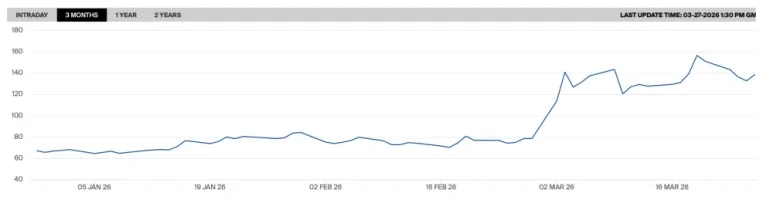
No, gas isn't priced in the same way as crude. Unfortunately though, all gas entering the UK grid, whether from the North Sea, Norway or LNG tankers is priced at a single virtual hub called the National Balancing Point. This means that the UK, despite having domestic NS supply, has close to zero insulation to world prices. See below for the price of UK gas for April delivery - spotting the outbreak of the Iran war isn't particularly tricky here sadly.
1774618297209.webp

Therefore, you have the same issue as crude, you are at the whim of the global market and increasing domestic supply actually doesn't help you very much in terms of energy self-sufficiency.

No one is pretending that electrification is easy, or possible to achieve 100%, but there are very obvious current technologies that can vastly reduce our reliance on gas and oil which should be the focus of our attentions if we want to reduce our reliance as a nation on gas and oil. The 2022 energy crisis sparked by the Russian invasion of Ukraine should have been a sufficient wake up call but this latest episode is a reminder. The effects of spiking gas and oil prices aren't just felt at the petrol pump and in your gas bill either, the resulting ramping inflation outlook causes rates to spike with all the economic implications of that (especially for people taking out mortgages!). As a nation, being in control of our own destiny should be paramount.
 
No, gas isn't priced in the same way as crude. Unfortunately though, all gas entering the UK grid, whether from the North Sea, Norway or LNG tankers is priced at a single virtual hub called the National Balancing Point. This means that the UK, despite having domestic NS supply, has close to zero insulation to world prices. See below for the price of UK gas for April delivery - spotting the outbreak of the Iran war isn't particularly tricky here sadly.

View attachment 320772

Therefore, you have the same issue as crude, you are at the whim of the global market and increasing domestic supply actually doesn't help you very much in terms of energy self-sufficiency.

No one is pretending that electrification is easy, or possible to achieve 100%, but there are very obvious current technologies that can vastly reduce our reliance on gas and oil which should be the focus of our attentions if we want to reduce our reliance as a nation on gas and oil. The 2022 energy crisis sparked by the Russian invasion of Ukraine should have been a sufficient wake up call but this latest episode is a reminder. The effects of spiking gas and oil prices aren't just felt at the petrol pump and in your gas bill either, the resulting ramping inflation outlook causes rates to spike with all the economic implications of that (especially for people taking out mortgages!). As a nation, being in control of our own destiny should be paramount.
We may well have no directly control over the commodity price itself, but more NS oil/gas = more UK revenue and more NS oil/gas = a bigger revenue windfall when energy prices surge. As I said, this additional revenue could then be used to insulate households from the effects of energy crises or, maybe, help pay for the transition to renewables.
 
We may well have no directly control over the commodity price itself, but more NS oil/gas = more UK revenue and more NS oil/gas = a bigger revenue windfall when energy prices surge. As I said, this additional revenue could then be used to insulate households from the effects of energy crises or, maybe, help pay for the transition to renewables.

Yep, you can make a general economic growth and revenue argument, but it's worth being clear that the actual oil/gas local production leading to reduced prices and/or increased stability argument that is often trotted out in favour of NS development just doesn't hold up as we've seen. Given this, it becomes very clear that NS development isn't an alternative to electrification if we want the UK to reclaim control of its energy and not be a hostage to fortune of world events.
 
  • Like
Reactions: CAB
The other thing to consider, in addition to the obvious issues with North Sea reserves, is that gas/oil is an international market. Therefore, even if you are technically self-sufficient in oil or gas, you will still get hammered by global events such as this. The obvious current example is the US which is a net exporter of oil but still getting hammered at the pumps (albeit from a lower base cost).
Genuine question.
So can anyone explain why it has to be this way (other than it always has been)? The fields are in UK waters and extraction is licensed by the UK so in times of emergency, which seems to be most of the time nowadays, it would make sense to extract the oil and or gas but NOT let it go into the international market unless there's a surplus to domestic requirements. I'm not clever enough to know the answer or how our own supplies might be priced for domestic consumption but somebody on here probably knows the answer (or thinks they do).
 
False choice - the North Sea isn't unstable.
It’s not reliable either - in terms of the companies extracting the stuff are understandably looking for the highest profit… so of course they will say they need more licenses (even though they can expand current ones) but that doesn’t mean it helps out cause at all - likely another country would outbid us and ‘our’ reserves would be diverted across the globe. Money talks.
 
An exploration licence is not expandable. Its a geographical 'block' or part of. The North Sea is divided into a grid. Each block can be divided into smaller blocks or sections. The Govt licences these blocks for exploration. Companies that win the exploration licences can sell or lease them to other companies or just sit on them until the licence runs out.
 
No, gas isn't priced in the same way as crude. Unfortunately though, all gas entering the UK grid, whether from the North Sea, Norway or LNG tankers is priced at a single virtual hub called the National Balancing Point. This means that the UK, despite having domestic NS supply, has close to zero insulation to world prices.
And this is why it’s shocking Ofgen allows/suggests electricity prices are tied to gas generation cost, so even when far more is generated by clean sources here in the UK we still pay daft prices for our home electric. Such a scam.
 
An exploration licence is not expandable. Its a geographical 'block' or part of. The North Sea is divided into a grid. Each block can be divided into smaller blocks or sections. The Govt licences these blocks for exploration. Companies that win the exploration licences can sell or lease them to other companies or just sit on them until the licence runs out.
But they can invest more within the licence areas they hold and yield more oil or gas.
Of course, they want the easiest to reach stuff first as the profits are greater. Hence they hold off investing in their current grid and argue it would be best if they could have a new area. That isn’t great for energy security, competition or costs going forward.
 
And this is why it’s shocking Ofgen allows/suggests electricity prices are tied to gas generation cost, so even when far more is generated by clean sources here in the UK we still pay daft prices for our home electric. Such a scam.

I agree it seems insane at first glance to price off gas when solar/wind is so cheap. It’s complex though and articles like the below, for example, make an argument that it’s actually a reasonable policy.

 
  • Like
Reactions: CAB
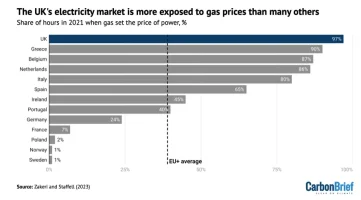
The reason why UK electricity is so expensive compared with much of Europe is less to do with the policy of pricing off the greatest marginal cost (which most countries do) and more to do with the fact that the marginal producer is gas far more of the time than most European countries and gas is just a very expensive fuel compared with the alternatives.
 
Genuine question.
So can anyone explain why it has to be this way (other than it always has been)? The fields are in UK waters and extraction is licensed by the UK so in times of emergency, which seems to be most of the time nowadays, it would make sense to extract the oil and or gas but NOT let it go into the international market unless there's a surplus to domestic requirements. I'm not clever enough to know the answer or how our own supplies might be priced for domestic consumption but somebody on here probably knows the answer (or thinks they do).

This is a good question and, whilst I don't know the full answer, I know enough to know it's complicated! In general, creating a policy of export control is very difficult. For example, how would you define an emergency? For another thing, during these times domestic producers would essentially be forced to sell at under the market rate which, understandably, they would not be very happy to do and so would charge a premium to cover themselves at other times. Basically, coming up with a policy where you pay a reasonable price during 'normal' times and magically under market rates in times of stress would be economic wizardry...

In terms of the UK gas situation infrastructure specifically, it wasn't always like this, the market was effectively 'opened up' by Thatcher in the 1980's and further gas interconnects to Europe were built in the late 90's and 2000's.
 
I agree it seems insane at first glance to price off gas when solar/wind is so cheap. It’s complex though and articles like the below, for example, make an argument that it’s actually a reasonable policy.

A very interesting and easy read summarising the system of marginal pricing. Thanks.

I can see there is acknowledgment that weening ourselves of these expensive and frankly damaging fuels will lower prices for end users. (It should in theory lower other costs too such as healthcare for those suffering from all the ills air pollution foists upon us and from rebuilding infrastructure that has to cope with a harsher climate in the long run) but I still believe while pricing based on the most expensive option is allowed then there is surely reduced incentive to get us to the holy grail of clean and sustainable energy, despite us knowing what needs to be done. After all Energy UK is a trade body for the energy sector and so will be keen not to see profits hit and being able to price linked to gas yet using wind and solar means max profits.

Still - it gives a clearer picture yet (like we needed one) on why the oil and gas industry lobbies so much and why we need to not fall for their propaganda
 
The reason why UK electricity is so expensive compared with much of Europe is less to do with the policy of pricing off the greatest marginal cost (which most countries do) and more to do with the fact that the marginal producer is gas far more of the time than most European countries and gas is just a very expensive fuel compared with the alternatives.
We might use more gas than Europe but it’s still a relatively small proportion of the overall mix (roughly 25% is gas). Clean renewables make up a hefty percentage. No coal now either which is good.
But yes - reducing gas generation further would drop prices.
 
We might use more gas than Europe but it’s still a relatively small proportion of the overall mix (roughly 25% is gas). Clean renewables make up a hefty percentage. No coal now either which is good.
But yes - reducing gas generation further would drop prices.

Yes we only use 25% gas but look below at the proportion of time that gas is the greatest marginal cost compared to other European countries. This is why the price of electricity is so high, because despite using only 25% in terms of total power, it actually sets the marginal price 97% of the time. This proportion will fall though the more renewables come online, which will drive the price down.


1774635805261.webp
 
  • Like
Reactions: CAB
Back
Top