[Guide] DC-DC Charger (for leisure battery) -- How I Done It --

Ignition live now connected.

Does the Renogy charger have a cut off point where the starter battery gets down to a certain voltage or will it just continue to run until the starter battery is dead. (If i leave the ignition on without the engine running for any length of time).
It's has an auto cutoff...

You can screenshot you're Dc-Dc settings page?
 
Just bought a ( new to me ) 2016 camper that is fitted with a 100ah leisure battery ( not gel) and a nordelettronica battery charger thingy. So I plugged in the electric hook up checked it was all plugged in ( it’s fitted in the back of my van under the bed) and I get a yellow flashing light.. all of the 240 and 12v sockets work but I don’t think the charger is.. can I get it repaired?
 
Hi all, but perhaps especially @Dellmassive and @TallPaul_S

I'm about to install my new Orion XS and, having read through the relevant bits of this thread, plus sundry others, I haven't yet arrived at a definitive answer to whether or not it is best practice to run an ignition signal wire to the H pin (which I did on my previous T6 to the old version of the Orion), or whether to rely on the engine/alternator detection to run the unit. It feels like the Orion should work without the signal wire but is a belt and braces approach the best way to go? To be honest I am less confident with testing/changing the voltage settings in the Victron app.

I have a 2024 T6.1 Startline which has a blade fuse box with a 20a fuse under the double passenger seat (cigarette socket on the dash? Assuming it is an ignition live, is this the best place to use a fuse tap to run the signal wire from?

Cheers,

Sam

 
The best is an actual engine run signal, an ignition signal is next best as long as it’s not going to be sat with the ignition on without the engine running for any length of time. The auto-detection should work ok, but you might be faffing with thresholds etc to fine tune it.
 
Hi all, but perhaps especially @Dellmassive and @TallPaul_S

I'm about to install my new Orion XS and, having read through the relevant bits of this thread, plus sundry others, I haven't yet arrived at a definitive answer to whether or not it is best practice to run an ignition signal wire to the H pin (which I did on my previous T6 to the old version of the Orion), or whether to rely on the engine/alternator detection to run the unit. It feels like the Orion should work without the signal wire but is a belt and braces approach the best way to go? To be honest I am less confident with testing/changing the voltage settings in the Victron app.

I have a 2024 T6.1 Startline which has a blade fuse box with a 20a fuse under the double passenger seat (cigarette socket on the dash? Assuming it is an ignition live, is this the best place to use a fuse tap to run the signal wire from?

Cheers,

Sam
I use auto detection with my XS but it did take a while to get settings that worked with my set up. Works perfectly now. Easier for me than running a signal wire!
 
The best is an actual engine run signal, an ignition signal is next best as long as it’s not going to be sat with the ignition on without the engine running for any length of time. The auto-detection should work ok, but you might be faffing with thresholds etc to fine tune it.
What he said. . . . .


OEM engine run signal is best.
Then
IGN Feed.
Then
Auto detection.

I've tested all three and all three work well.

The Auto setting will take some tweekage for your particular van as the starter battery age and health will play a key factor.

So did you have the opertunity to run a cable in do it, but don't connect it for now, just go with the auto and dial in the settings, then if you have a problem later on then you can add in the IGN feed.
 
Thanks chaps. I'm about to take the seats out and the cab floor up to grind off the bulkhead brackets so I'll stick a length of cable in just in case.
 
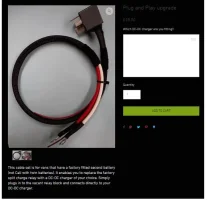
If the van was originally supplied with a factory-fitted auxiliary battery along with a split charge relay/voltage controlled relay, then the small grey wire connected to this relay can supply the engine run signal (H) to the Orion XS (the link wire needs removing if you do).
 
If the van was originally supplied with a factory-fitted auxiliary battery along with a split charge relay/voltage controlled relay, then the small grey wire connected to this relay can supply the engine run signal (H) to the Orion XS (the link wire needs removing if you do).

Thanks but it is a basic spec Startline so no aux battery...
 
Hey @Dellmassive Thanks for your blogs, I'm looking through them whilst I make my way on my own little journey electrifying my camper side of the van.

I got question if you don't mind.

The Victron Orion XS 12/12 50A how are the temps on it, has it been good the last couple of years for you?
I have the fogstar 230ah under seat (drivers seat) and would like to squeeze it in there but only if it can handle the restricted airflow.
 
Hey @Dellmassive Thanks for your blogs, I'm looking through them whilst I make my way on my own little journey electrifying my camper side of the van.

I got question if you don't mind.

The Victron Orion XS 12/12 50A how are the temps on it, has it been good the last couple of years for you?
I have the fogstar 230ah under seat (drivers seat) and would like to squeeze it in there but only if it can handle the restricted airflow.
The newer 50A XS is awesome and stays cool as a cucumber under 40A.

At 50A it starts to warm up, but nothing with the old 30A version that was volcanic....... Easy to run it at <40A via the app.

I've got mine set to 40A with two Roamer 230ah seatbase batterys plus the 50A mppt.... So far so good and not run out of power. (This setup is on the camper)
 
I think Travel volts made up a few kits years ago. Before they shutdown.

It's just some cable soldered to the inside pins of a gutted relay.

Fairly easy to make up.
 
Last edited:
Back
Top