[Guide] Renogy IP67 50A DC-DC Charger + MPPT (for leisure battery) -- How We Done It --

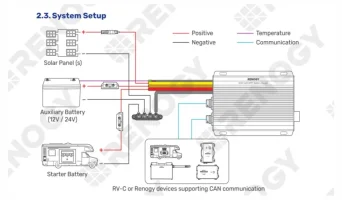
Ground to SB, LB, and PV. All normal, just that you'd only normally have ground to SB in an isolated DC-DC charger. Just have the SB ground going to your chassis ground, and your shunt (if you have one) also connected to chassis ground.
 
That's the 3 black grounds. So the other 2 - one will go your negative leisure battery terminal (directly or indirectly via a shunt), the other is the negative for the solar panel.
 
Ah ok. I think some online wiring diagrams where everything seems to meet at busbars is confusing me. So if I do eventually connect to PV then I need to run a negative (and pos) all the way from the renogy to the PV and can’t terminate at local chassis grounds, like you would something like LED lights? (I need to learn more)

So why does the 50A being reviewed at the start of this thread have only a single GND then?IMG_3676.webp
 
Thanks for the write-up on the Renogy 50A @Dellmassive, I thought the same about it being a Redarc copy when my 40A DCDC + MPPT arrived today. It's a Renogy RBC40D1S.

I'm a bit concerned that this model has three (black) GND wires fixed to the unit, which seems unnecessary if you're grounding to the chassis, rather than a negative back to the starter battery, leisure battery and solar. Any idea why this has been done this way? Should I connect all to a negative bus bar? Or just one? It's a bit strange combined with my limited understanding.

Interestingly this unit prioritizes SB over solar, which I think is an improvement over previous units that would switch to solar even if that meant slower charging than SB.

View attachment 266777View attachment 266778View attachment 266776
View attachment 266779
I've not tested that exact unit.

but id imagin they do that for the american market where the motorhomes are all wood and fiberglass,

so they give you a wire to connect to for each of the grounds, PV, SB, LB.

id imagine they are all connected together internaly.

i would just ground them all out to the same chassis neg on the van, either all to the same ground stud or use a NEG bus bar.

looks like a nice unit though.

good to see Renogy contuing to inovate and keep churning out new and improved proctucts.


.
 
Ah, that makes sense assuming you then need to run cable everywhere. I'm glad I don't have to do that though.

So, with that in mind, am I mad to think you'd only really need to ground one, and the others could be heat shrink covered or taped off?

Thanks again for the write-up on the similar unit. This helped me. And thanks again to @TallPaul_S for the help yesterday.
 
I will poke my nose in here being willing to be shot down!

Personally I would connect all three together and continue them to -ve bus-bar or chassis ground with a large enough cable to ensure no significant volt drop under the maximum possible current flow plus a small margin.

Rod
 
just a quick look. . .

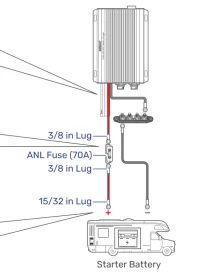
RED - the 60A fuse needs to be moved as close as possible to the LB POS terminal.

Black - just ground the black NEG to chassis as close to the LB NEG terminal as poss, i wouldnt run back to the starter battery. ( i know the Renogy install guide shows that, but the vans bodywork is a much better NEG)


View attachment 249977

Hi Dellmassive,

Hoping you could clarify a couple of things for me...So I have the Renogy DCDC 50A IP67 charge control unit...I have been looking over much of your research/testing and others comments. I am at the install stage and am a little confused about wire/fuse sizing...Renogy may appear to have some conflicting info in their install manual Re: suggested fuse size or, it is just I who am overthinking it, anyways:

My van a 2018 Transporter t6...I have pulled out the OEM leisure battery (from under passenger seat) including the OEM underseat Relay/wiring and 80A fuse....now left with POS+ power cable from ebox is to under seat 10mm2...the Positive Starter Battery Cable (red) from MPPT charger matches @ 10mm2, easy. Now this...I wish to replace the 80A fuse however, considering the cable size (10mm2 range 40-55AMPS) should i place a smaller inline fuse to protect the cable...? Renogy suggests 70A fuse as per their most recent install guide (image)...is this ok for 10mm2 cable...? does this fuse go as close to MPPT charge controller...?

I made reference to your suggestions from above as it was sound advice...my setup will be similar on paper...geographically different location in van.

1777771503701.webp
 
Not wading in too deep but there's nothing to stop you putting a smaller fuse after that 80A fuse, as you say even 70A through a 10mm2 cable when you're not exactly sure of the length is a bit cavalier.
If your unit can manage a 50A output then a 60A fuse on that cable is a bit better but ideally a 50A fuse and then throttle back your B2B as you're going to have solar input too I assume.
I've got the DCC50S and that outputs at 30A now as I cooked the first one I had, this later model does have deeper cooling heatsink fins now.
 
Not wading in too deep but there's nothing to stop you putting a smaller fuse after that 80A fuse, as you say even 70A through a 10mm2 cable when you're not exactly sure of the length is a bit cavalier.
If your unit can manage a 50A output then a 60A fuse on that cable is a bit better but ideally a 50A fuse and then throttle back your B2B as you're going to have solar input too I assume.
I've got the DCC50S and that outputs at 30A now as I cooked the first one I had, this later model does have deeper cooling heatsink fins now.

Cheers for the feedback Frosty,

Right you are, cavalier yes...there is no more 80A fuse so current to MPPT charger is open to whatever it can handle (max 50A i'm assuming...open to further commentry)...I reckon 60A inline fuse for now and as you suggest, throttle the SB charging parameters back to say 40A...I guess it was the cabling that was may may concern...given i removed the OEM relay/80A fuse, that open wire run is now longer to SB approx. 2m. Yes to solar, I am installing a single renogy 200w shadowflux solar panel...tested the current on a sunny day here in Oz and reading was near specs on website i.e. 6.38A. SWB van, simple setup yest all a learning curve for me so appreciate your advice :-)
 
@Banjodubb You'll get a lot of help on here as there's a fair spread of different installs and not just 100% Victron or Renogy fan boys but combinations of smaller name kit too.
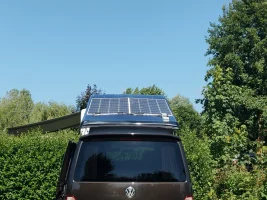
I've got a couple of Renogy 175 watt flexi panels and a 230Ah seat base lifepo4 battery by Roamer.
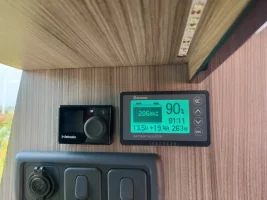
Managed a month without hookup in France last year, June/July, nice to see just under 20A going into the battery when you've picked a decent parking spot ie shaded in the morning and evening and brutal overhead sun during the day. :geek: :thumbsup:.

3105.webp
3097.webp
Edit and found piccies...
 
Last edited:
Back
Top