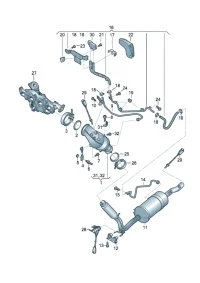
DPF Dilemma and the van is stranded. Any ideas?

The Tangerine Dream

Member
VIP Member
Hello gang,

The issue is that the van will only start with the Lambda Sensor removed, so I highly suspect an ash-clogged DPF. (Pressure sensor readings ranging between 400 - 650 support this).

That issue is bad enough in itself.

A more pressing issue is that it's on a public road, downhill, and about 0.2 miles away from my driveway.

I don't have anyone to tow me and it's on too steep an incline to jack the van up to remove the DPF, not that I'd be confident in doing that, anyway.

I tried the Mannol 9694 Foam Cleaner in the Lambda sensor (#29 in the pic) in the vain hope that it would clear enough of the blockage so that I could at least limp the distance, but no joy.

Could anyone please advise at all?

Cheers all,

- TTD

DPF Pressure Sensor Hoses.webp
 
First and foremost have you had some diagnostics plugged in to check the fault codes.

Have you had any previous DPF light / warnings come on? With the diagnosis you can check the soot and ash levels of the DPF, just seems strange you haven’t had anything pre warning come up.
 
First and foremost have you had some diagnostics plugged in to check the fault codes.

Have you had any previous DPF light / warnings come on? With the diagnosis you can check the soot and ash levels of the DPF, just seems strange you haven’t had anything pre warning come up.
Very weird that there hasn't been any fault codes, but I think I have dodgy map from the previous owner.

The van previously had heavy black smoke under load, especially going up hills. It later got much worse: it started and ran very rough, would barely rev past around 1,500 rpm, and produced a lot of black smoke. After that it became a crank/no-start, occasionally firing briefly but not sustaining running.

I discovered injector #2 had accidentally been fitted with two copper washers. Since then, all injectors have been removed, seats cleaned, correct single washers fitted, and injectors refitted. The #4 high-pressure injector pipe also looked suspect/crooked at the end, so I replaced it with a genuine VAG pipe today. Leak-off rail/lines have also been checked and I’ve been using VCDS fuel pump/bleed routines.

VCDS findings:

Fuel pressure appears strong during cranking/start attempts. In various logs it has built to around 50,000–90,000 kPa. Injection is being commanded and the engine has repeatedly caught briefly, reaching over 1,000 rpm at times, but then dies.

No fault codes are currently showing.

DPF / exhaust pressure findings:

The DPF differential pressure readings looked very high during start attempts with the oxygen sensor fitted. I was seeing spikes in the hundreds of mbar, including around 400–580 mbar during brief firing/cranking attempts.

I then removed/loosened the oxygen sensor before the DPF/cat to create an exhaust bypass. With the oxygen sensor removed, the van started and ran. During that test, DPF pressure readings were much lower, mostly around the low tens of mbar once running.

I refitted the oxygen sensor after trying Mannol DPF foam cleaner. The van still would not start normally, and the DPF pressure again climbed very high during attempts, with readings over 500 mbar seen again.

Other DPF values:

  • Soot calculated: 0.00 g
  • Soot measured: -4.60 g
  • Oil ash mass: 122.74 g
  • Time since last regen seen in one log: 7679 minutes
The soot values seem odd/untrustworthy, but the pressure behaviour seems significant. I’m also not sure whether the DPF may have been mapped out previously, so I’m unsure whether a forced regen is even possible or meaningful.

The engine seems capable of starting when exhaust pressure is relieved via the oxygen sensor hole, so I’m now suspecting a serious exhaust restriction downstream of the oxygen sensor, most likely DPF/cat assembly, possibly soot/ash loading or collapsed substrate.

What I'd like to know from those more experience that I is:

  1. Does the oxygen sensor removal test pretty much confirm an exhaust restriction?
  2. Would you suspect DPF/cat blockage or collapsed substrate rather than injector/fuel issues now?
  3. Is 122.74 g oil ash mass significant on this engine?
  4. Is there any point attempting more in-car cleaner, or is this now an off-car DPF/cat clean/replacement job?
  5. If the DPF has been mapped out, would forced regen be impossible or unreliable?

With the oxygen sensor fitted, DPF pressure spikes into the hundreds of mbar during start attempts, up to around 580 mbar, and the engine will not sustain running.

With the oxygen sensor removed/loosened before the DPF/cat, the van starts and the DPF pressure drops to roughly low tens of mbar.

So I’m now trying to confirm whether this points conclusively to a blocked/restricted DPF/cat assembly, collapsed substrate, or another exhaust restriction downstream of the oxygen sensor.

Any advice appreciated.

 
Last edited:
So initially oil ash mass seems way too high,
There is a limit you can view in the same measuring values

My CXGB engine was 110g limit and I was around 90.

I was told the only way to clean the ash level was a DPF off and flush.

If you have had a bad injector previously producing a lot of black smoke and soot this will probably confirm what you are thinking that the DPF is completely blocked.
 
2017 T6 CXHA engine.
  1. Does the oxygen sensor removal test pretty much confirm an exhaust restriction?
  2. Would you suspect DPF/cat blockage or collapsed substrate rather than injector/fuel issues now?
The engine seems capable of starting when exhaust pressure is relieved via the oxygen sensor hole, so I’m now suspecting a serious exhaust restriction downstream of the oxygen sensor, most likely DPF/cat assembly, possibly soot/ash loading or collapsed substrate.
Agreed, exhaust restricted.

Is 122.74 g oil ash mass significant on this engine?
Not alone. It's just a counter, not a hard limit. Per workshop manual after reaching 110 grams things will monitored when serviced.

Soot calculated: 0.00 g
Time since last regen seen in one log: 7679 minutes
No fault codes are currently showing.
If the DPF has been mapped out,
All the above are quite suspicious. CXHA engine would never report 0 grams of soot calculated. Also 7679 minutes without DPF regeneration definitely would clog the DPF. Typically the DPF is regenerated below/around 500 minutes. So suspecting the DPF has been overloaded 15 times of normal soot load. Perhaps the fault codes are suppressed.

How many miles you have driven/owned the van? 7679 minutes would equal something like 4000 miles.

Please post engine blockmap file.


How-to create a blockmap file:

Ignition ON
[VCDS]
[Applications]
[Controller Channel Map]
- Single Controller Address = 01
- Login or security access code: Leave blank
- Function: Measuring values
- Output: CSV file
[Go]


The result file (.csv) is saved into directory C:\Ross-Tech\VCDS\Logs
 
Thanks for taking the time to reply, @mmi

I've done roughly 6,500 miles since owning it, but I've never known it to attempt a Regen, which I've always put down to it supposedly being mapped.

I have the Blockmap here. Please do let me know if you'd prefer it to be presented in another way.

Thanks again.
 
  • Like
Reactions: mmi
I should also mention the the Lambda sensor was in place during the blockmap reading, but not necessarily tightened to the correct torque.

Also, one of the temp sensors on the intercooler was disconnected.
 
  • Like
Reactions: mmi
@ post#3
You reference "heavy black smoke"
That tells me it hasn't even got a dpf fitted.
More than likely removed and mapped out as you suspect.
I can't see anybody mapping out a dpf but physically leaving it in situ.
But there are total cranks around lol
 
@ post#3
You reference "heavy black smoke"
That tells me it hasn't even got a dpf fitted.
More than likely removed and mapped out as you suspect.
I can't see anybody mapping out a dpf but physically leaving it in situ.
But there are total cranks around lol
Good shout. The actual case for the DPF is there, but you reckon it could be hollowed out?

No potatoes in the exhaust, sugar in the fuel tank or general manevolence to neither me or the van!
 
As mentioned, the van starts immediately with the Lambda sensor removed in the engine bay, as shown in the diagram.

Will it be safe to drive it back the short distance back home?
 
Do you have mineral wool (rock wool, stone wool) - to protect wires etc. During 0,2 miles exhaust gases don't get very hot (<250 °C) as turbo will absorb most of the heat for a short time. Perhaps some cooking foil to divert the gases?
 
An insignificant update for the rest of you, but significant for me, but I was able to move the van that short distance with the Lambda sensor removed.

I've never seen black smoke like it, but I got back safely and without anything melting or catching fire.

I can now look at properly over the weekend.

Thanks to @mmi for assuring me that it would be safe.

I wonder if there's any significance in such black sooty smoke coming from the lambda sensor hole? It was very thick under load.
 
I wonder if there's any significance in such black sooty smoke coming from the lambda sensor hole? It was very thick under load.
If as suspected the DPF is totally blocked, then the hole for the lambda sensor is not big enough to flow much gas, so the engine will still be choked up with not enough air flowing through for the fuel injected.
I think first thing is to remove all the exhaust and DPF to inspect, and see if the engine then runs smoke free. If you were getting black smoke with an intact DPF, it's cracked. But it could have been badly hollowed out, and has now collapsed and blocked.
 
  • Like
Reactions: mmi
Back
Top