Hoping it might be useful to share my experience so far and progress towards fixing it myself - I'm adamant VW are not making a penny out of me for a problem that they engineered in and made especially tedious to fix....
In the first case, both of these videos were helpful to my understanding;
This set me off on the path that I need to obtain ODIS, VW's servicing [and extortion] software. Seeing some of the more recent posts above, this might not be strictly necessary now. Though having said that, a lot of these 'other' tools seem to require a subscription, such is the 'modern' way - again something i'm principally opposed to! My understanding is that the battery re-initialisation steps can't be performed in VCDS either.
I've now obtained ODIS per my thread
here, and I'm running it in it's offline capactiy, which appears to permit Guided Fault Finding (GFF) and it's this functionality that's needed to re-learn the battery values following replacement.
In the first case I used ODIS to confirm that the fault is indeed the SOS battery;
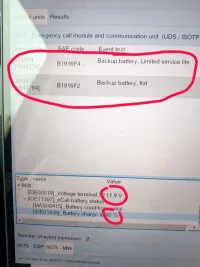
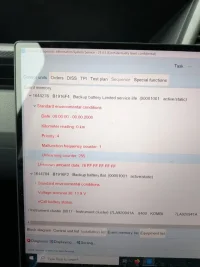
I then set about getting access the battery itself to be 100% sure of the part number. As covered earlier in the thread this is buried behind the instrument cluster. Previous posts have implied this was easy to get to. My personal experience is that removing the trim/cluster surround is an absolute p*** take, it took fecking ages and was very frustrating. Perhaps I just need better trim tools but I really struggled... also wear gloves the plastic edge to the rear is razor sharp if you slide your fingers along it whilst trying to prize it away.
Eventually, I was victorious and got to the battery;
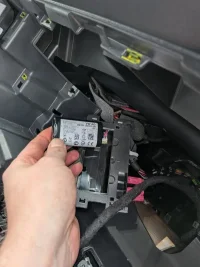
Noting that the ordinary price of these is ~£100 I wanted to go a step further and understand exactly what the underlying cells were;
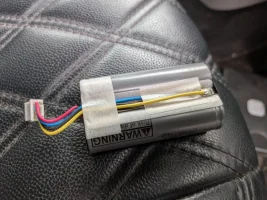
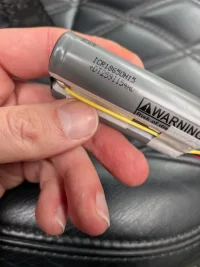
That's ICR18650H15
Essentially this is just a variation of a very common 18650 battery, in this case made by LG.
Now I suspect, someone who's handy with a soldering iron could quite easily knock one of these up for a tenth of the VW price, just transporting the harness over. Sadly, I'm not that person and don't know enough about electronics. However, Googling the cells caused me to find this thread and a discussion of what a poor choice of battery chemistry this is considering it's operating environment on
IPace Forums
So, under the cover it's a LG Chemical 65x18mm ICR18650H15 (+DT310K054A7-). It was manufactured 2021. It uses wrap around tags for soldering the flying leads to. I'm not sure whether it incorporates a bi-metal strip but it didn't look like it. It probably incorporates internally to the battery two safety devices a Current Interrupt Device (CID) and possibly a positive temperature coefficient (PTC). However these are now common for 18650 batteries for safety reasons and I believe may be mandatory for selling into the USA at least. I assume its the same for Europe. The length of the battery is a standard 65mm so it probably doesn't contain a PCB for additional over charge, over discharge protection. If it did incorporate a PCB it would normally be 67mm long.
Now this next bit I find interesting. Assuming LG use standard abbreviations, it's a ICR Lithium Cobalt Round 18650 as opposed to a IMR (Lithium Manganese Round), INR (Lithium Nickel Round) or IFR (Lithium Iron Round). Why is this interesting? well according to various sources ICR is the least stable at higher temperatures. ICR batteries are less stable under high temperatures and more prone to thermal runaway compared to other chemistry, so they often require protective circuits.
So when the TCU was designed ICR Lithium may have been the obvious choice. But in 2025 there are more stable types of Lithium battery. Does it matter whether its a ICR? probably not, it no doubt includes CID protection for safety and I've not heard of any TCUs catching fire, but if they were designing this TCU today it probably wouldn't use ICR chemistry. Ref:
Comprehensive knowledge of 18650 batteries
The failed battery also has exactly 0.00v output. This would be very unusual for any other battery, you would generally see something even if just a few millivolts. This to me indicates the CID has operated and effectively caused an open circuit due to thermal overload.
So for me, I'd still install this Genuine Jag part, even though technically there are safer 18650 cells in 2025 because I don't want to risk my extended warranty paying out by not fitting a Genuine Jaguar part. But if it was out of warranty and no further extended warranties on the vehicle were possible, i'd certainly be considering an alternative after looking at the charge/discharge rates and characteristics of any alternative, on the other hand for £28 for a Genuine Jag battery could I really be bothered to go with anything else?
Interesting points indeed.
Perhaps in future someone brighter than me will be able to put together a safer, cheaper and more durable solution than VW's. For me and the short term, I've ordered the same again from
aliexpress for £40 (I notice the price is steadily increasing).
Once I've received I'll post again to confirm if I was able get ODIS to reinitialise the new battery.