Hillside Birchover

Do you mean to operate the portable panel in conjunction with your existing or instead of?
The important specs that you need to allow for are the Voc and Isc of your panels.
The Voc is the open circuit voltage and the Isc is the short circuit current.
Each has to be within your controllers spec.
Now if you are operating one or the other then just ensure the open circuit Voltage of your portable panel is less than the input voltage of your controller and the short circuit current of the panel is less than the max output current of your controller. If so then you can connect your portable panel instead of your existing.
It gets slightly more complicated if you want to connect both panels together.
If you do then the panels need to have pretty similar specifications or the power that can be produced will be severely compromised and not worth it: You won't get the sum of the wattage from each panel.
If the Voc specified for both panels is pretty much identical and within the controllers range then you could connect them in parallel as long as your controller can take the combined current total of the two panels Isc. Your cabling will also need to be rated for the combined current.
You could also connect them in series if the sum of each panels Voc doesn't exceed the input voltage limit of your controller. Your cabling will need to be rated to take the higher voltage.
If you provide your controller and panel specs and whether you want to run them together or separately then I can take a look to see what is possible.
thanks EAN, this already sounds more complicated than I was envisioning. C GPT tells me this for the panel:

  • Voc (Open Circuit Voltage): 28.5V
  • Isc (Short Circuit Current): Anker doesn’t explicitly list it on the product page, but based on the panel’s operating specs:
    • Vmp (Operating Voltage): 24.5V
    • Imp (Operating Current): 4.1A
    • The Isc is typically around 4.3–4.5A for this class of panel.
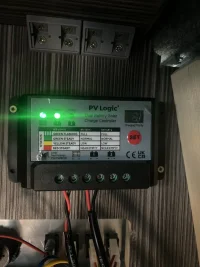
It’s a PV logic controller and I think it’s rated up to 36v, I’ve added a pic below. I was planning on running it in conjunction with the other which is currently a 100w pv logic flexi that is fixed to the pop top.IMG_5979.webp
 
Last edited:
thanks EAN, this already sounds more complicated than I was envisioning. C GPT tells me this for the panel:

  • Voc (Open Circuit Voltage): 28.5V
  • Isc (Short Circuit Current): Anker doesn’t explicitly list it on the product page, but based on the panel’s operating specs:
    • Vmp (Operating Voltage): 24.5V
    • Imp (Operating Current): 4.1A
    • The Isc is typically around 4.3–4.5A for this class of panel.
It’s a PV logic controller and I think it’s rated up to 36v, I’ve added a pic below. I was planning on running it in conjunction with the other which is currently a 100w pv logic flexi that is fixed to the pop top.View attachment 326422
Ok, your portable panel Voc is ok with your controller
Series connection is out as your controller won’t have the voltage headroom at 36V.
Need to know how many amps your controller can o/p and the Voc and Isc of your panel on your poptop, to see how much power you could actually achieve.
Basically in a parallel connnection the current of both panels is added together but the voltage settles at the lowest Voc, which reduces your max wattage.
 
Ok, your portable panel Voc is ok with your controller
Series connection is out as your controller won’t have the voltage headroom at 36V.
Need to know how many amps your controller can o/p and the Voc and Isc of your panel on your poptop, to see how much power you could actually achieve.
Basically in a parallel connnection the current of both panels is added together but the voltage settles at the lowest Voc, which reduces your max wattage.
The best I can find on the PV panel is
roughly:
  • Vmp: ~18V
  • Voc: ~21–22V
So I guess is less than the Anker, which which would drag the Anker down but I’m still thinking could be higher overt if I parallel wired them?

Would it work better if I swapped the PV controller out for a MPPT Victron?
 
Yes, it'll drag it down quite a bit, probably losing around 25 to 30W or so at peak.
You would still get more than a single panel, but nowhere near the 200W peak that you'd think
Tried to look up your PV logic controller and they seem to do 2 models that look like yours; 10A or 20A. If you've got the 10A you aren't going to get much over 120W regardless. 20A version and you should be good for the 170W that the panels in parallel could theoretically produce.
 
Yes, it'll drag it down quite a bit, probably losing around 25 to 30W or so at peak.
You would still get more than a single panel, but nowhere near the 200W peak that you'd think
Tried to look up your PV logic controller and they seem to do 2 models that look like yours; 10A or 20A. If you've got the 10A you aren't going to get much over 120W regardless. 20A version and you should be good for the 170W that the panels in parallel could theoretically produce.
Cheers for that, makes sense. I guess the best way is to just give it a try, if I’m not getting much then I haven’t lost owt.

What are your thoughts on swapping out the PV controller for a Victron MPPT ?
 
Folks in the know!

Spent the morning fitting panel, sca rails etc. got wire to this point….. (wardrobe unit).

Plan to spade piggy back into cbe.

Is this going to work? Looks like already a fair bit going on there…

Also found the grounding point. Anyone know how I can best get in there to unscrew and add ground?View attachment 230773

View attachment 230772
@EAN sorry for jumping on this one, when you say piggy back. You mean attracting an additional spade clip onto the very bottom lug in the picture and the connects to the leisure battery?

Is the connection disabled when the ignition is on also ?
 
@EAN sorry for jumping on this one, when you say piggy back. You mean attracting an additional spade clip onto the very bottom lug in the picture and the connects to the leisure battery?

Is the connection disabled when the ignition is on also ?
I think @EAN ‘s installation is similar to that of my 2023 Birchover. Attaching the spade connector (from the solar controller +ve output) onto the lower CBE terminal allows current from the PV panel to flow to the auxiliary (leisure) battery via the factory-installed rear-to-front cable that runs behind the kitchen furniture.

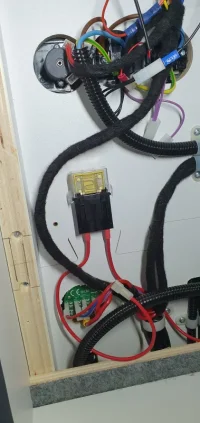
In my installation I included a 20A fuse in this cable as shown in the picture below (prior to the spade connector being attached to the CBE fuse panel). The connector remains live when the engine is running. It is not switched by the engine run relay. Hope that helps.

IMG_2866.webp
 
@Jleadbeater
I think your question has been answered by @Captain Quick.
My solar install hasn't been wired this way (currently I use the MPPT of my Redarc DC-DC under drivers seat and connect 400W of portable panels via wiring through to the engine bay), but connecting to the CBE panel is the easiest.
 
@Jleadbeater
I think your question has been answered by @Captain Quick.
My solar install hasn't been wired this way (currently I use the MPPT of my Redarc DC-DC under drivers seat and connect 400W of portable panels via wiring through to the engine bay), but connecting to the CBE panel is the easiest.
I’m just clarifying the “piggyback” is it literally re-crimping a new spade connector with the solar wire and attaching to the bottom most lug on the CBE?
 
I’m just clarifying the “piggyback” is it literally re-crimping a new spade connector with the solar wire and attaching to the bottom most lug on the CBE?
@Jleadbeater
There may be some slight confusion:
The connection to the CBE is an easy way to connect the output of the solar controller to the leisure battery circuit. "Piggy backing" is just connecting onto the existing wiring.
As you were talking about running your portable solar panel in parallel to your existing then you'd wire another couple to wires in parallel to the existing input wires of your solar panel controller and connect to a convenient connector so you can connect/disconnect to your portable solar panel when you want to deploy it.
 
@Jleadbeater
There may be some slight confusion:
The connection to the CBE is an easy way to connect the output of the solar controller to the leisure battery circuit. "Piggy backing" is just connecting onto the existing wiring.
As you were talking about running your portable solar panel in parallel to your existing then you'd wire another couple to wires in parallel to the existing input wires of your solar panel controller and connect to a convenient connector so you can connect/disconnect to your portable solar panel when you want to deploy it.
Probably me that’s confused matters, yes that’s what I’m planning. I tested it yesterday with food results.

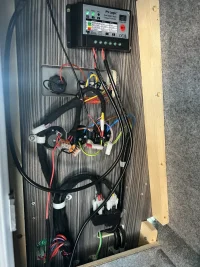
Im only asking this as my current controller to battery connection goes to the 12v socket so I was wondering if this is ok or if I should swap it to connect to the cbe, pic for reference of current setup. IMG_5934.webp
 
@Jleadbeater Your current solar output is wired via the 12V socket. That is fused separately to the Hillside main rear 12V feed which is fused at 40A. Not sure of the rating off the top of my head but think it's 20A. As a minimum I'd add another 20A in line fuse on the positive output of the solar controller for belt and braces and add a few p-clips to mechanically support the wiring.
 
@Jleadbeater Your current solar output is wired via the 12V socket. That is fused separately to the Hillside main rear 12V feed which is fused at 40A. Not sure of the rating off the top of my head but think it's 20A. As a minimum I'd add another 20A in line fuse on the positive output of the solar controller for belt and braces and add a few p-clips to mechanically support the wiring.
Thanks @EAN, so to clarify, the wiring is fine as it is, but I should add an additional 20amp inline fuse to the positive output?
 
Back
Top