
You are using an out of date browser. It may not display this or other websites correctly.
You should upgrade or use an alternative browser.
You should upgrade or use an alternative browser.
[Guide] Accelerator Pedal Kickdown Removal
- Thread starter Drifterman
- Start date
-
- Tags
- 7h2723503 dsg how to guide kickdown


Not sure - but anyways below fresh data readouts what ECU reports:I’m sure someone tested the throttle output ages ago and said that without pushing through it you only got 90% throttle ?
@mmi was it you ?
I could test it if needs be but haven’t got time today
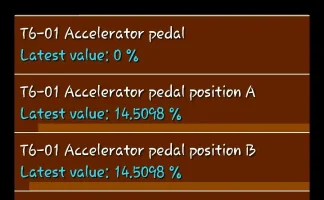
Foot off
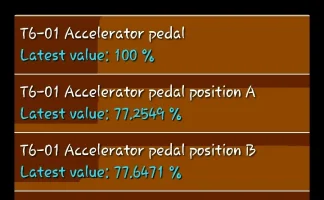
Down to the stopper
Through the kick-down (at floor)
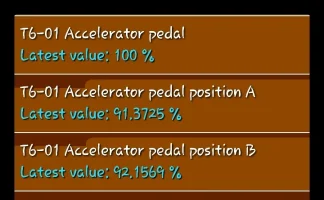
In the VCDS the values above are found as:
IDE07826
IDE00086
IDE01880

That seems to say that 100% throttle opening is achieved before pressing through the stopper, position A and B don't represent throttle opening but pedal positioning ( er carry out an evaluation called accel pedal position where we check w.o.t position but not position A and B to confirm. Again just my 2 psetas  , can't find my 2 cents coin
, can't find my 2 cents coin
Morning @HopefulHi @Drifterman, that's a great find for anyone who likes to drive by "feel" (and not be forced by a machine on how to drive). I havent taken delivery of my T6.1 yet, but will definitely be looking at this when i get it.
There also may be a third "half way" fix for owners who are stuck between maybe doing this mod or not. Here goes my suggestion - by the photos you can see the angle on the spigot is about 60 degrees, which is the cause of the strong pedal resistance. What if the spigot angle was tapered more to say 45 degrees or even more, which would then allow the spigot to more easily enter the resistance block? This way you would still has some pedal resistance, depending on how much you have changed the taper.
This would require going one step further in disassembling the throw arm and coil spring to get good access at filling the spigot face angles.
Might be worth a try for those who aren't sure on the with or without options?
Also, seeing you have already done the tough investigative work, do you think it necessary to remove the electrical contacts cover at all seeing as those 5 screws only fix into the middle section (which comes off via the 8 clips anyway)?
I did contemplate changing the profile of the spigot to smooth out the travel through the resistance block; in the end, I didn't want any resistance at all though, so it was a no-brainer to simply remove it. Plus, once it's altered, there's no going back if you don't like it/can't get the feel right.
The electrical contact lever arm is an interference fit onto the shaft. When you remove it, it'll just move within the upper section of the quadrant and won't be aligned to the shaft is you then try to refit it without separating them. If it's out of alignment even slightly, it won't go back on and it'd very probably break if you got the force in the wrong place; for the sake of 2 mins to remove the 5 screws and the cover, I definitely wouldn't do it without separating them.
Hope this helps
@Pauly @Pedro20001
Morning Gents - my extra two groats (caveated by the fact that mine's a manual - may differ in DSG models):
Not sure why the readout uses the pedal position language and terms it does, but I can definitely confirm that WOT is only achieved when the pedal is 'on the floor' (i.e. through he resistance block and the full range travel is achieved by the wiper arm within the accelerator quadrant). If WOT was achieved when you got the stop, there'd be no point in it - the contacts the wiper makes beyond the stop are obviously what provides the signal to DSG to 'kick down', but they also enable the fuel scheduling to reach WOT.
Morning Gents - my extra two groats (caveated by the fact that mine's a manual - may differ in DSG models):
Not sure why the readout uses the pedal position language and terms it does, but I can definitely confirm that WOT is only achieved when the pedal is 'on the floor' (i.e. through he resistance block and the full range travel is achieved by the wiper arm within the accelerator quadrant). If WOT was achieved when you got the stop, there'd be no point in it - the contacts the wiper makes beyond the stop are obviously what provides the signal to DSG to 'kick down', but they also enable the fuel scheduling to reach WOT.
Hi, mine a manual too, all 110 hp of it and from my understanding it purely is to manually override the speed limiter in case you need to accelerate past it. That's how Toyota have it set up, although as my missus says, I am sometimes wrong 
and from my understanding it purely is to manually override the speed limiter in case you need to accelerate past it. That's how Toyota have it set up, although as my missus says, I am sometimes wrong
When the stop was fitted and no speed limiter set, the revs would 'top-out'. Push past the stop and revs increased - it definitely (in my experience) increases the fuel scheduling
N.B. ....it does the same on the Helicopters I fix.....and they're not a Toyotas either ;-)
N.B. ....it does the same on the Helicopters I fix.....and they're not a Toyotas either ;-)

What we need is a full VCDS record of a DSG and a manual 
The interesting bit to me there (microcontroller background) is not how the position signal is mapped to the throttle demand but that at full mechanical travel the position signal doesn't appear to be full scale.
However it's quite common using ADC (analogue to digital) inputs to stay away from the ends of the scale for a variety of reasons, the ADC itself can get less accurate and the physical resistance tracks can alter near the ends where they have to turn into connections.
I note there are 2 readings which matches the 2 physical wipers in the pictures. Would be interesting to see the track arrangements but from the evidence so far as a critical control I suspect there are 2 independent measurements going on to provide validation. I suspect if they ever significantly differed that would be a fault rather than failing over - you'd generally need 3 measurements to do that as with 2 you know they differ but not which one is correct.
The interesting bit to me there (microcontroller background) is not how the position signal is mapped to the throttle demand but that at full mechanical travel the position signal doesn't appear to be full scale.
However it's quite common using ADC (analogue to digital) inputs to stay away from the ends of the scale for a variety of reasons, the ADC itself can get less accurate and the physical resistance tracks can alter near the ends where they have to turn into connections.
I note there are 2 readings which matches the 2 physical wipers in the pictures. Would be interesting to see the track arrangements but from the evidence so far as a critical control I suspect there are 2 independent measurements going on to provide validation. I suspect if they ever significantly differed that would be a fault rather than failing over - you'd generally need 3 measurements to do that as with 2 you know they differ but not which one is correct.
I’ll bounce this up, I’ve got a ‘22 204hp DSG and I’ve removed the stop. I found when I wanted more acceleration pushing through the stop to wide open throttle was never smooth. Now it’s easier to hold a gear at any revs and load. It’s obviously no faster but the feel is much more natural.

Has it been proven on a manual that WOT is only achieved by pushing past the stop?
I've tried and I can't say there seems to be any difference in power delivery.
Will check what the OBD2 readings say...
I've tried and I can't say there seems to be any difference in power delivery.
Will check what the OBD2 readings say...
I've had a very short run out in mine today and honestly can't say there is any difference by pushing through the resistance into the "kick down" zone.
There are a few different readings from the obd2 port for throttle position, or at least thats how they read.
One of them seems to hit a max of around 83%
Another "relative throttle position" will go to 100%
Pushing past the kick down appears to make no difference.
Can anyone else confirm?
One of them seems to hit a max of around 83%
Another "relative throttle position" will go to 100%
Pushing past the kick down appears to make no difference.
Can anyone else confirm?

Is it an easy job to remove the plastic cowling around the throttle pedal? Thank you.I’ll bounce this up, I’ve got a ‘22 204hp DSG and I’ve removed the stop. I found when I wanted more acceleration pushing through the stop to wide open throttle was never smooth. Now it’s easier to hold a gear at any revs and load. It’s obviously no faster but the feel is much more natural.

Yes. Remove the entire trim panel above andnthe bit around the pedal comes off with it. A trim tool, or a large flat bladed screwdriver and a lot of care, easily pops off the 4 or 5 clips at the front edge and out it comes as one item.Is it an easy job to remove the plastic cowling around the throttle pedal? Thank you.
Thank youYes. Remove the entire trim panel above andnthe bit around the pedal comes off with it. A trim tool, or a large flat bladed screwdriver and a lot of care, easily pops off the 4 or 5 clips at the front edge and out it comes as one item.

Hi and thanks for this info, I carried out the mod last night and its like my campervan has been chipped night & day differenceThe only thing I didn't like about my T6.1 was the annoying 'kickdown' resistance in the accelerator pedal. There's no good reason to have it fitted on a vehicle with a manual gearbox, so I thought I'd work out what causes the resistance and get rid of it. I didn't want to risk breaking my accelerator quadrant and being stuck without my van, so I bought a 2nd-hand one form eBay so I could do my research and it worked out perfect - I figured it out really quickly. I've done it now, and the van drives so much better; it's got to be one of the best modifications ever....and [if I hadn't bought a spare to practice on] it was free!
Here's how I did it:
Remove the trim under the dash to access to the accelerator Pedal (just pop down the clip to release it (inc the section that wraps around the steering column):
View attachment 200937
You should now see the accelerator quadrant, with the pedal linkage attached. Using a flat screwdriver, pop the upper ball-joint off to disconnect the linkage:
View attachment 200938
Now that's out the way, you will be able to access the 3 M10 mounting nuts on the quadrant and the electrical connector - remove them all and the quadrant will slide out off the studs:
View attachment 200939
This is what you'll be left with:
View attachment 200940
Now head off to your workbench with the quadrant and secure it so you can split it apart. You can see the 5 Philips screws that hold the electrical contacts cover on and the 8 clips that hold the middle section to the main body:
View attachment 200941
Remove the 5 screws.
View attachment 200942
Here's what you'll find inside. This is the wiper arm with the brushes that slide across the carbon contacts as the pedal is moved - don't get them dirty. The arm is well secured onto the square-drive shaft that goes through into the main body of the quadrant - rather than try to pull it off now, wait until the mid-section comes off and it'll draw it up off the shaft with it.
View attachment 200944
Next up, carefully prise off the 8 clips that hold the mid-section to the main body of the quadrant. I used a right-angled scriber to get it behind the clips; just taking your time, work around the clips to carefully pop them onto the shoulder of the lock until they're eventually all unlocked (it may be a case of going round them all a couple of times to get them all off together). Once they're all released, slowly raise the mid-section off the main body, keeping it level. As it comes up, it'll slide the wiper arm off the shaft and release it all together:
View attachment 200946
Once it's off, this is what you'll be left with in the main body of the quadrant:
View attachment 200945
At this angle, you can see the spigot and the 'resistance' block that it enters. Pushing in as you press the accelerator, the spigot forces its way through the spring in the block, which is the force we feel - this is the bit we need to get rid of.
View attachment 200947
It seems like our friends at VW knew it was going to annoy a lot of people and they made it easy for us to remove. The resistance block is installed by slotting into 2 guides and it literally just slides out. No tools or force required, just pick it out with your fingers:
View attachment 200949
Now it's out, you can see why it needs such a force to overcome when you press the accelerator - the angle on the spigot is about 60 degrees; with very little taper on it, it's always going to need a fair bit of force to push through the springs in the block. In this photo, you can also see the slots the block slips in to:
View attachment 200950
Lastly, here's the block itself:
View attachment 200951
Putting the quadrant back together is just the same in reverse. It took me less than 6 minutes to get it apart and back together. If you add 10 mins for removal from the van and another 10 to refit, that's a mod that'll take you less that 30 mins. It's honestly one of the simplest and best mods you can do; having taken the van for a drive, I can honestly say it's a game changer and makes it drive so much better. Even though it cost me the price of a spare part to experiment on, it's the best £30 I've spent.
If anybody wants to try it out and has any questions, feel free to ask...
View attachment 200943
View attachment 200948

Glad you found it helpful…..don’t know why everybody hasn’t done itHi and thanks for this info, I carried out the mod last night and its like my campervan has been chipped night & day difference

Similar threads

- Replies
- 0
- Views
- 278


