T6 150 injectors

Motormouth

New Member
My T6 is showing a fault for torque difference cylinder 3 P100600. I’ve just bought the van so not sure if it sounds normal, it seems to drive fine other than maybe a bit of a shudder/vibration sometimes when setting off but I’m being very critical.

Has anyone had any experience with this fault code? How did you resolve it? I was thinking injector on its way out but don’t know much about diesels engines as I normally buy petrol cars. Do these engines suffer from injector wiring loom faults.

If it was an injector fault, not sure how to test. What is the best fix, do all 4 need replacing? Can they be repaired/overhauled. Are they easy to remove and do they need setting up or anything fancy when replaced?

Any help appreciated.
 
Please provide VCDS Auto-Scan and full engine blockmap files please?

1) Full VCDS Auto-Scan
2) Engine blockmap - Ignition ON/engine OFF
3) Engine blockmap - Engine running at idle
4) Engine blockmap - Engine running at idle - 3 minutes after startup
5) Engine blockmap - Hot engine idling - after minimum of 15 minutes of driving - please turn off Stop/Start


How-to create a blockmap file:
[VCDS]​
[Applications]​
[Controller Channel Map]​
- Single Controller Address = 01
- Login or security access code: Leave blank​
- Function: Measuring values
- Output: CSV file
[Go]​

The result TXT and CSV files are saved into dircetory C:\Ross-Tech\VCDS\Logs
Please attach the files here.
 
Thank you for the detailed response.

I’ll attempt to get all this at the weekend. What will all this information hopefully tell us?

How hard is it to replace the injectors. Do they get stuck on these engines?
 
What will all this information hopefully tell us?
Well, it's just starting point to (hopefully) better understand what's not exactly right - at different stages: off/cold/after initial warm up/hot. E.g. injector deviations vs. torque deviations. Anyways, the blockmaps are just snapshots so most likely more actual measurements need to be carried out to rule e.g. the injectors in/out.

How hard is it to replace the injectors. Do they get stuck on these engines?
Replacing injectors is fairly simple/quick. Usually they are not stuck.

If it was an injector fault, not sure how to test.
To finally confirm could swap two injectors and see if the fault follows. Before opening the hood the VCDS probably helps quite a lot.

do they need setting up or anything fancy when replaced?
Yes, they need to be adapted - code their calibration/correction data into ECU.


1762978929470.png

 
Last edited:
I’m not sure what you mean by more actual measurements need to be carried out, but I’m sure with some help I can figure it out.

It must be the glow plugs I’m thinking about that get stuck on diesel engines? Would I need any special tools to get them out or do they literally pull out by hand?

I did think about swapping the injectors over like you would a coil pack for example, but wouldn’t they need the coding swapping as well in the ecu?

Is the coding the only thing that needs to be done when an injector is swapped or do they need calibrating or something else as well?

I was thinking I might replace the diesel filter and put some diesel additive in, what are peoples thoughts on this and is there any additive anyone recommends?
 
I did think about swapping the injectors over like you would a coil pack for example, but wouldn’t they need the coding swapping as well in the ecu?
Is the coding the only thing that needs to be done when an injector is swapped or do they need calibrating or something else as well?
Yes, the injector coding need to match their location. The "coding" is their calibration data to compensate variations in each injector.

I’m not sure what you mean by more actual measurements need to be carried out, but I’m sure with some help I can figure it out.
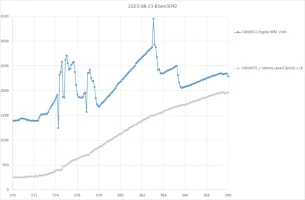
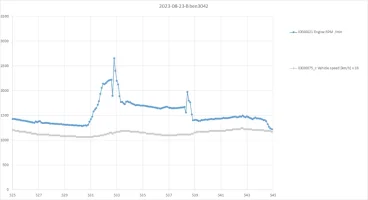
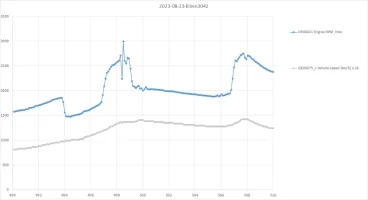
T6 engine has approx. 1500 different data items which can be interrogated. A blockmap is just a collection of each one (once). It takes about 65 seconds to gather them all (once). So not very useful for recording e.g. charge pressure (just once per minute).

"Actual measurement" would be collecting just a subset, e.g. cylinder torques (4), injection deviations (4), engine RPM, charge pressure which would total only 10 data items (of 1500). By downsizing the collected data much higher sampling rate is achieved. In the example approx. all 10 items are recorded 10 times per second which would allow to catch e.g. random glitches (of 0.1 seconds)
An example below
 
Back
Top