T6.1 2020 CXHA failure to start

robin_cox

Member
VIP Member
10 days ago without any prior warning I had an oil temperature sensor error message, followed by an engine light. I checked that there was oil on the dipstick and this was adequate and pencilled this in as take it to the workshop the following week as soon as I was able to get the time off and garage appointment to get the sensor checked / replaced. Van is on ~114800 miles with a full service history, belts, fluids and filters all done as required. Half an hour later I got a further warning that the parking sensor system was now inactive. Real ghost in the machine territory.

Had a look using VCDS (Hex-NET that I use for my other cars) following morning - although it does advise I need to get a newer interface it would speak to the vehicle. Oil temperature sensor still coming up as faulty, a few spurious errors related to recently slightly flattening the battery (forgot the dashcam plugged in a week before), cleared those but oil sensor still coming up. VCDS scan reported ECU 10 (parking aide) not communicating, so that's on the to-do list although it appears that it is on the same fuse as a bunch of other things so would expect to have had more things stop working if it was just a blown fuse upstream of the parking aide.

Went to work, filled up with fuel at the local supermarket (there was still 1/3 tank of Shell premium from the previous fill) and headed out into the country, although the engine light came up again with the oil temperature sensor warning again heading out - not a great deal that I could do then. No warning at all after around 50 miles elapsed journey, climbed a hill with no issues, went round a corner and changed into second - as I then started to accelerate away from the corner it seemed a bit misfirey / wouldn't go above 2000 rpm and within a second or two, one flash of the coil symbol and then the engine died completely with "restart engine manually" message. Pulled in to the side.

No restart - starter turning the engine over quickly but no firing - nothing.

Got recovered back to the mechanics I've used for years on everything in Dundee - initial AA diagnostics suggested inadequate fuel pressure while cranking. Once a workshop space came up the investigation started. Fuel sample looked clean although a couple of tiny metallic specks eventually visible when left to settle. Fuel filter (changed not that long ago) opened up and clean as a whistle. LPFP runs when instructed to do so. HPFP check - when the unit on the top is removed there is a haze of metallic stuff in the solenoid opening. So new HPFP in order. Rail / lines to be checked and cleaned out. Injectors are also going away to be tested and checked - obviously enough the quoted parts prices are beginning to get eye-watering (at full factor prices that I can't avoid).

Trying to determine if there are any other "if this sensor has gone wrong the ECU will not command the ECU to run the injectors even if everything else is right" cross-checks that could be verified after doing a lot of reading here it appears that there are all sorts of different things that can go awry - - can things like oil pressure switches etc. also stop things running to protect the engine?

Any thoughts appreciated as I'm stuck at home with a dose of man-flu and a few concerns on my mind.
 
Sounds like the HPFP had failed causing the non running.?

Not sure on the oil temp error. But assumed unrelated?

The oil level and quality sensor is on the bottom of the sump.

I'm assuming the engine didn't over heat at any point?.... Water temp all good?
 
No evidence of overheating. Just stopped without any prior warning barring that pernicious sensor fault and linked engine light.

I'm receiving some more diagnostics in a wee while - also checking turbo re DPF condition as there have been regular regens recently (every 2-3 days).
 
I have the van back, running again after some heroic last-minute-before-shutdown efforts in the workshop.. don't want to know what the bill is going to be. New HPFP as the original was full of swarf and looked like the aftermath of a metalwork student's first go on a lathe, 4 new injectors and complete fuel system strip down and cleanout. Oil level / temp sensor replaced while there was access to the underside.

"Oil sensor, visit workshop" warning still present on dash and cannot be cleared (which in turn provokes an engine light immediately after starting), but no clear information regarding *which* oil sensor it is. There is an oil temperature reading on the DIS. Parking sensor circuit still absent.

Could it be a fuse? One fuse box diagram for the T6.1 I have suggests fuse 40 powers parking sensor unit and the oil level / temperature sensor, but also a bucket load of other things that I would have expected to stop working as well.
 
  • Like
Reactions: CAB
Could it be a fuse? One fuse box diagram for the T6.1 I have suggests fuse 40 powers parking sensor unit and the oil level / temperature sensor, but also a bucket load of other things that I would have expected to stop working as well.
I'd pull that fuse and check it - I don't see what harm it could do?
I'm glad you've got the van back running anyway, don't worry about the bill until next year!
 
Check the wiring connected to the sensor on the sump, mine got pulled off with part of the under tray after going through a puddle - this gave oil sensor warning as well as the pdc system not working. Could be just a coincidence that your fuel pump shit itself around the same time.
 
I've also downloaded the circuit diagrams that depict the supplies / fuses for both the oil temp/level sensor and the rear parking sensor controller in an attempt to see if there is any common feature between the two that could explain how both circuits went down the day before the fuel supply failure. The VIP downloads section is a gold-mine, very impressed that these documents are available through the T6 forum. I should make it clear though that I am a novice at understanding wiring diagrams so if I have misunderstood anything I am happy to be corrected.

This revealed the following (excerpted from both diagrams, hope that this is permissible, apologies if I have transgressed - if they need to be removed, please do so).

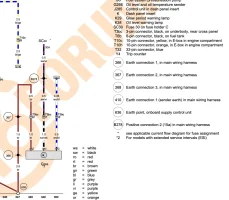
Firstly - Page 26 of the CXHA circuits, G266 is the oil temp/level sensor.

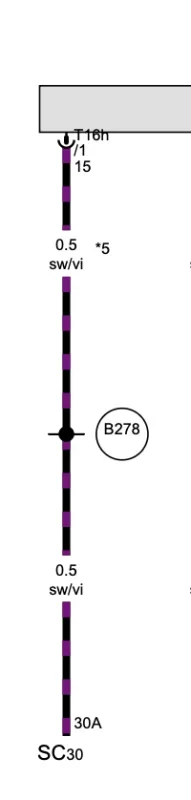
Associated power supply - "B278" - +ve connection 2, 15A, main wiring harness.
Associated fuse - "SC30" - Fuse 30 in fuse holder C
Associated earths - 367, 368 (Earth connections 2 and 3, main wiring harness), 636 (earth point, onboard supply control unit)
Associated connector - T3bc, 3 pin connector on underbody.


1766576444204.webp

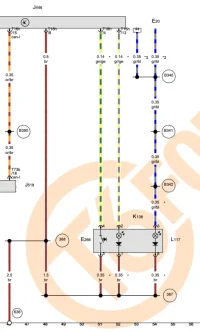
Secondly - Parking aid control diagram, pages 2 and 5, excerpts pasted below.

J446 control unit (grey box at the top of diagram)
Associated power supply "B278" - positive connection 2 (15A), main wiring harness
Associated fuse "SC30" - Fuse 30 on fuse holder C
Associated earths - 367 and 368 (earth connections 2 and 3, main wiring harness), 636 (earth point, onboard supply control unit).

So if my understanding of both diagram sets is correct, the oil temp / level sensor AND the parking control unit share power supply from B278 "positive connection 2, main wiring harness", Fuse SC30 (fuse 30 fuse holder C), and all three earth points 367, 368 and 636, as well (if I believe the 2020 T6.1 interactive fuse box diagram), fuse 40.

Could this suggest a single point of failure to home in on or have I completely messed this interpretation up? I guess the starting point would be to look at those fuses as they are probably the single simplest thing to check and replace ; if instead there is potential wiring / connector damage to find and resolve that would be an entirely different level of complexity.

1766577142269.webp1766577411261.webp
 
Decided to start with the simplest action first. Check Fuse 40 in fuse box C under the steering wheel.

1766758454807.webp1766758380959.webp

New 10A fuse fitted. Parking sensors restored immediately, and oil sensor warning did not appear when van started up. Engine light cleared and warnings about stop start also gone.

Obviously I would be happier if I knew the root cause of the fuse blowing (ie loom damage somewhere, malfunctioning component in a different system supplied by the same fuse etc. or even something simply sporadic), but right now I am pretty chuffed at being able to restore function.

Given the long list of other systems supplied by fuse 40 as cited above I am astonished there were no other symptoms, although it is plausible of course that many of them are options that are not fitted on my van.

In short - thank you to everyone who has read and commented - it has been a tricky 3 weeks being unable to work, but I have learnt a lot both from other threads on here and the VIP section technical documents resource. Wishing you all a wonderful 2026!
 
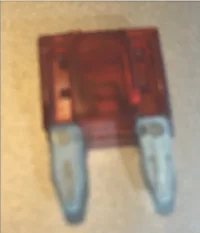
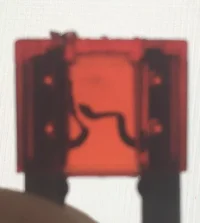
Was the fuse blown, or cracked? If blown, the bit in the middle will be melted away with an obvious gap. If cracked, it will look good, but test as open circuit.
The blurry picture above seems to show the fuse as cracked not blown, but I'm not sure.
Normally a cracked fuse is just bad luck, but a blown fuse has short circuit associated with it, and is likely to happen again.
 
A quick post-script for follow-up reads including some observations that became clearer over the last couple of days.

Although it all happened around the same time in my first post, there were two separate issues going on that need to be considered separately.

1) Simultaneous apparent loss of parking sensor module and oil level/temperature sender -> see 3)

2) Catastrophic failure of HPFP, with substantial degradation of the rotating cam surface resulting in large amounts of metal debris knackering the injectors and putting a fair bit of swarf into the return fuel and thus the fuel tank. Solution : deep clean of fuel system and tank, replacement (twice) of fuel filter, replacement of LPFP (which was running but manky), HPFP and injectors. Engine light for oil level / temp sender did not clear with sender replacement, however van running again with noticeably improved mid-range pull, leaving the electrical issue to resolve.

3) investigation of wiring diagrams and fusebox using various documents in the VIP section suggested Parking module and Oil senders have substantial commonality in terms of power supply and earthing, although a little confusion to begin with over whether these were downstream of fusebox C / #30 (a.k.a. SC30) or fusebox C / #40. The fusebox diagram suggested #30 is "5A Light Switch E1" with #40 supplying a large number of systems inclusive of Parking module *and* the oil level / temp sender. The current path circuit diagrams suggested Fuse SC30 is upstream of a similar list of systems including the Park Assist module and the oil/temp sender. So which is it?

The fix in my 2020 T6.1 was replacing fusebox C #40 which is a 10A fuse. The explanation for my confusion is that there are a few differences between T6 and T6.1 in terms of fuse nomenclature, particularly in fusebox C - and it is therefore necessary to exercise a little caution when using reference documents that are useful for both but have occasional detail differences.


Edited further, after returning to my original VCDS scan.

I commented earlier that I was surprised to not see further system errors when the fuse 40 failed - only the loss of parking assist and oil sensor. However, I've just fired up my VCDS laptop and gone back to the detailed scan. Running through the different detailed ECU readouts, I've just noticed that there were further errors that all logged within a 5-6 second window of the oil sensor fault registering - HVAC ECU (a/c high pressure sensor which is on the same fuse), an interior electronics ECU (something else on the same fuse) and something else that I've now forgotten but I'm guessing is on the same fuse. Because I'm using an obsolete version of VCDS-HEX, it doesn't give me a clear readout of what each error means, but the time stamps all correspond to the fuse failure event and with greater prior knowledge would have directed me to the fuse check earlier. Learning by experience - who would have thought that is a thing? :)
 
Last edited:
  • Like
Reactions: CAB
Was the fuse blown, or cracked? If blown, the bit in the middle will be melted away with an obvious gap. If cracked, it will look good, but test as open circuit.
The blurry picture above seems to show the fuse as cracked not blown, but I'm not sure.
Normally a cracked fuse is just bad luck, but a blown fuse has short circuit associated with it, and is likely to happen again.
The photo I took is terrible.

I have had another look at the fuse bearing your question in mind using this laptop screen as backlighting, and based on your thoughts I'm also doubtful that it has melted in that the central filament is intact, and it is off to the side of the M-shaped fusible link that there is a small gap at a corner in the M. From memory when I've seen melted fuses before there is sometimes evidence of scorching and where it has melted there is an appreciable gap with small metal balls on the end of the filament ends which is definitely not the case in this instance - the filament is all there, just not electrically intact. Fingers crossed!

Here's another go.

1766837763420.webp
 
Last edited:
  • Like
Reactions: CAB
Back
Top