Solar Sheds & Other Non-t6 Solar Projects - How We Done It -

I think Jason from Joondalup Electrical on YouTube did some panel testing last year that had earth faults, there are a few YouTube vids on solar panel earth faults.

 
I've had a quick search and can't find the answer to my query, so I thought I'd park it here.

We have a 4kW domestic solar installation approximately 12 years old. It's developed an earth fault in wet/damp weather that clears when things dry up. I want to do some fault finding and see if I can trace the problem, it's most likely water in either a panel or connector. I'm happy insulation testing conventional AC circuits and have all the usual gear, Megger/Fluke multimeter etc. But I know bugger all about testing solar. The system has 2 strings of panels that get up to around 600V dc on full chat.
So my main question is, can I use my "Normal" insulation tester which is 500/1000V ac output to test my solar panels?
Any pointers greatly appreciated.
So you want to test earth leakage from the DC strings too Earth?

Can't see any reason why you can't do an insulation resistance test pic the strings.. . Just keep the test voltage below the max steering voltage the line can take, 250v or 500v whatever.

But what is going into fault?

The inverter showing a dc pv to pe problem!

Or is it an RCD tripping on on the mains side of the inverter?
 
So you want to test earth leakage from the DC strings too Earth?

Can't see any reason why you can't do an insulation resistance test pic the strings.. . Just keep the test voltage below the max steering voltage the line can take, 250v or 500v whatever.

But what is going into fault?

The inverter showing a dc pv to pe problem!

Or is it an RCD tripping on on the mains side of the inverter?
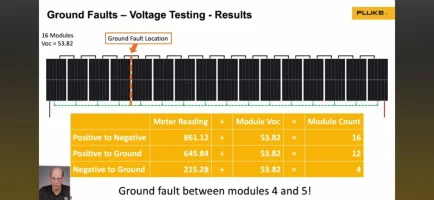
This may help....


....


.Screenshot_20260202_132951_YouTube.webp
 
So you want to test earth leakage from the DC strings too Earth?

Can't see any reason why you can't do an insulation resistance test pic the strings.. . Just keep the test voltage below the max steering voltage the line can take, 250v or 500v whatever.

But what is going into fault?

The inverter showing a dc pv to pe problem!

Or is it an RCD tripping on on the mains side of the inverter?
Inverter is locking out on PV insulation resistance fault (SMA error 35) I was wary about putting 500/1000V ac insulation test onto a dc system. Depending on what you believe, you need a dc insulation tester.
However I’ve just watched a couple of YouTube videos and all you need is a dc multimeter. You measure the dc voltage to earth at the +ve and -ve ends, divide the results by the OC voltage of the individual panels & voila, the fault is at point “x”
E.g. 10 x 40V panels gives 400V/string
Measure voltage to earth at +ve, say 320V
Measure voltage to earth at -ve say 80V
320/40=8
80/40=2
The fault is 8 panels from the +ve end and 2 panels from the -ve end, magic :thumbsup:
 
My Brother has a RCD tripping occasionally and he was thinking it was his solar system but I suspect it's a faulty outside light.
It tripped while he was away in France last winter and it knocked off the boiler circuit, came home to a frozen pipe burst 😔. I'm trying to get him to change to an RCBO consumer unit which should make things more resilient.
 
My Brother has a RCD tripping occasionally and he was thinking it was his solar system but I suspect it's a faulty outside light.
It tripped while he was away in France last winter and it knocked off the boiler circuit, came home to a frozen pipe burst 😔. I'm trying to get him to change to an RCBO consumer unit which should make things more resilient.
We had some nuisance RCD trips on the solar when it was first installed. We ended up putting it on its own dedicated RCD.
 
We also had some original nuisance RCd tripping.

We had a full EICR report done and ended up with a main consumer unit upgrade, all swapped out to rcbo's..(from the original 18th edition split load panel that we had, as the RCD would trip and take out half the board)

And also swapped out the sub board that the main inverter is connected to.... But now it seems to be that there's some talk about bidirectional rcds.... So I need to have another look at this year and possibly look at getting the electrician in to replace the inverter chain of protection back to the main consumer board for bi-directional RCD / RCBOs..
 
I currently have 3kwh solar on the (house) roof and 5kw home battery.
I was looking at getting another 5kw battery installed by GIVEnergy, but £2,200 seems too much given that battery prices are fallen.
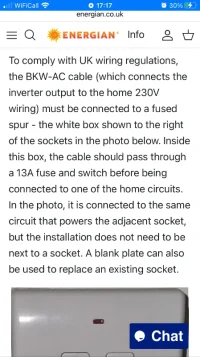
Ecoflow say that with new regs, this battery can be wired directly into the ring main through a fused spur.
Seems an easy way of increasing battery capacity, but have I missed something?
Thanks for sharing your experience/knowledge.
 
So does it need a grid connection to work as a source or would you have to disconnect the grid in a power cut to use what's in it while ensuring you're not backfeeding to the grid?
 
Apparently not, just a label to remind you to turn off before working on the mains.
According to Ecoflow battery needs connecting to a fused spur. I wonder if this is the relaxation of rules to allow for‘Balcony Solar’.
I think there is a benefit to a moveable battery.

IMG_8140.webp
 
So it can't be used in a power cut, it needs to see the voltage and frequency of the grid in order to work. Any inverter connected to the grid needs to disconnect in a VERY short time if the grid connection goes down to avoid putting anyone working on the network at risk.
 
It's a standard grid tied inverter, battery solar combo....

I had the early version, which come with the 3pin plug.

It's fine in the EU etc as they accept the balcony plug in setup.

But the UK is more picky...... So to get around the regs the unit needs to be hard wired too a spur..... Same the other end on the cable on the unit side is also screwed in.

It's rated at under the 13A 3200w limit for a uk socket.

And yeah power wise it disconnects immediately when it loses a grid sync.

It's a nice all in one box.
 
Is your Givenergy install capable of supplying power from the battery in cases of grid outage? If it is this new battery won't help, you'd need to add storage in the same way as the Givenergy battery is connected to make it more useful.
 
Is your Givenergy install capable of supplying power from the battery in cases of grid outage? If it is this new battery won't help, you'd need to add storage in the same way as the Givenergy battery is connected to make it more useful.
The GivEnergy battery shuts down if there is a power failure, I believe you need a form of changeover circuit that would prevent the battery feeding back into the grid. The solar inverter shuts down as well.

The Ecoflow can be used as a freestanding portable power station, there are a couple of 13a sockets on the back and the regs are less restrictive in preparation for Balcony Solar.

I have ordered the Ecoflow today, apparently 3 weeks to delivery.
 
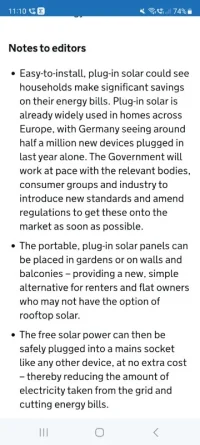
  • The free solar power can then be safely plugged into a mains socket like any other device, at no extra cost – thereby reducing the amount of electricity taken from the grid and cutting energy bills.
I think I am happier wiring through a fused spur.

They used to call a 13a plug to 13a plug connector a "suicide lead".
 
Like anything, there will be a lag between approval and the kits being available. Then a gradual decrease in the kit prices
 
Back
Top