Solar Sheds & Other Non-t6 Solar Projects - How We Done It -

  • The free solar power can then be safely plugged into a mains socket like any other device, at no extra cost – thereby reducing the amount of electricity taken from the grid and cutting energy bills.
I think I am happier wiring through a fused spur.

They used to call a 13a plug to 13a plug connector a "suicide lead".
These newer boxes have very Strick safety features that sync with the mains supply and instantly cut off when unplugged.
 
  • The free solar power can then be safely plugged into a mains socket like any other device, at no extra cost – thereby reducing the amount of electricity taken from the grid and cutting energy bills.
I think I am happier wiring through a fused spur.

They used to call a 13a plug to 13a plug connector a "suicide lead".
In the good old days before they started insulating the pins if you had particularly long nimble fingers you could quite easily give yourself a belt inserting or removing a 13A plug top bearing in mind the socket itself probably didn't have an isolating switch either.
Would these balcony range extenders just show up as a reduced bill from the utility provider or would they require some smart meter recording of what's actually going on.
I'm thinking here of vehicle to grid via a wall charger as a beefier version of the balcony setup or is that a different situation?
 
The kits are available now.
They are, but not the full range of usual suppliers and with the 3 pin as far as I can see. As with anything, on the Internet, there will be access to them somewhere.
As Ed said this morning, he wants to 'see them in supermarkets'
 
In the good old days before they started insulating the pins if you had particularly long nimble fingers you could quite easily give yourself a belt inserting or removing a 13A plug top bearing in mind the socket itself probably didn't have an isolating switch either.
Would these balcony range extenders just show up as a reduced bill from the utility provider or would they require some smart meter recording of what's actually going on.
I'm thinking here of vehicle to grid via a wall charger as a beefier version of the balcony setup or is that a different situation?
As I read it, seems to intergrate with the grid without Metering. You'll just notice less on your bill. But you will have an app showing your generation. Coupled with a battery (like the Ecoflow Stream) you can overgenerate on good days and still use less from the grid on the cloudy days
 
  • Like
Reactions: CAB
In the good old days before they started insulating the pins if you had particularly long nimble fingers you could quite easily give yourself a belt inserting or removing a 13A plug top bearing in mind the socket itself probably didn't have an isolating switch either.
Would these balcony range extenders just show up as a reduced bill from the utility provider or would they require some smart meter recording of what's actually going on.
I'm thinking here of vehicle to grid via a wall charger as a beefier version of the balcony setup or is that a different situation?
From my understanding, its totally different to vehicle to grid.

These solar and power units (battery) in that video, work after your domestic meter. So if you are using less than 800W it doens't register on the meter. If you use more than 800W then it will draw that from the solar / battery and any more will be taken from the mains through the meter.
 
They are, but not the full range of usual suppliers and with the 3 pin as far as I can see. As with anything, on the Internet, there will be access to them somewhere.
As Ed said this morning, he wants to 'see them in supermarkets'
You can buy them from the DJI website with UK 3 pin plugs.

 
Cheers chaps, you would think it would be a bit more obvious as potential customers would get an idea of payback on investment especially for tenants.
 
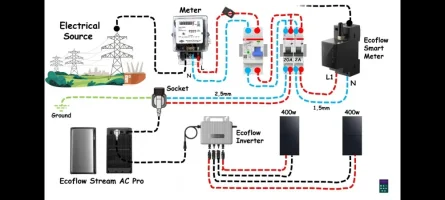
I find this schematic useful in getting my head around the 'balcony solar/plug-in solar' systems. The Stream battery is optional, the microinverter can be plugged into a socket direct (but not legally in the UK presently)

Screenshot_20260318_195621_YouTube.webp
 
Hi all I am thinking of going with the stream microinvertor, I have a plan and would like comments from people please as to whether there is an alternative , better option, etc, although I know, it all depends

Our roof is thick slate on Victorian house, don't really want to mess with it for fear of leaks in future. Heating is oil, but have two log burners that do most of the heavy lifting. We are looking to get an ev in the future and possibly a heat pump, but the house is poorly insulated, so a switch to HVO on the boiler may be better. We currently use 9/10 kw/h of electricity a day.

The plan:

Buy say 6 No. 450w (2.7kw) panels (not ecoflow), fit on garage roof
Buy microinverter and feed with 2No. of the panels (1.2kw limit)
Buy an ecoflow delta 3 max plus (1kw solar limit) + extra battery, feed that with the other 4 panels, panels split into two groups overpanelling , 2 No. panels in parallel into each of its solar inputs (make sure panel voc under 60v)
all of above to be fitted in garage

Feed the microinverter into garage distribution board through a ecoflow shelly smart meter

The garage is connected to the house on a 32amp breaker

800w is fed from solar / battery to house to cover background power and help with larger loads

Theoretically if get an ev in future and change to a cheap overnight tariff could charge the battery in garage in the winter

Costs

£100 Microinverter
£250 Shelly
£500 Panels (4kw)
£2000 Delta 3 max plus + extra battery (4kwh)

Say 3k for the lot with bits. I'm keen to do solar, and wondering if this is the best route. The garage is dual pitch and running north / south so likely 3 panels each side. There is space for more panels if wanted, is wooden garage (double length). The 800w feed from garage to house may seem a disadvantage, but for a starter system keeping it lowish I don't have a problem with. Looking to reduce our yearly electrical bill (~£1100), we've have quotes for big arrays on main roof, with 10kw batteries etc but not sure that is best route for us. Sorry for the ramble, hope it makes sense, thanks in advance

 
Hi all I am thinking of going with the stream microinvertor, I have a plan and would like comments from people please as to whether there is an alternative , better option, etc, although I know, it all depends

Our roof is thick slate on Victorian house, don't really want to mess with it for fear of leaks in future. Heating is oil, but have two log burners that do most of the heavy lifting. We are looking to get an ev in the future and possibly a heat pump, but the house is poorly insulated, so a switch to HVO on the boiler may be better. We currently use 9/10 kw/h of electricity a day.

The plan:

Buy say 6 No. 450w (2.7kw) panels (not ecoflow), fit on garage roof
Buy microinverter and feed with 2No. of the panels (1.2kw limit)
Buy an ecoflow delta 3 max plus (1kw solar limit) + extra battery, feed that with the other 4 panels, panels split into two groups overpanelling , 2 No. panels in parallel into each of its solar inputs (make sure panel voc under 60v)
all of above to be fitted in garage

Feed the microinverter into garage distribution board through a ecoflow shelly smart meter

The garage is connected to the house on a 32amp breaker

800w is fed from solar / battery to house to cover background power and help with larger loads

Theoretically if get an ev in future and change to a cheap overnight tariff could charge the battery in garage in the winter

Costs

£100 Microinverter
£250 Shelly
£500 Panels (4kw)
£2000 Delta 3 max plus + extra battery (4kwh)

Say 3k for the lot with bits. I'm keen to do solar, and wondering if this is the best route. The garage is dual pitch and running north / south so likely 3 panels each side. There is space for more panels if wanted, is wooden garage (double length). The 800w feed from garage to house may seem a disadvantage, but for a starter system keeping it lowish I don't have a problem with. Looking to reduce our yearly electrical bill (~£1100), we've have quotes for big arrays on main roof, with 10kw batteries etc but not sure that is best route for us. Sorry for the ramble, hope it makes sense, thanks in advance
Hi, your set-up seems very similar to mine. We have a Victorian stone built cottage with slate roof. Are waiting for 20 solar panels to go up there, with 2x 5kw batteries, a gateway and inverter. Should be a net exporter with this hopefully. We have a 2 year old oil burning central heating system which works well using 900 litres a year as their is just the 2 of us. We have 3 log burners, although only use the one in the main living area.
We are considering switching to an ASHP. Hopefully the radiators we have should be OK. We have good loft insulation, double glazing and the walls are rubble filled with stone exterior. I suspect its quite thermally efficient. Most people believe old cottages aren't but after digging on the Web, it's more specific that that.
I've just purchased a Ecoflow STREAM Microinverter and will be getting 2 x 450w panels the intention being to stick them on the garage roof for a bit more feed into the house and grid. Bit of an experiment really.
I'd say, don't discount your roof solar. Our tiles are heavy but stable.
 
Thanks for reply, we would likely need to go roof solar on main roof if we got a heat pump, at the moment its overkill as we don't use hardly any power, also apart from loft the house is very difficult to insulate. I'm keen on the Ecoflow or similar idea as can do most if not all of the work myself. I'm tight but 'eco' conscious, so it appeals as ticks both boxes as a semi solution
 
As above I chose the Ecoflow Stream Ultra X - 3.84kWh 800w output. This tops up my existing 3kWh solar and 5 kWh battery


It is designed to take 2kW solar through the built in Microinverter, so might limit you slightly, but 2kW solar would charge the battery most sunny days - all in for £2k. Are you hoping to export the surplus?

I have always used enough electricity overnight to justify economy 7, and last year (before the new battery was fitted) I used 65% overnight - hoping for 90% now.

You just need a spur in the garage to install.

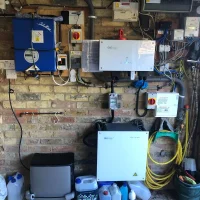
Here's my set up in the garage.

Power setup 21.03.26.webp
 
Back
Top