I fitted the Osram resistors using the connectors supplied initially. Still had hyperflash after that and the connectors didn't look great so I tried positap connectors instead and still no joy. I thought perhaps I had faulty resistors so I returned the Osram resistors and want to buy some others that others have had success with but I'm not sure of the specific ones I need for these bulbs.
I wonder if it could be the side repeaters causing problems if they have no resistor?
I believe I fitted them correctly yes. I have since returned them thinking they were faulty so looking to buy some new resistors to try. It sounds like those I linked to should be the correct ones to use.
As per above indicator wattage setup.
All 3 indicator bulbs(front/rear/side) on either side of the vehicle are connected in parallel(one common circuit fed directly from the BCM).
So if any of the filament bulbs is replaced with LED version the combined wattage
10 = 21/16/5 W - total of 42 W
00 = 21/21/5 W - total of 47 W
01 = 21/27/5 W - total of 53 W
11 = 27/27/5 W - total of 59 W
has to be "maintained" to avoid IC hyper-flash and BCM catching DTC.
For example if you change your rear and side bulbs to LEDs, the total power of 2 filament bulbs must equal total power of 2 LEDs plus adequate resistor. And yes one resistor could be used to cover wattage reduction at two different locations. It doesn't matter at what location that resistor is connected (front/rear/side).
As per above indicator wattage setup.
All 3 indicator bulbs(front/rear/side) on either side of the vehicle are connected in parallel(one common circuit fed directly from the BCM).
So if any of the filament bulbs is replaced with LED version the combined wattage
10 = 21/16/5 W - total of 42 W
00 = 21/21/5 W - total of 47 W
01 = 21/27/5 W - total of 53 W
11 = 27/27/5 W - total of 59 W
has to be "maintained" to avoid IC hyper-flash and BCM catching DTC.
For example if you change your rear and side bulbs to LEDs, the total power of 2 filament bulbs must equal total power of 2 LEDs plus adequate resistor. And yes one resistor could be used to cover wattage reduction at two different locations. It doesn't matter at what location that resistor is connected (front/rear/side).
Guys I can't stop doing this. I am still managing to keep myself happy as I come up with a new idea almost every week. Have a look below and judge yourselves.
Thanks Robert. I didn't realise all indicators were on the same circuit, one resistor per side sounds like a good setup.
Front and rear LED bulbs need 1.65W each compared to the original 21W each. So I need to make up for 38.7W for these.
Not sure what the side repeaters need but I'll assume another 1.65W compared to the original 5W (I think). So I need to make up 3.35W. In total, that's 42.05W per side I need to make up with resistors.
P = U x I ---> I = P / U = 42.05W / 12V = 4.3375A ===> R = U / I = 12V / 4.3375A = 2.76Ω
That seems like a really low resistance value to me considering all bulbs have been changed to LEDs and are drawing significantly less power. Please could you check my maths?
Thanks Robert. I didn't realise all indicators were on the same circuit, one resistor per side sounds like a good setup.
Front and rear LED bulbs need 1.65W each compared to the original 21W each. So I need to make up for 38.7W for these.
Not sure what the side repeaters need but I'll assume another 1.65W compared to the original 5W (I think). So I need to make up 3.35W. In total, that's 42.05W per side I need to make up with resistors.
P = U x I ---> I = P / U = 42.05W / 12V = 4.3375A ===> R = U / I = 12V / 4.3375A = 2.76Ω
That seems like a really low resistance value to me considering all bulbs have been changed to LEDs and are drawing significantly less power. Please could you check my maths?
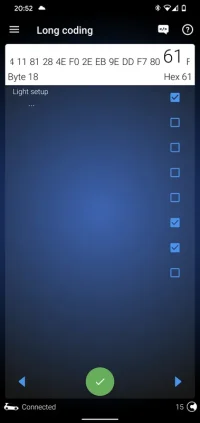
I've got OBDEleven, just had a look at 09BCM Byte 18 and there are no labels in the app for that byte but there are a few ticks - likely not very helpful.
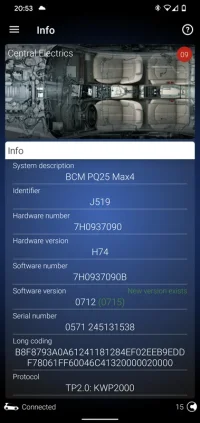
I also grabbed the full long coding which I believe may have the value in somewhere...
Thanks Robert. I didn't realise all indicators were on the same circuit, one resistor per side sounds like a good setup.
Front and rear LED bulbs need 1.65W each compared to the original 21W each. So I need to make up for 38.7W for these.
Not sure what the side repeaters need but I'll assume another 1.65W compared to the original 5W (I think). So I need to make up 3.35W. In total, that's 42.05W per side I need to make up with resistors.
P = U x I ---> I = P / U = 42.05W / 12V = 4.3375A ===> R = U / I = 12V / 4.3375A = 2.76Ω
That seems like a really low resistance value to me considering all bulbs have been changed to LEDs and are drawing significantly less power. Please could you check my maths?
You shouldn't do your resistor calculations based on assumptions.
Can I ask where did you get your wattage of 1.65 from?
Have you got anything like photos/specs/links to your new LED bulbs?
EDIT:
Found your post with links.
What is the exact wattage of your new side indicator LEDs?
You shouldn't do your resistor calculations based on assumptions.
Can I ask where did you get your wattage of 1.65 from?
Have you got anything like photos/specs/links to your new LED bulbs?
EDIT:
Found your post with links.
What is the exact wattage of your new side indicator LEDs?
Osram provide specs for their bulbs but there is no spec for the side repeaters and unsure how I could measure. Appreciate what you're saying though, I don't want to order the wrong resistors and then have to order again.
Perhaps adding some extra resistance should cover some variance from the assumed 1.65W or decrease the assumed 1.65W to maybe 0.5W in the calculation?
To measure power consumption of any bulb the best thing would be to use adjustable power supply unit with output current & voltage display and your power is ( P = I × U).
If you don't have such a device than you could measure your new bulb resistance( using ohmmeter although not easy in some cases).
Once you have your resistance value, the power would be (P = U² ÷ R).
But you have to be also aware that vehicle voltage is 12V when engine is OFF and it rises to 14.5V when engine is ON.
So even if you do your maths 100% correctly for 12V it may not be accurate enough for 14.5V.
There is some tolerance from the BCM perspective but I have never verified how much that tolerance is (% of expected watts being consumed).
In your case, as a indicative guidance only, cause it is based on some assumptions ( approx. 2.5W for side repeater)
I would suggest to use 3.3 ohm(at least 100W) resistor connected in parallel to any bulb.
Example below.
To measure power consumption of any bulb the best thing would be to use adjustable power supply unit with output current & voltage display and your power is ( P = I × U).
If you don't have such a device than you could measure your new bulb resistance( using ohmmeter although not easy in some cases).
Once you have your resistance value, the power would be (P = U² ÷ R).
But you have to be also aware that vehicle voltage is 12V when engine is OFF and it rises to 14.5V when engine is ON.
So even if you do your maths 100% correctly for 12V it may not be accurate enough for 14.5V.
There is some tolerance from the BCM perspective but I have never verified how much that tolerance is (% of expected watts being consumed).
In your case, as a indicative guidance only, cause it is based on some assumptions ( approx. 2.5W for side repeater)
I would suggest to use 3.3 ohm(at least 100W) resistor connected in parallel to any bulb.
Example below.
This site uses cookies to help personalise content, tailor your experience and to keep you logged in if you register.
By continuing to use this site, you are consenting to our use of cookies.