Is this RCD/MCB consumer unit suitable? And wiring Help please.

That's a type A RCBO you've posted, type B is a better spec as it's tolerant of switch mode PSU and inverters but realistically most site hookups will be type A or whatever they fitted last century so stick with your type A bit better aware that Screwfix and Toolstation can offer cheaper and better brand name breakers and enclosures compared to some of these "specialist" online suppliers, think Wylex, MK etc.
You should be looking for DP B16 30mA written on the RCBO front and ideally a test button.
Ok thanks, and what about the MCBs do I go for B curve or C curve?
 
I would say that whatever RCBO and mcbs you go for stick to the same make so that they sit evenly on the top hat din rail and the breakers present an even face where the stick out of the enclosure.
B curve, C is for motor rated and as indicated earlier means you'll always trip the site EHU before your vans incomer.
Stop dithering, hurry up and buy the wrong thing :whistle:
 
I would say that whatever RCBO and mcbs you go for stick to the same make so that they sit evenly on the top hat din rail and the breakers present an even face where the stick out of the enclosure.
B curve, C is for motor rated and as indicated earlier means you'll always trip the site EHU before your vans incomer.
Stop dithering, hurry up and buy the wrong thing :whistle:
😂 yea, I do tend to over research at times. But worth it when it comes to electrics. I’ve ordered the ones I last pictured CPN Cudis RCBO A DP 16a and the DP 10a MCBs to match.( All B curve)

Thanks for all the help chaps 👍🏼
 
I would say that whatever RCBO and mcbs you go for stick to the same make so that they sit evenly on the top hat din rail and the breakers present an even face where the stick out of the enclosure.
B curve, C is for motor rated and as indicated earlier means you'll always trip the site EHU before your vans incomer.
Stop dithering, hurry up and buy the wrong thing :whistle:

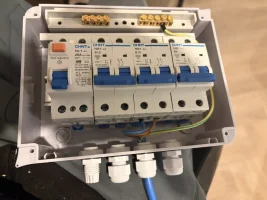
Does this setup look safe enough, I bought all the bits long time ago and after reading this thread I thought it’s right time to start putting it together.

Using 2,5mm artic for my main supply, 1,5mm for rest.

Will be running two c line double sockets on the 10a MCBs and one single socket for Victron mains charger on 6a

IMG_1961.jpeg
IMG_1959.jpeg
IMG_1965.webp

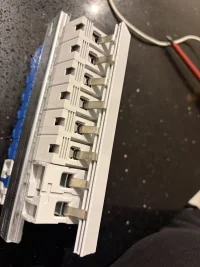
Does the location of bus bar make any difference. On diagram I found it’s fitted on bottom but ChatGPT told me to fit at top and outputs and hook up input at bottom o_O (very confused)
 
Last edited:
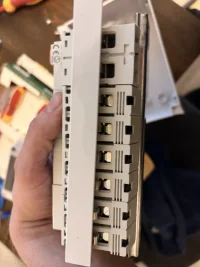
If you've got busbars for that unit it would be interesting to see a picture as normally with single pole MCBs the busbar would simply come along the bottom from the live out on the main incomer and feed into the bottom of each MCB.
With two inputs to each DP mcb and the inputs being directly inline it's difficult to see how you could fit a separate live and neutral busbar to link the MCB inputs from the incomer output?
 
If you've got busbars for that unit it would be interesting to see a picture as normally with single pole MCBs the busbar would simply come along the bottom from the live out on the main incomer and feed into the bottom of each MCB.
With two inputs to each DP mcb and the inputs being directly inline it's difficult to see how you could fit a separate live and neutral busbar to link the MCB inputs from the incomer output?
IMG_1973.jpeg


So question is can I leave my bus bar on top as is and fit all my loads at bottom along with input from hookup?
 
Last edited:
Looking at your second picture @HubertK it looks like your incoming supply from the site EHU will go into the bottom terminals of the RCBO and effectively pass through that device to the dual busbar arrangement at the top to distribute the separate live and neutral to the top incoming side of each MCB.
Power into the bottom of the RCBO with the incoming earth up to the short earth busbar, then an earth of the same CSA eg 2.5mm2 from the vehicle bodywork to the earth bar with the individual outgoings circuit live and neutral fed from the bottoms of the DP mcbs with their earth connected to the earth bar at the top.
It doesn't look like the RCBO has a functional earth so effectively no earth connection to the device although the little pozi screw between the live and neutral incomers caught my eye but is probably just part of the device construction as a functional ie. reference earth is normally pre installed as a flying lead.
Apart from the RCBO 25A rating most likely being higher than the campsite EHU 16A device, meaning that will probably trip first, you're good to go.

 
Sorry, I'm going to ask the same question again here! Are you sure that NL1-63 is actually an RCBO @Stay Frosty? From a quick google, it looks more like an RCCB - i.e. a pure RCD device? If so, that collection of MCBs can potentially pull 26A before tripping which is potentially over the rating of the incoming 2.5mm cable?
 
Looking at your second picture @HubertK it looks like your incoming supply from the site EHU will go into the bottom terminals of the RCBO and effectively pass through that device to the dual busbar arrangement at the top to distribute the separate live and neutral to the top incoming side of each MCB.
Power into the bottom of the RCBO with the incoming earth up to the short earth busbar, then an earth of the same CSA eg 2.5mm2 from the vehicle bodywork to the earth bar with the individual outgoings circuit live and neutral fed from the bottoms of the DP mcbs with their earth connected to the earth bar at the top.
It doesn't look like the RCBO has a functional earth so effectively no earth connection to the device although the little pozi screw between the live and neutral incomers caught my eye but is probably just part of the device construction as a functional ie. reference earth is normally pre installed as a flying lead.
Apart from the RCBO 25A rating most likely being higher than the campsite EHU 16A device, meaning that will probably trip first, you're good to go.
Thank you, much appreciated.

It’s nice to get some solid information/confirmation. ChatGPT was driving me insane, I ask same question get given different answers
 
Sorry, I'm going to ask the same question again here! Are you sure that NL1-63 is actually an RCBO @Stay Frosty? From a quick google, it looks more like an RCCB - i.e. a pure RCD device? If so, that collection of MCBs can potentially pull 26A before tripping which is potentially over the rating of the incoming 2.5mm cable?
Now you have successfully confused me :thumbsdown:

From my research the NL-63 is RCCB and works along side the MCB to provide overcurrent protection? RCBO would be used without need of using the separate MCBs
 
Now you have successfully confused me :thumbsdown:

From my research the NL-63 is RCCB and works along side the MCB to provide overcurrent protection? RCBO would be used without need of using the separate MCBs

Yes, but your MCBs add up to a 26A load which is potentially above the rating (depending on route and insulation) of your incoming 2.5mm cable - i.e. you run the risk of the cable blowing first.
 
@t0mb0 I'll be honest I just read it that 25A was pretty small for a current limit so the device was an RCBO, as you say if there's an higher current limit then you really are relying on the site EHU protective device and your 10A and 6A mcbs for over current protection.
Pressing the reset button then, just get the RCBO 16A 30mA version of that 25A device to give a limiting 16A total capacity for the consumer unit with the 10A and 6A DP mcbs giving diversity for the skts and charger.
 
I’ve been reading all this and finally decided to chip in.
@HubertK What you have will work and will be safe. There are better options but what you have is fine. You will not be able to pull 26A as the incoming supply will be limited. If you tried, you’d trip the campsite breaker.
@t0mb0 You are correct that the NL-1 63 is a pure RCD device. However it is the job of the upstream campsite electrical outlet to protect the incoming 2.5mm2 cable and it has to be limited to 16A max or below as that’s the rating of the blue 3 pin connectors anyway. Sites will generally be 10A or 6A depending upon their installations.
 
I’ve been reading all this and finally decided to chip in.
@HubertK What you have will work and will be safe. There are better options but what you have is fine. You will not be able to pull 26A as the incoming supply will be limited. If you tried, you’d trip the campsite breaker.
@t0mb0 You are correct that the NL-1 63 is a pure RCD device. However it is the job of the upstream campsite electrical outlet to protect the incoming 2.5mm2 cable and it has to be limited to 16A max or below as that’s the rating of the blue 3 pin connectors anyway. Sites will generally be 10A or 6A depending upon their installations.

I agree in theory, but I'd rather be reliant on what I've got under my control in the van itself than trusting the supply protection on some random campsite - especially if you're travelling to regions where electrical safety and regulations are somewhat 'looser'. On the incoming cable, before it hits your van MCU I suppose there are two failure modes:

1) Failure of the cable due to overcurrent.
2) Failure of the cable due to mechanical damage, i.e. insulation failure due to rubbing, etc.

In the case of (1), you can protect yourself through use of RCBOs, MCBs, etc. In the case of (2), for the stretch of cable before it hits your own van MCU I suppose you are basically reliant on the campsite supply for protection anyway. Presumably this is why it's good practice to minimise the length of the cable before it hits your van MCU.
 
Ok understood guys, decision has been made to go with what I have. I’m not every planning on using all the sockets at same time or plug anything higher then let’s say 800-900w camping kettle etc so I think the setup is safe enough for me. Especially with sites being limited/protected to max 16a as well

If I start changing stuff again I will soon become electrical supply shop as already have all single pole MCBs and multiple amp RDC and just about every wire stripper, crimp/ferrule and any wire available on UK market :oops:

Edit//

In terms of the 2,5mm wire it is a very short run around 50-70cm as mounted a stealth and consumer units is going into the main rear tall furniture.
 
I agree in theory, but I'd rather be reliant on what I've got under my control in the van itself than trusting the supply protection on some random campsite - especially if you're travelling to regions where electrical safety and regulations are somewhat 'looser'. On the incoming cable, before it hits your van MCU I suppose there are two failure modes:

1) Failure of the cable due to overcurrent.
2) Failure of the cable due to mechanical damage, i.e. insulation failure due to rubbing, etc.

In the case of (1), you can protect yourself through use of RCBOs, MCBs, etc. In the case of (2), for the stretch of cable before it hits your own van MCU I suppose you are basically reliant on the campsite supply for protection anyway. Presumably this is why it's good practice to minimise the length of the cable before it hits your van MCU.

Yes, for the stretch of cable before it goes into your own consumer unit, you are reliant on the campsite supply for protection of that.
What you fit in your consumer unit won’t protect the upstream.
 
The 25A main switch (BS 61008) in the picture gives NO OVERCURRENT PROTECTION. It is purely a switch and is there for safety and maintenance I.e to isolate all circuits prior to carrying out any work. It does however give additional protection in the form of an RCD.

As @EAN has said, protection for the incoming supply is via the site mcb and shouldn’t be rated above 16A.

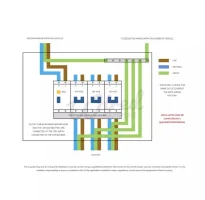
I strongly suggest that the advice given in red on the drawing is followed by all.
 
  • Like
Reactions: EAN
So is my suggestion of a double pole MCB rated at say 20A for the main incoming switch (don't need an RCD because that will be covered by the RCBO's alongside it, 20A to avoid nuisance tripping over campsite breaker) and a few RCBO's with switched neutrals for each output to sockets a good option? Single busbar along the bottom, earth from campsite connection socket to van chassis and common earth rail in the consumer unit, earths to sockets connect here too, neutrals from DP 20A MCB and RCBO's to common neutral rail in consumer unit, Live to top of DP 20A MCB and busbar from bottom to RCBO live inputs at bottom. Then live and neutrals to sockets to tops of RCBO's.
 
So is my suggestion of a double pole MCB rated at say 20A for the main incoming switch (don't need an RCD because that will be covered by the RCBO's alongside it, 20A to avoid nuisance tripping over campsite breaker) and a few RCBO's with switched neutrals for each output to sockets a good option? Single busbar along the bottom, earth from campsite connection socket to van chassis and common earth rail in the consumer unit, earths to sockets connect here too, neutrals from DP 20A MCB and RCBO's to common neutral rail in consumer unit, Live to top of DP 20A MCB and busbar from bottom to RCBO live inputs at bottom. Then live and neutrals to sockets to tops of RCBO's.
There is a requirement in the 18th edition electrical regs where each incoming supply shall be directly connected to its associated RCD. Having a double pole MCB before the RCD functionality of the RCBOs doesn’t comply.

 
You don’t need to fit an MCB for the main switch. You’ll gain no benefit from it.

The type of consumer unit shown on the original post is perfectly adequate. This gives safe isolation using a “switch” rather than than an mcb (contacts will be stronger and larger spaced when “off”) plus gives the additional RCD protection. You can also pick one up for the same price as most DP RCBO’S. It is also physically smaller in size so is better suited for installation in the type of space available in a van. Double pole mcb’s will not give any greater safety, if the supply has reverse polarity it will still be reversed through a DP mcb and so live will become neutral and vice versa at the end appliance. The best advice given was to use a socket tester to check the polarity on initial hook up. If you really want to be safe get one that also checks the Zs and the RCD, there’s a lot more than just polarity to worry about! If you really feel the need to spend the extra money and go DP then connect it as shown in the drawing. Make sure the bus bar is DP too!
 
Back
Top