
You are using an out of date browser. It may not display this or other websites correctly.
You should upgrade or use an alternative browser.
You should upgrade or use an alternative browser.
Is this RCD/MCB consumer unit suitable? And wiring Help please.
- Thread starter RogueOne
- Start date

Just as matter of dicussion, what you say is theoretically correct (not saying it is legal in UK) only if you have just ONE derivative circuit limited at 10A . If you had 2 or 3 you could let your loads take 20 or 30 A from your input circuit. That is obviously not safe. In practice, except the most simple cases , you you always need a main max current protection, in your case likely being a 16A breaker.Not saying you don’t need over-current protection on the incoming of course, seems wise to have it too rather than just an RCD. Although given it’s running straight into the MCBs anyway maybe it’s overkill.
Just as matter of dicussion, what you say is theoretically correct (not saying it is legal in UK) only if you have just ONE derivative circuit limited at 10A . If you had 2 or 3 you could let your loads take 20 or 30 A from your input circuit. That is obviously not safe. In practice, except the most simple cases , you you always need a main max current protection, in your case likely being a 16A breaker.
Yep, I agree, I probably would use an RCBO on the incoming to get the RCD along with max current protection. With two circuits at 10A each, you are protected to 20A though - I agree this doesn't scale well to multiple circuits!

Thanks for the info Stay Frosty, nice to hear from an Electrician.That 63A 30mA RCBO is going to be receiving power from a 16A supply so way oversize for over current protection and never likely to trip before the site power RCBO unless via an earth leakage fault.
When you started the thread with the kit shown you were ok, as often happens offered advice has dragged the subject all over the place and doubt has crept in, I'm waiting for someone to come in and quote the IEE regs for a TT installation complete with earth stake.
Going back to that 63A RCBO you would need a 16mm2 individual conductor size in your extension lead compared to the normal 2.5mm2 so go back to the original items.
Be aware that with a 25A 30mA RCBO on the incomer though there's every likelihood that the site 16A 30mA RCBO will most likely trip in an overcurrent fault ahead of your larger capacity of 25A, I use a 16A 30mA RCBO as the incomer and a 10A single pole MCB for our one twin skt.
I should point out I don't normally use an EHU though and our 230V comes from a 2kW inverter which is a whole other minefield.
I would like to stick with Double Pole MCBs as we will be travelling to France & Spain ad I want the extra protection from reverse polarity EHU.
its a basic system I'm after, and im fine with the wiring up It's just the ratings on the DP RCD and the two DP MCBs I want to get right.
So, your Electricians opinion is very much welcome.
The two DP MCBs will be feeding two Dual pole double PLug sockets with built in USB-C Ports, one double socket on each side of the van (T6.1 Transporter).
The Drivers side socket will mainly charge phones , drone, cameras and maybe a coffee machine (Nespresso) and also to up an Ecoflow large power bank occasionaly (I have no Leisure battery).
The passenger side sockets will power items like a small Ninja Air fryer, possibly a induction hob, occasional air pump etc, maybe an alphicool coolbox and in the winter a 700w micro water filled heater.
So I need a suitable RCD and two MCBs, not sure if i should I have 10amp or 16 amp and should they be B Curve or C Curve and which type for which socket?
Also someone posted about not touching chinese manufactures components but i see a lot of suppliers and camper converters using brands like CHINT
Many Thanks for any advice you can give.

I took recommendation from Roamer when doing my install and fitted a 16A Double Pole 2 Module Bidirectional C Curve 10kA 30mA Type A RCBO close to the hook up point (cant remember the actual required distance; either 50cm or 1 mtr max). I have a single mains circuit running into the van. I earthed from RCBO to the chassis on the D-Pillar.
The advice I was given is that UK regs require and good practice is that both live and neutral need to be proper pole switching and a single pole live and switched neutral (eg 1p +N switching) doesnt meet regs and is a bad idea.
Also worked through design and physical implementation with a Sparky mate so containment & anchoring on everything (trunking, junction boxes) & only used 2.5mm2 blue arctic.
The advice I was given is that UK regs require and good practice is that both live and neutral need to be proper pole switching and a single pole live and switched neutral (eg 1p +N switching) doesnt meet regs and is a bad idea.
Also worked through design and physical implementation with a Sparky mate so containment & anchoring on everything (trunking, junction boxes) & only used 2.5mm2 blue arctic.
Last edited:

As @t0mb0 had spotted and I hadn't your 63A 30mA RCD was just that and not an RCBO as I thought so I would swap that out for a 16A 30mA RCBO and stick with your 10A DP mcbs.
It's a ball ache resetting the 16A RCBO every five minutes if it turns out your appliances plugged into those two twin 13A skts are trying to pull 20 odd Amps but they would also knock out the site 16A hookup RCBO too.
Just a case of remembering you've only got about 3.5 kW to play with not four lots of 3kW, as for not using Chinese kit it's pretty much that or Indian from the national DIY places regardless of where the stuff was designed but generally most of it is fit for purpose.
It's a ball ache resetting the 16A RCBO every five minutes if it turns out your appliances plugged into those two twin 13A skts are trying to pull 20 odd Amps but they would also knock out the site 16A hookup RCBO too.
Just a case of remembering you've only got about 3.5 kW to play with not four lots of 3kW, as for not using Chinese kit it's pretty much that or Indian from the national DIY places regardless of where the stuff was designed but generally most of it is fit for purpose.
I dont think is necessarily where its made, its more buying from a reputable source who have confidence in their supplier, which is what wont get with random online suppliers. Roamer explained they have seen too many failures from cheap switches and breakers so are quite strict on what they recommend now.
(The MCG 16ADP30CAT is linked to above is made in Spain I believe so within the EU)
(The MCG 16ADP30CAT is linked to above is made in Spain I believe so within the EU)
I've yet to see a pre populated Campervan Consumer unit with an RCBO, thy all seem to have standard DP RCD. What are the benefits/pros/cons of one over the other then?As @t0mb0 had spotted and I hadn't your 63A 30mA RCD was just that and not an RCBO as I thought so I would swap that out for a 16A 30mA RCBO and stick with your 10A DP mcbs.
It's a ball ache resetting the 16A RCBO every five minutes if it turns out your appliances plugged into those two twin 13A skts are trying to pull 20 odd Amps but they would also knock out the site 16A hookup RCBO too.
Just a case of remembering you've only got about 3.5 kW to play with not four lots of 3kW, as for not using Chinese kit it's pretty much that or Indian from the national DIY places regardless of where the stuff was designed but generally most of it is fit for purpose.
I've yet to see a pre populated Campervan Consumer unit with an RCBO, thy all seem to have standard DP RCD. What are the benefits/pros/cons of one over the other then?
The RCD doesn’t limit max current at all, it just protects against current leakage. Therefore, if you have two 10A MCB circuits you could be pulling 20A total. An RCBO is effectively an RCD combined with an MCB.
So I'd still need the 2 DP MCBs as well as the RCBO, Correct?The RCD doesn’t limit max current at all, it just protects against current leakage. Therefore, if you have two 10A MCB circuits you could be pulling 20A total. An RCBO is effectively an RCD combined with an MCB.
So I'd still need the 2 DP MCBs as well as the RCBO, Correct?
Yes, it wouldn’t replace the per-circuit MCBs. I’m afraid I don’t know what the actual regulations are though, as you say, plenty of places are selling pre-populated van boxes with RCD plus two MCBs.
So, i want it as safe as possible, especially as we will be visiting 5 campsites on the continent all with EHU and I don't want to have to worry about reverse polarity.Yes, it wouldn’t replace the per-circuit MCBs. I’m afraid I don’t know what the actual regulations are though, as you say, plenty of places are selling pre-populated van boxes with RCD plus two MCBs.
Wiring is the same with an RCBO as a RCD then with the set up Im aiming for with the two 10a MCBs? Another question an that is should I go for B-Curve or C-Curve MCBs. will run some high wattage appliances like a mini air fryer, coffee machine, Induction hob mini radiator etc (Obviously not at the same time)
I think I'm getting there, leaning a lot but loving it.
To summarise then;
RCBO : 16A 30mA RCBO
MCB : Dual Pole 10a x 2 (B or C Curve ?)
To two double Dual pole plug sockets.
Yup. 
What I was trying to indicate earlier in the thread is that you're only going to be able to draw 16A worth of electric from the site's 16A blue outlet skt before their RCBO thinks about tripping.
In reality this will depend on the site's protective device but effectively with a 13A outlet equalling 3kW output 16A doesn't add much to the mix with a further just under 700 Watts so 3.7kW @ 230V so however many 230V skts you have in the van 3.7kW is the point where a protective device, yours or the site's will start thinking about dropping out.
Domestic mcbs are type b with c type being more like the old motor rated type which historically tolerated inductive loads like electric motors, transformers and the old school fluorescent lights, disconnection times normally decide the use of type b at home.
Third edit, to clarify if you fit type c mcbs then your b rated RCBO or the site's unknown rated device will trip first when you're trying to draw more than 3.7kW ie an overcurrent fault.
What I was trying to indicate earlier in the thread is that you're only going to be able to draw 16A worth of electric from the site's 16A blue outlet skt before their RCBO thinks about tripping.
In reality this will depend on the site's protective device but effectively with a 13A outlet equalling 3kW output 16A doesn't add much to the mix with a further just under 700 Watts so 3.7kW @ 230V so however many 230V skts you have in the van 3.7kW is the point where a protective device, yours or the site's will start thinking about dropping out.
Domestic mcbs are type b with c type being more like the old motor rated type which historically tolerated inductive loads like electric motors, transformers and the old school fluorescent lights, disconnection times normally decide the use of type b at home.
Third edit, to clarify if you fit type c mcbs then your b rated RCBO or the site's unknown rated device will trip first when you're trying to draw more than 3.7kW ie an overcurrent fault.
Last edited:
Yup.
What I was trying to indicate earlier in the thread is that you're only going to be able to draw 16A worth of electric from the site's 16A blue outlet skt before their RCBO thinks about tripping.
In reality this will depend on the site's protective device but effectively with a 13A outlet equalling 3kW output 16A doesn't add much to the mix with a further just under 700 Watts so 3.7kW @ 230V so however many 230V skts you have in the van 3.7kW is the point where a protective device, yours or the site's will start thinking about dropping out.
Domestic mcbs are type b with c type being more like the old motor rated type which historically tolerated inductive loads like electric motors, transformers and the old school fluorescent lights, disconnection times normally decide the use of type b at home.
Ok thanks , so would you go for B or C Curve, bearing in mind I’ll be using an induction hob occasionally and a mini air fryer again occasionally, coffee machine (not at same time)?
The tail end of my last post after my third edit
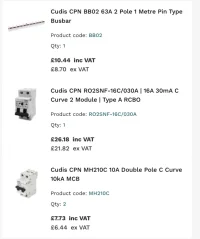

They make 2 Pole RCBO's nowadays, look for neutral switching in the bumpf. They are /can be narrow format MCB style as well so reduces the size of consumer unit that is required.So I'd still need the 2 DP MCBs as well as the RCBO, Correct?
I would look for B curve breakers (unless you plan on having large electric motors in use), and Type A is the norm nowadays (used to be Type AC so you'll find these really cheap, don't be misled).
If you can find suitable 2P RCBO's, Could you use a non RCD 2 Pole breaker at say 20A for the incoming main switch, and then use RCBO's on each subsequent outgoing circuit to add the RCD protection?
That would give a double width MCB on the incoming main switch and single width on the outgoing RCBO's which could reduce the required size of the consumer unit, rather than double width RCD on the incoming and double width 2P MCB's on the outgoing circuits. Could save a few ways in the CU.
That's a type A RCBO you've posted, type B is a better spec as it's tolerant of switch mode PSU and inverters but realistically most site hookups will be type A or whatever they fitted last century so stick with your type A bit better aware that Screwfix and Toolstation can offer cheaper and better brand name breakers and enclosures compared to some of these "specialist" online suppliers, think Wylex, MK etc.
You should be looking for DP B16 30mA written on the RCBO front and ideally a test button.
You should be looking for DP B16 30mA written on the RCBO front and ideally a test button.
Type B RCD/RCCB's are really expensive, like £150, and normally reserved for EV Chargers and Solar Inverters.
Similar threads

- Replies
- 7
- Views
- 1K

- Replies
- 4
- Views
- 752
- Replies
- 12
- Views
- 649

- Replies
- 5
- Views
- 2K
