High idle and fans running at end of journey - no regen

it seems that the difference between them gets down to 3-5grams "halfway" and then measured might even overtake calculated, thus triggering the regen when calculated is only at around 25-28grams.
Result of todays ride: measured soot overtook calculated by approximately 2 grams by when measured showed 30grams thus triggering calculated to jump up to that value and starting regen.
Measured value overtaking the calculated is not a good thing. A possible/likely cause is excessive pressure loss in the DPF. A cheap explanation would be faulty pressure sensor - these were replaced as a recall on early T6 (MY2016).


Interested to see if we could see anything peculiar in engine data. Perhaps you could post the following please:

1) Full VCDS Auto-Scan
2) Engine blockmap - Ignition ON/engine OFF
3) Engine blockmap - Engine running at idle
How-to create a blockmap file:​
[VCDS]​
[Applications]​
[Controller Channel Map]​
- Single Controller Address = 01
- Login or security access code: Leave blank​
- Function: Measuring values
- Output: CSV file
[Go]​
The result CSV files are saved into dircetory C:\Ross-Tech\VCDS\Logs​
Please attach the files here.​


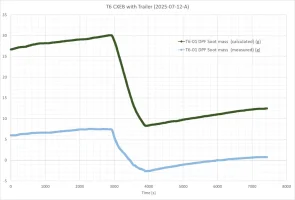
Below a snippet how the calculated and measured behave on engine of 120000 kilometrage. Measured minimum -2.6g, maximum +7.4g, thus quite far from the calculated. DPF regen in the middle.
1757484591927.png


I still decided to start the EGR test. And then it did not start but showed an error.

I have seen the error "Service not supported in active session" when tried to do more than one Basic Settings in one "session" (e.g. to do the same again). It seems the controller "session" is left somehow not closed/initialised properly. Exiting Basic Settings, possibly even exiting the engine controller = back to main menu level of VCDS - has solved my issue.
 
Thanks man doing the tests soon.

Until then...
Measured value overtaking the calculated is not a good thing. A possible/likely cause is excessive pressure loss in the DPF. A cheap explanation would be faulty pressure sensor - these were replaced as a recall on early T6 (MY2016).
... sooty tailpipe? It should indeed cause excessive pressure loss if DPF substrate is cracked. But I would have thought that higher LOSS of pressure results in LOWER measured soot as soot accumulation should go hand in hand with pressure raising?

Anyways, sending the blockmaps soon and retrying EGR test later when engine is warm.
 
  • Like
Reactions: mmi
even blockmap creation doesn't work. It runs fine, seemingly collecting data from engine controller and then no file is saved even though CSV is set as output.
Ahhh.... the VCDS cable you have is an older generation cable which indeed can't handle blockmap data collection. Yes, it's a bit confusing as it seems to run but nothing is saved. Unfortunately can't find the reference from Ross-Tech mentioning that...
EDIT: A few somewhat related links

The old cable might also explain why the EGR test didn't work. It's confirmed that e.g. ECU codings don't work on these newer generation engines.

The newer generation cables (sold since 2016) are HEX-V2, HEX-NET
 
Last edited:
Ahhh.... the VCDS cable you have is an older generation cable which indeed can't handle blockmap data collection.
We may call it old. Or a quick solution borrowed from a friend until a genuine one arrives form overseas for sh*tload of money just for shipping. :(

But anyways, you can't diagnose my issues without data so...

First lucky thing that I've got an appointment for a fault analysis in one of the higher reputation garages for tomorrow (promised until finishing by the day after) so fingers crossed they tell me what's going on.

I think there's no way around I have to have them replace the DPF but I want to know why it's gone so early to avoid the next one being gone quickly. High-ish oil consumption to be analyzed further if it remains (it seems it does unfortunately but not enough miles driven since the caravan was parked to know for sure). While the van is in for analysis and then most likely having the DPF+SCR unit replaced I might as well ask for an oil service too as suggested earlier so as to rule out degraded oil quality as the cause. Makes sense even after just 6kkm in the oil (although in heavy use)?
 
  • Like
Reactions: mmi
But anyways, you can't diagnose my issues without data so...
Well, a short version if you've got time


Please make a recording as follows:

Turn IGN on -

VCDS > Select > Engine > Adv. Meas. Values >

Tick the following:

IDE00021 Engine speed​
IDE00347 Air mass: actual value:​
IDE04090 Exhaust temperature bank 1​
IDE07738 Charge air cooler inlet: pressure sensor 1 bank 1: raw value​
IDE07744 Particle filter: air pressure sensor 1 bank 1: raw value​
IDE07757 Exhaust recirc.valve 1 bank 1: posit.feedback - Actual value​

Click Log - Start !!!

Wait 20 seconds - Start the engine - let it idle for 1 minute.
Switch off the engine - turn ignition back on for 20 seconds.

Stop logging etc.

The logfile will be in folder C:\Ross-Tech\VCDS\Logs
 
IDE00021 Engine speed​
IDE00347 Air mass: actual value:​
IDE04090 Exhaust temperature bank 1​
IDE07738 Charge air cooler inlet: pressure sensor 1 bank 1: raw value​
IDE07744 Particle filter: air pressure sensor 1 bank 1: raw value​
IDE07757 Exhaust recirc.valve 1 bank 1: posit.feedback - Actual value​
Managed to collect it and sent it in private message. Feel free to respond here though.

Actually, saving parameters in a u01 file worked even with this not so current interface as well as loading them so I don't know why your (re the EGR test) didn't work.
 
  • Like
Reactions: mmi
Actually, saving parameters in a u01 file worked even with this not so current interface as well as loading them so I don't know why your (re the EGR test) didn't work.
I don't think the parameter save has anything to do - as it's a feature of the Windows software. I suspect it's the interface itself not being capable to handle the protocol in the test (as it's known to fail some other things on this engine). Edited a couple reference links into post #44.
 
Managed to collect it and sent it in private message. Feel free to respond here though.
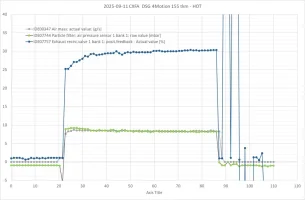
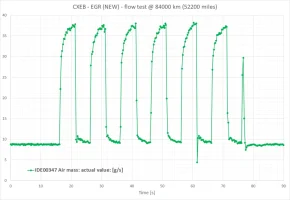
Thank you very much. Actually the second data package was collected in a comparable way - engine hot thus DPF at about 200 °C. Also 20 second wait before starting again "forces" EGR to bypass cooler thus eliminating the cooler out of the equation.
Anyways, below the plot -

First 20 seconds (engine OFF), as well as 90-110 seconds were to determine DPF pressure sensor bias (as raw data from the sensor is used) - here -0.9 mbar.

Engine idling the air mass is now "standardised" as EGR is at about 30% and bypassing the cooler - thus resulting steady air mass of 8.5 grams/second.

At those conditions the pressure across the DPF engine idling is 8.4 mbar (raw) and corrected by offset effectively would be 9.3 mbar. In the graph the overlapping of air mass and DPF pressure is just a coincidence when the units above are used.

IMO the DPF pressure reading (green) are perfectly normal. So wasn't as simple as I thought 🤔


1757581060289.png

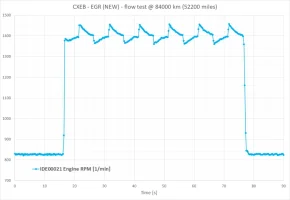
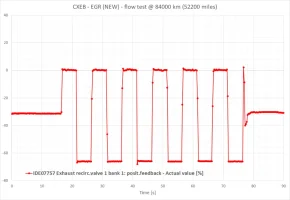
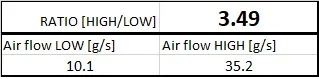
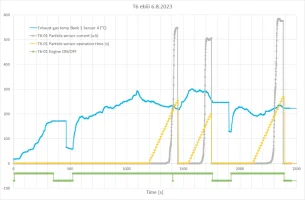
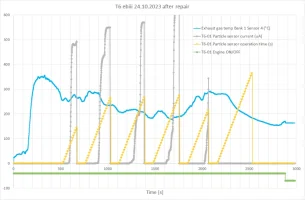
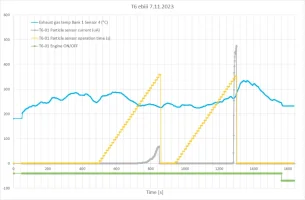
For comparison e.g. first 17 seconds in graphs below -


Also the results of cold engine align very well - sensor offset, smaller pressure across DPF, slightly higher air intake, partially because of less exhaust recycling.
 
Hmm then we don't know anything or we already know something like...DPF flow seemingly correct - albeit the sooty tailpipe?
 
Hmm then we don't know anything or we already know something like...DPF flow seemingly correct - albeit the sooty tailpipe?
Yes, a bit confusing indeed. The sooty tailpipe is an interesting thing... shouldn't be at all

I would very interested to see dynamics of the DPF pressure vs. soot values thus on the road.
So if interested/have a chance a log of following would be interesting:

IDE00021 Engine speed​
IDE00075 Vehicle speed​
IDE00347 Air mass: actual value:​
IDE00434 Particle filter: soot mass calculated​
IDE00435 Particle filter: soot mass measured​
IDE04090 Exhaust temperature bank 1​
IDE07738 Charge air cooler inlet: pressure sensor 1 bank 1: raw value​
IDE07744 Particle filter: air pressure sensor 1 bank 1: raw value​
IDE07757 Exhaust recirc.valve 1 bank 1: posit.feedback - Actual value​
IDE08340 Particle sensor: measuring current calculated​
IDE08721 Particle sensor: time in op. mode measurement​
IDE10817 Lambda value at inlet of particulate filter​

Besides the soot values, added particle (soot) sensor parameters to see if we can detect the moments of soot leaking through the DPF.
Just a note: the particle sensor measurement doesn't happen very often - usually takes more than 30 minutes from start to activate. So a fairly long drive is needed, also I would turn off Stop/Start to eliminate it's effects.

The particle sensor evaluation can be found e.g. here
 
Last edited:
Thanks!

The van is now in for analysis and I should have it back by tomorrow evening and then I'm gladly running the above test. Along with the test we should have the garage standpoint and recommended remediation of the issue.

In the meantime, is there any parameter which I should add to the above ones to see where the soot comes from? Like monitoring oil level (which I did but it seems hectic based on terrain and oil temps) or any parameter of the turbo or air/fuel mixture as mentioned in ebiiis case? And, ebiiis case seems interesting as I also had an intermittent P226D one time and while it never came back, the tailpipe doesn't lie... If in ebiiis case some particles went through and the DPF wasn't required to be replaced then it might not be required for me etiher?
 
  • Like
Reactions: mmi
In the meantime, is there any parameter which I should add to the above ones to see where the soot comes from?
any parameter of the turbo or air/fuel mixture as mentioned in ebiiis case?
Good idea, I edited the above - added "IDE10817 Lambda value at inlet of particulate filter" thus residual oxygen at the exhaust. Diesels run "lean" by default (rich in oxygen). I doubt that we'll find anything unusual - but lets see :thumbsup: Of course would explain soot if there were lack of oxygen.

Turbo charge pressure is already included. Many turbo's imperfections should be trigger fault codes.

Unfortunately VCDS is limited to 12 data items hence good advance planning pays off. Well, with newer interface you could log the full blockmaps continuously but as it's 1500 items for each blockmap, it takes approx. 1 minute for each value to repeat so not great for catching glitches.

Like monitoring oil level (which I did but it seems hectic based on terrain and oil temps)
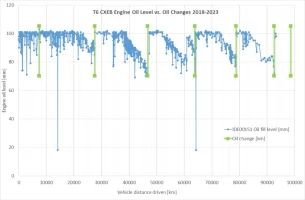
True, oil level indeed is fluctuating so quite difficult to get a good view in such a short time. Sampling every now and then is probably good enough. Below how fuel level has been logged in mine
 
Good idea, I edited the above - added "IDE10817 Lambda value at inlet of particulate filter" thus residual oxygen at the exhaust. Diesels run "lean" by default (rich in oxygen). I doubt that we'll find anything unusual - but lets see :thumbsup: Of course would explain soot if there were lack of oxygen.

Turbo charge pressure is already included. Many turbo's imperfections should be trigger fault codes.

Unfortunately VCDS is limited to 12 data items hence good advance planning pays off. Well, with newer interface you could log the full blockmaps continuously but as it's 1500 items for each blockmap, it takes approx. 1 minute for each value to repeat so not great for catching glitches.
Okay, added to my u01 file too. :)

True, oil level indeed is fluctuating so quite difficult to get a good view in such a short time. Sampling every now and then is probably good enough. Below how fuel level has been logged in mine
This report/record is craaazy :) But it's not fuel level but fill level ;)
 
  • Like
Reactions: mmi
Back
Top