Which means this not-so-insignificant amount of money goes for 20g of gas (plus labour)?157€ for the pleasure, 810g emptied, 830g filled.

You are using an out of date browser. It may not display this or other websites correctly.
You should upgrade or use an alternative browser.
You should upgrade or use an alternative browser.
High idle and fans running at end of journey - no regen
- Thread starter gergely
- Start date

Which means this not-so-insignificant amount of money goes for 20g of gas (plus labour)?
Yes.
Of course the expectation was that after 7 years loss of refrigerant would have been more significant. I suppose the lesson is no reason to do this service unless you start to notice AC not being what it used to be. I (foolishly) had it done as the dealer here recommends the service every 4 years.

No, not yet. Now added on my to-do listHave you noted at which ambient temperature A/C is cut off?

Never thought about that...Also any guesses why it does that? I think the freezing point of R1234yf is well below -100°C, can't be due to that. Too much condensation and it would be forming ice bergs?
Oh, didn't realise that some variants of T6 already had R1234yf - mine (panel van) is still running on R134a.
810g emptied, 830g filled.
At last A/C service (after 2 years from previous)
R134a
drained 555 g
oil 0 ml
refill 605 g

Oh, didn't realise that some variants of T6 already had R1234yf - mine (panel van) is still running on R134a.
The dealer might have changed the refrigerant type like they did with the preferred oil couple of years back.
Have to dig a bit to see if I can find which one was used from the factory.
”Compatibility: R1234yf can be used in most existing R134a systems with minimal modifications, making it a practical choice for many manufacturers.”
The dealer might have changed the refrigerant type like they did with the preferred oil couple of years back.
Have to dig a bit to see if I can find which one was used from the factory.
”Compatibility: R1234yf can be used in most existing R134a systems with minimal modifications, making it a practical choice for many manufacturers.”
Browsing through the build sheet noted this one - my van has indeed come with R1234yf from the factory

Same here. As far as I know it’s a bit more eco friendly but helluva more expensive than traditional R134a.Browsing through the build sheet noted this one - my van has indeed come with R1234yf from the factory
View attachment 274728


I will second this.AC guy told me that generally everything post 2017 should be newer 1234 gas
EU introduced regulation for all vehicles manufactured after the 1st of January 2017 to use R1234yf as the standard refrigerant for air conditioning systems instead of R134a.
Bringing an old topic back to life. I noticed during my holiday approx 2000km driven, most of this done towing a 1500kg caravan the van tends to do regens each 200km. Seems it's doing it like clockwork. The calculated soot climbs to 30g and then regen starts until it goes down to 8(ish) g. Measured one is way less, seemingly reaching only 16-18g when calculated gets to 30. This seems to be normal. I don't know why the 200km regen frequency though. Seems too frequent to me especially given how much lower the measured soot usually is.
Also, oil consumption went up significantly during the journey. I believe hot weather and highway speeds (90-100 km/h with the caravan) in Croatian mountains took their toll on the engine. I measured approximately 0.75 liter per 1000km oil consumption which would scare me if I was solo driving the van and it still somewhat does despite the load. I measured 0.6 liter per 1000km earlier this year when towing during less demanding conditions. Hope this increased oil use is not a tendency and returns to normal 0.1-0.2 when in solo.
Also noticed the tailpipe being a bit sooty which according to this forum should not be at all. With a one time occurence of P226D00 which I just discovered during a routine DTC check as it didn't glow the engine light few thousand kilometers ago I'm wondering about it's meaning regarding the general wellbeing of my engine and emissions system.
May there be any correlation between the seemingly frequent regens and the oil consumption as well as the lightly sooty tailpipe?
Also, oil consumption went up significantly during the journey. I believe hot weather and highway speeds (90-100 km/h with the caravan) in Croatian mountains took their toll on the engine. I measured approximately 0.75 liter per 1000km oil consumption which would scare me if I was solo driving the van and it still somewhat does despite the load. I measured 0.6 liter per 1000km earlier this year when towing during less demanding conditions. Hope this increased oil use is not a tendency and returns to normal 0.1-0.2 when in solo.
Also noticed the tailpipe being a bit sooty which according to this forum should not be at all. With a one time occurence of P226D00 which I just discovered during a routine DTC check as it didn't glow the engine light few thousand kilometers ago I'm wondering about it's meaning regarding the general wellbeing of my engine and emissions system.
May there be any correlation between the seemingly frequent regens and the oil consumption as well as the lightly sooty tailpipe?
Last edited:
Forgot to add that I had P012100 occuring twice during the last few thousand kilometers too. Also not causing any visible issue, just logged. Tried to observe the throttle body visually by removing the short rubber pipe between the charge air cooler and throttle body and the flap was not sooty at all. It had some gummy oily residue which I believe didn't cause any blockage in its movement so the fault code may not be caused by that. The EGR pipe joining in just under the throttle body seemed full of soot though which is strange as I have never got any EGR related codes. Also the pipe between CAC and throttle body had oil mist but not much oil in it which leads me to believe that PCV works quite okay but as far as I know doesn't tell much about turbo health as PCV already separates oil might be seeping in the airstream before it reaches the part I was observing. Just to continue thinking about the oil consumption source...

@VanDamMan. For info re towing,
towing a 1500kg caravan
highway speeds (90-100 km/h with the caravan)
I'd say not surprising - as most likely burnt significantly more fuel than solo. Perhaps could try to do 60-70 km/h instead to see how different it will betends to do regens each 200km

DPF regens are triggered solely on calculated value. The measured should indeed be significantly less than calculated. I believe (based on measurement data) that the measured is actually based on pressure loss across the DPF (differential pressure). When DPF gets clogged the measured value starts to climb up and if gets higher than calculated then the calculated starts to follow the measured thus triggering early DPF regen (at 30 grams) - e.g. in here

Hmmm.... looks like the log is an earlier one as it stops at 238907 km.
Thanks for sharing - very intriguing data!
Anyways, the same phenomena can be seen - e.g. below from 238579 km to 238763 km = 184 km, 2 hours.
Plotted the two soot mass parameters (calculated & measured) which are used by ECU to monitor and trigger DPF regeneration.
Normally "soot calculated" (blue) is the dominant one. Here it's a kind of opposite. As soon as "soot measured" reaches the DPF regeneration trigger level (30 grams) also the "calculated" is jumped to 30 grams which then forces the DPF regeneration to...
Thanks for sharing - very intriguing data!
Anyways, the same phenomena can be seen - e.g. below from 238579 km to 238763 km = 184 km, 2 hours.
Plotted the two soot mass parameters (calculated & measured) which are used by ECU to monitor and trigger DPF regeneration.
Normally "soot calculated" (blue) is the dominant one. Here it's a kind of opposite. As soon as "soot measured" reaches the DPF regeneration trigger level (30 grams) also the "calculated" is jumped to 30 grams which then forces the DPF regeneration to...

Also if you would monitor the measured closely would see also negative values - on these engines.
Also noticed the tailpipe being a bit sooty which according to this forum should not be at all.
Correct. The two above are connected.With a one time occurence of P226D00
What's the mileage of your van - or actually kilometrage

Can you get so called freeze frame data of the faults - I suspect the fault was captured engine not running as I have been getting (captured the below 4 years ago but not seen sinceForgot to add that I had P012100 occuring twice during the last few thousand kilometers too. Also not causing any visible issue, just logged.
 ).
).
Code:
30540 - Throttle Position Sensor (G69)
          P0121 00 [032] - Implausible Signal
          Intermittent - Not Confirmed - Tested Since Memory Clear
             Freeze Frame:
                    Fault Status: 00000001
                    Fault Priority: 2
                    Fault Frequency: 2
                    Mileage: 55548 km
                    Date: 2038.01.28
                    Time: 08:35:46

                    Engine RPM: 0.00 /min
                    Normed load value: 0.0 %
                    Vehicle speed: 0 km/h
Coolant temperature: 88 °CWell, I would be still on my way home if I was doing 60-70 but indeed it would be less load so less soot... Interestingly, normal highway fuel consumption is rather high for me even in solo, I'd say approximately 9-9.5 l / 100 km (4M and Multivan trim might contribute to this as the van is 2.4 tons+ even when empty) and compared to this, 11.5 towing the caravan in the Croatian mountains doesn't look so bad. So fuel consumption is not so much higher compared to solo but oil usage is!I'd say not surprising - as most likely burnt significantly more fuel than solo. Perhaps could try to do 60-70 km/h instead to see how different it will be

Yes that's what I also observed and is in line with what I read here many times. So I tend to follow measured values when interested as it is closer to calculated in not so ideal conditions and quite far from it (when calculated triggers the regen) if conditions are ideal for producing less soot (like 90-100km/h on flat terrain in solo which can even lower the measured soot value somewhat).DPF regens are triggered solely on calculated value. The measured should indeed be significantly less than calculated. I believe (based on measurement data) that the measured is actually based on pressure loss across the DPF (differential pressure). When DPF gets clogged the measured value starts to climb up and if gets higher than calculated then the calculated starts to follow the measured thus triggering early DPF regen (at 30 grams) - e.g. in here
...
Also if you would monitor the measured closely would see also negative values - on these engines.
Very interesting to see negative values for the measured one. First I thought it might be related to my P226D00 if DPF is indeed cracked. But it can't be. Even if DPF was missing pressure could not be higher AFTER it than before. So it's just measuring discrepancy I believe.
They must be. I'm just wondering how can it happen only once and not again in approx 2000 km. If it's cracked it's cracked. Don't want to think much about it until it works and I can't better understand the source of high oil consumption. If it's only towing and it returns back to normal then replacing DPF is an option but if oil continues to flood it anyways I'm not doing it. "Kilometrage" is 154k, DPF should not give up yet although not new. Total ash is around 62 grams which seems fine and says nothing if it is not measured but calculated.Correct. The two above are connected.
What's the mileage of your van - or actually kilometrage
Bingo, it's engine stopped and also with warm engine just as for you.Can you get so called freeze frame data of the faults - I suspect the fault was captured engine not running as I have been getting (captured the below 4 years ago but not seen since
Code:30540 - Throttle Position Sensor (G69) P0121 00 [032] - Implausible Signal Intermittent - Not Confirmed - Tested Since Memory Clear Freeze Frame: Fault Status: 00000001 Fault Priority: 2 Fault Frequency: 2 Mileage: 55548 km Date: 2038.01.28 Time: 08:35:46 Engine RPM: 0.00 /min Normed load value: 0.0 % Vehicle speed: 0 km/h Coolant temperature: 88 °C
Code:
30540 - Throttle Position Sensor (G69)
          P0121 00 [032] - Implausible Signal
          Intermittent - Not Confirmed - Tested Since Memory Clear
             Freeze Frame:
                    Fault Status: 00000001
                    Fault Priority: 2
                    Fault Frequency: 1
                    Mileage: 153520 km
                    Date: 2093.01.15
                    Time: 09:39:01

                    Engine RPM: 0.00 /min
                    Normed load value: 0.0 %
                    Vehicle speed: 0 km/h
                    Coolant temperature: 78 ∞C
                    Intake air temperature: 33 ∞C
                    Ambient air pressure: 1010 mbar
                    Voltage terminal 30: 12.359 V
                    Unlearning counter according OBD: 32
                    Mass airflow sensor 1 bank 1 airflow: raw value: 0.0 mg/stroke
                    Throttl.valve adapt. 1 bank 1: posit feedback - Specified value: 4.46 %
                    Throttl.valve adapt. 1 bank 1: posit feedback - Actual value: 100.00 %
                    Throttl.valve adapt. 1 bank 1: posit feedback - Offset closed: 0.41 %
Throttl.valve adapt. 1 bank 1: posit feedback - Raw voltage: 4.745 VVery strange that measured soot mass now in solo driving seems to accumulate just as fast if not faster than when I was towing. I'm monitoring it while waiting for a proper diagnosis and now I see that even on long outruns (throttle lift-off, no fuel goes in) measured soot tends to continue accumulating even if by a few hundredth of grams. Sooner I observed that when no fuel goes in, no soot does accumulate, and even on low loads, some soot burned off just by itself (no regen) and now I seem to be unable to reproduce that behaviour (btw it was at cca 90-100km/h flat low throttle). I have no new codes, P226D00 did not return, so I only suspect that something's wrong can't just point on a DTC and let the garage evaluate that. 

Oil service was 6000kms ago so quite recently however I've been towing nearly 3000km of this so the oil can't be considered as fresh as it could be...Try an oil service to see if that improves anything.
Isn't T6'ing just fascinating 
Meanwhile you could run ECR cooler test - it would give an estimation of DPF condition as a sideproduct.
Same conditions - speedwise? Accumulation over time or distance, or in comparison with calculated?Very strange that measured soot mass now in solo driving seems to accumulate just as fast if not faster than when I was towing.
I think the "measured" value is not exactly about soot but probably based on pressure loss across the DPF - thus a different interpretation of DPF blockage. I have noticed the same irregularity when compared with the calculated one. Have you got recordings to share?now I see that even on long outruns (throttle lift-off, no fuel goes in) measured soot tends to continue accumulating even if by a few hundredth of grams.
Meanwhile you could run ECR cooler test - it would give an estimation of DPF condition as a sideproduct.
So it seems - inevitable P0401.
Well, visited a VW garage to be tested - the van had accumulated 30 events in ECU's memory since July 2021 (since 20 months now). Eventually managed turn on the emission light at event number 31 - thus had a priviledge to have EGR flow tested. The result - pending - the ODIS went to an unending loop without a concluding result.
Meanwhile, I think I have reproduced the EGR flow test using VCDS. However, I don't have any reference value to estimate the degree of EGR cooler blockage. Neither did ODIS tell the reference value (should have told but the computer...
Well, visited a VW garage to be tested - the van had accumulated 30 events in ECU's memory since July 2021 (since 20 months now). Eventually managed turn on the emission light at event number 31 - thus had a priviledge to have EGR flow tested. The result - pending - the ODIS went to an unending loop without a concluding result.
Meanwhile, I think I have reproduced the EGR flow test using VCDS. However, I don't have any reference value to estimate the degree of EGR cooler blockage. Neither did ODIS tell the reference value (should have told but the computer...
- mmi
- egr p040100 t6_measured
- Replies: 84
- Forum: Engine, Gearbox, Exhaust, Drivetrain
Similar, yes. 90-110kmh but lot less load given it's in solo. Since speed is similar I decided to watch the distance between regens not really time as they are mostly hand in hand in such case. Also, during the summer holiday when towing, calculated went up quite fast, reaching 30g in 200km or a bit less even and measured followed loosely, mostly around 18(ish) grams by when calculated was 30. This meant a somewhat fixed distance between the two values of approximately 10-12g throughout the cycle.Same conditions - speedwise? Accumulation over time or distance, or in comparison with calculated?
Now I'm observing that measured starts from the same -2ish grams and slowly catches up with calculated. Don't have graphs but it seems that the difference between them gets down to 3-5grams "halfway" and then measured might even overtake calculated, thus triggering the regen when calculated is only at around 25-28grams.
I must admit I'm watching this very closely and might be a bit to freaken out by now and there's a chance it has always worked like this - few shorter trips not 100% highway and the delicate balance is gone - but since seeing the P226D00 and the sooty tailpipe I'm not so relaxed. Especially so because if the code doesn't return and apart from frequent(?) regens the van works fine I don't know how long a new DPF would last without eliminating the root cause.
Yes, but pressure loss shouldn't raise during overruns should it? And again, this is different from what I observed recently but unfortunately I don't have enough data to support the analysis. I just recently got my hands on a VCDS and I'm not at all a pro using it yet so all I know/suspect now is based on eyeballing live data in OBDEleven.I think the "measured" value is not exactly about soot but probably based on pressure loss across the DPF - thus a different interpretation of DPF blockage. I have noticed the same irregularity when compared with the calculated one. Have you got recordings to share?
I will try to do this as EGR might as well be the root cause for most of the soot accumulation and given the 154kkm "kilometerage"Meanwhile you could run ECR cooler test - it would give an estimation of DPF condition as a sideproduct.
So it seems - inevitable P0401.
Well, visited a VW garage to be tested - the van had accumulated 30 events in ECU's memory since July 2021 (since 20 months now). Eventually managed turn on the emission light at event number 31 - thus had a priviledge to have EGR flow tested. The result - pending - the ODIS went to an unending loop without a concluding result.
Meanwhile, I think I have reproduced the EGR flow test using VCDS. However, I don't have any reference value to estimate the degree of EGR cooler blockage. Neither did ODIS tell the reference value (should have told but the computer...
- mmi
- egr p040100 t6_measured
- Replies: 84
- Forum: Engine, Gearbox, Exhaust, Drivetrain
it may be nearing the end of its life or at least it is not in the best shape anymore.Result of todays ride: measured soot overtook calculated by approximately 2 grams by when measured showed 30grams thus triggering calculated to jump up to that value and starting regen. Regen went just as usual. It was in solo driving, regen triggered after approximately 200kms just as when towing. But some start-stop city traffic was also part of this so it's so-so.
End of the trip I wanted to run the EGR test but I failed in two points. One, after loading measuring values from file the selected values were not added to the window but I still decided to start the EGR test. And then it did not start but showed an error. As today I arrived very late at home just to find out I can't complete this seemingly not so complex task, I decided to give up.
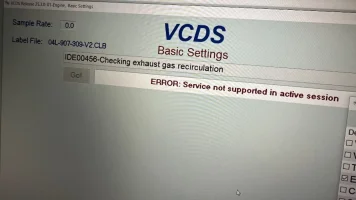
End of the trip I wanted to run the EGR test but I failed in two points. One, after loading measuring values from file the selected values were not added to the window but I still decided to start the EGR test. And then it did not start but showed an error. As today I arrived very late at home just to find out I can't complete this seemingly not so complex task, I decided to give up.
Similar threads
- Replies
- 11
- Views
- 2K

- Replies
- 7
- Views
- 2K
- Replies
- 5
- Views
- 648
- Replies
- 14
- Views
- 2K