Yes, looks normal now. Any crank-no start issues still?To my untrained eye it looks like Regulated operation via quantity control valve is present as soon as it cranks?
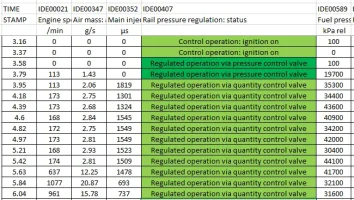

Yes, looks normal now. Any crank-no start issues still?To my untrained eye it looks like Regulated operation via quantity control valve is present as soon as it cranks?
As seen above in post #61 for a successful start-up the registerd air mass was significantly more - even cranking speed was significantly less - 170 RPM.Also a bit mystery why the air mass meter (yellow) doesn't register much air (<0.4 g/s) - would expect to see 10 times more.

Curious to see how things are different - could you please make another set of blockmap files 1) engine off 2) engine idling.So now I've got a stock file on the ECU, we're ruling out any monkey business with software
No crank no starts yet but to be fair I've not had it on a long enough drive to similuate the conditions
Mass air flow is an interesting point. After these logs (so if it was an issue at all, it would have to be intermittent at best) I was checking for loose fuses. Although not loose and not a recent addition, there was a piggyback fuse holder in SB20 Mass Air Flow Meter and ECU. Cant imagine it being a thing as surely if it was loose, it would shut the van down if it came loose. Anyway, I've put a fresh fuse in and removed the piggyback for now.As seen above in post #61 for a successful start-up the registerd air mass was significantly more - even cranking speed was significantly less - 170 RPM.
For the non-start (post#54) cranking speed was 280 RPM- possibly because of well charged battery. But still mystery why the registered air mass was so low.
Unless I'm interpreting wrongly - it seems that in post#54 the throttle valve was closed thus preventing engine getting air (and therefore engine being capable to cramk much faster). Should have thrown fault code though
View attachment 307111
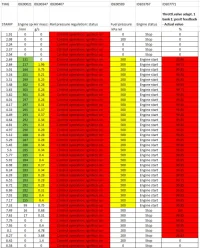
Not sure why ECU would ever close the throttle (rightmost red column) for start-up. Neither did the fuel pressure regulation work at all - possibly bleeding the pressure? Bad software??
Below a slightly modified parameter set for next start-up logging - in case it still fails to start. Throttle valve monitoring added (0%=fully open)
IDE00021 Engine RPMIDE00347 Air mass: actual value:IDE00352 Main injection: duration of activationIDE00407 Rail pressure regulation: statusIDE00589 Fuel pressureIDE05632 Fuel pressure regulator valve actual valueIDE05633 Valve for fuel metering: feedback value measuredIDE07771 Throttl.valve adapt. 1 bank 1: posit feedback - Actual valueIDE07822 Fuel pressure regulator valve: activationIDE07824 Tank-internal presupply pump 1 bank 1: activationENG125965 HPV current demand coming from the HPV controlENG125966 HPV current demand coming from the IMV control
Curious to see how things are different - could you please make another set of blockmap files 1) engine off 2) engine idling.
I did give it a little throttle one time, more to see if the noise of the crank changed, it didn't make any difference to it firing up or the noise while it triedOut of interest, I wonder if it would start if you gave a bit of throttle? I think I read that somewhere else, and if it is throtle valve related this may confirm it?
Mine wasn't looking bad but not great so swapped it and cleaned up the posts as a precaution @Dellmassive @DXX - little over a tenner must be worth it for future peace of mindThe main engine earth strap on the left has been a known problem and will documented on here.

ECU most likely would throw a fault code if the EGR valve couldn't follow commanded value. Unless the fault code had been blanked out.@mmi I was trawling through the logs there to see if potentially the EGR was stuck partially open under the EGR delete condition as that would explain the DPF not wanting to regen I think.
In the blockmap files the EGR was recirculating exhaust gases (non-zero values)I cant see it open at any point though, have I missed it or would you agree, its always been fully shut?

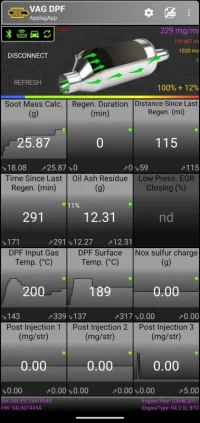
Correct.Am I right in thinking its circa 30g of calculated soot to kick a regen off?
No, CXEB engine has only one EGR (the high-pressure one).Also, should I have a Low Pressure EGR Closing data field? Noticed its not available in VAG DPF app, this is with a stock file installed
All blockmaps engine idling (green). Engine IGN ON - EGR is closed (0=no recirc)Was that in all the block maps that showed EGR movement?

I would have expected the ECU throw a fault code + dash DPF light etc. if something would have inhibited it to do a regen. Also an indication of something being seriously wrong were the zeros for soot calculated and soot measured (post #46)if it was partially open and still active (I have seen that with an incorrect solution in the past) could it potentially stop the DPF from a regen?

Based on the data something was definitely done to the DPF regeneration process. Actually, in stock software there even might be a backup process to do a forced DPF regen after 750 km since last regen (in case everything else have failed) --> Multiple Engine Management Faultswhy with nothing done to the DPF would it not throw an EML when it failed to regen for over a thousand miles. Was that all just because of failed regens due to short journeys etc etc?
Shouldn't be an issue - would eventually light up dash DPF light. Anyways, some experiments about short journeys --> [T6_measured] DPF regeneration vs. short journeysWhen I was saying short journeys I meant, potentially short enough to end a regen once in progress, not the request. The van has been driven in a feast or famine situation, so lots of continual 5 mile round trips so never really getting up to regen conditions.
Based on the data it seems to be working as normal, though not many data points. Yes, 0% would mean no recirculation. Perhaps it was meant to use blanking plates as quite a few fault codes were "suppressed" - obviously including DPF monitoring codes.what do you conclude about the EGR, it looks to be active and following demand (ish) in the "EGR Delete" data as well as the stock condition? I would expect to see 0% actual if it was properly removed
As seen above in post #61 for a successful start-up the registerd air mass was significantly more - even cranking speed was significantly less - 170 RPM.Also a bit mystery why the air mass meter (yellow) doesn't register much air (<0.4 g/s) - would expect to see 10 times more.