Any Radio HAMs out there?

Somebody say radio ham... Not quite sure what you're up against but you're pretty close frequency wise to the 70cm amateur radio band so if you're struggling to get a line of sight signal from a basic dipole to travel the distance you could buy a cheap amateur gain antenna which will focus the RF into a beam at your target transmitter... think torch here compared to the candle of a dipole.
Going back to the dipole and at it's most basic you can simply split the end of your coax cable and separate the centre core from the braid and foil outer sheath with the centre core being the positive half of the antenna and the braid being the other half.
The two halves should ideally be the same length so after stretching the braid you'll need to cut it back to the same physical length as the exposed centre core.
On your frequency you'll be around a quarter of that 70cms of a full wavelength so start at 18cms of centre core and 18cms of braid and make sure these wires leave the main coax at 90 degrees and are exactly pointing away from the other... should look like a T at the end of the coax and this dipole will need to be parallel with the transmitter dipole at the far end, any discrepancies will appear as signal attenuation hence the normal use of directional antennas at line of sight frequencies.
 
Plan is to use an electrical connector block as the centre piece, with copper legs either side with the core and braid feeding into it
 
Ideally you need to know what polarity the Arquiva mast transmitter uses but you can turn your dipole this way and that to see if your ghetto split coax antenna can get anything, you will get your best chance when your antenna is a mirror image of the transmitter antenna with just the 8 miles of air in between.
If you can't see the mast from where you're intending to site your antenna then it's unlikely that you're going to get enough refracted ie scattered by the landscape signal from there unless you can whack the antenna high enough but then you get increased losses from the coax itself.
 
Don't fart about with connector blocks as any insertion losses at these frequencies will really knock the stuffing out of what will be low power signals anyway, just try splitting the coax, trimming it as earlier posted for a quick and dirty feasibility study 🥸
 
My meter is on the 'wrong' side of the house to the transmitter, but I have clear line of sight, bar a small tree from the front. I was going to mount it on the inside of a window and run the coax through the loft (single story) and down to the meter box.
The window mount won't be square on to the fast though, don't know if that makes a difference?
I'll post some site pictures tomorrow
 
Think of the mast as a candle flame and your dipole as being your eyes then it's easier to see how looking even slightly away from the direct path reduces the amount of the candle light you can capture, RF is just the low frequency end of that same light spectrum.
In addition to getting your dipole as at right angles to the mast as possible ie both eyes looking directly at the mast, there's an additional case of making sure your dipole is also matching the orientation of the mast antenna but this is pretty well going to be a case of vertical polarity with the mast antenna radiating in 360 degrees to serve as many meters as possible (I'm guessing) so orient your dipole legs up and down in the window with your coax leading off horizontally sidewards for at least a couple of feet to stop the coax skewing/ reducing your dipoles performance.
 
Thanks, understood. Might have to mount it outside, from the window. Would making a support frame for it, with a pole mount be the way to go ?
Our best wall faces SW, and the mast is SE
 
It's normally easiest to buy proprietary equipment designed for the job but still worth trying the basic split coax experiment first as those stick on your windscreen DAB antennas work on 220 MHz and that's getting close to your 420 MHz frequency so you would just snip off the extra length (of the aerial part, not the coax) to make the antenna resonant at the new higher frequency instead of the DAB one.
As soon as you start with antennas outside the house everything ramps up with mechanical strength and waterproofing of the antenna and any supporting structure... you could use a dish but it would be half the size of the cottage at 400 odd MHz. 🤕
 
M0YVT, been licensed about 10yrs

Use mainly 2m HT but not as active as I'd like to be

Have a Yaesu 8900 for the van, just need to pull my finger out and get it installed
 
Think of the mast as a candle flame and your dipole as being your eyes then it's easier to see how looking even slightly away from the direct path reduces the amount of the candle light you can capture, RF is just the low frequency end of that same light spectrum.
In addition to getting your dipole as at right angles to the mast as possible ie both eyes looking directly at the mast, there's an additional case of making sure your dipole is also matching the orientation of the mast antenna but this is pretty well going to be a case of vertical polarity with the mast antenna radiating in 360 degrees to serve as many meters as possible (I'm guessing) so orient your dipole legs up and down in the window with your coax leading off horizontally sidewards for at least a couple of feet to stop the coax skewing/ reducing your dipoles performance.
So an update :

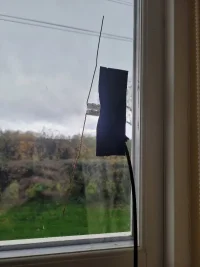
'Manufactured' a couple of simple dipole antennas using 14agm copper wire, some connector blocks with a 10m length of 50ohm coax. One antenna on the window at the front of the house which gives it line of sight, although a bit obliquely, to the Chatton Arquiva mast 8 miles away.

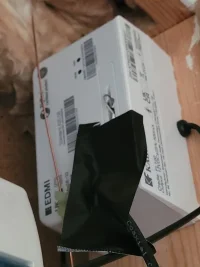
The other antenna was crudely taped to the front of the comms box near the meter. The previous engineer had already moved it away from the actual meter in an unsuccessful attempt to get a signal.

Almost immediately, the HAN light which had been solid, started to flash every 5 seconds, in unison with the WAN light. Encouraging.
Gave it a couple of days but still nothing on the IHD or reading appearing on the app.

So, gave OVO a live chat and eventually managed to find out that the meter is communicating!!

So, according to OVO, it is sending 30 minute readings but they are only logging 1 a day until the system fully commissions, which can take up to 6 weeks.

20251103_153318.webp

20251103_133541.webp
 
My Smart Meter has now successfully sent 7 registered daily readings (although presumably 30min readings are also being sent).
So I have proof of concept !!
Had an email from the Northern DCC saying they noticed the readings now coning through......
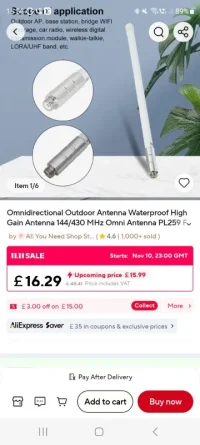
So, I now have to move the window antenna outside as the coax is very in the way. I'm guessing my simple dipole wouldn't stand up to the rigour of a Northumbrian winter so I'm now weighing up the options for an external antenna. Quite like the look of the white fibreglass enclosed ones on the Chinese sites....

Screenshot_20251109_153652_AliExpress.webp
 
You'll need a PL259 male plug to go on the end of your coaxial and a bracket to carry the antenna, car CB mobile mount might work.
Obviously the higher you can get the antenna, within reason, then the clearer the path to the mast and the better signal but for a relatively lossy passive setup you've done well to bend the signals path to and from your meter.:thumbsup:
 
A little late to the party here, but I’ve got a CB from the days of owning a defender.. and have a ICOM 7300 & Intermediate license but it was really TOUGH to break through last few times I’ve used it, so it gathers dust in the garage now.

I've got a FT5 somewhere as well.. this thread has inspired me to get them all set back up!
 
A little late to the party here, but I’ve got a CB from the days of owning a defender.. and have a ICOM 7300 & Intermediate license but it was really TOUGH to break through last few times I’ve used it, so it gathers dust in the garage now.

I've got a FT5 somewhere as well.. this thread has inspired me to get them all set back up!
I get a bit disheartened at the lack of activity on the bands due to this latest sun spot cycle not being the greatest and then when it is open fed up with the same morons calling out their callsign two or three times in a row so they can block out any or everybody else calling some DX or at least rare part of the world.
That apart as a 2E0 call after April last year you can now use your full 100 watts from the Icom 7300 and as we're at the peak of Cycle 25 you can bung up a cheap CB vertical antenna, shortened slightly for 10 metres and work some proper DX or at least across to the US and Canada.
I talked to a ham in Sydney last Wednesday mid morning on 10 using my Hex beam and 700 watts but in reality it was down to him having three 5 element Yagi antennas stacked so your 100 watts and vertical would have been at most one S point down on my effort so definitely in with a chance.
Probably your biggest setback, if you can only get on the radio at weekends are the "weekend warriors" who keep calling and not listening or poxy contesters who really use up all the space on 10, 15 and 20 metres plus if you have a couple of DXpeditions on 17m then that pretty well kills any chance of a rag chew, if 17 is clear of clutter though then you're away and back across the Atlantic at least.
 
Im a 2EO and never used more than 20 watts. I was doing Japan with PSK on 7mhz with 10W so never felt the need for thermonuclear power levels like some folk do.
 
A lot of hams use FT8 which like phase shift keying and whisper is meant to be lower power as the mode is PC to PC so fairly constant tx followed by Rx timed intervals and pretty much like beacons working each rather than hams blathering on.
I'm afraid just like stadium pressurising sound systems I like to paint the ionosphere with enough RF to ideally blow the bloody doors off and make a solid contact to another deaf head on the other side of the world, not for me the intimacy of the acoustic set but then I'm a little bloke with compensation issues. :geek:
 
Back
Top