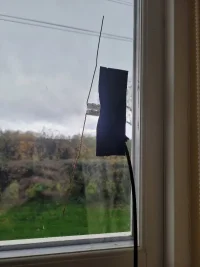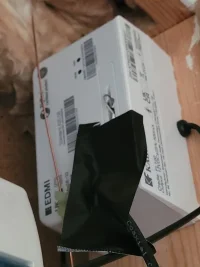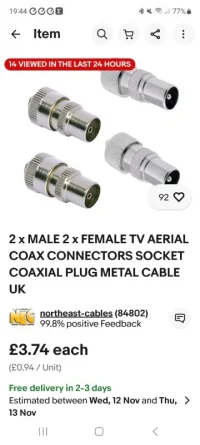

Somebody say radio ham... Not quite sure what you're up against but you're pretty close frequency wise to the 70cm amateur radio band so if you're struggling to get a line of sight signal from a basic dipole to travel the distance you could buy a cheap amateur gain antenna which will focus the RF into a beam at your target transmitter... think torch here compared to the candle of a dipole.
Going back to the dipole and at it's most basic you can simply split the end of your coax cable and separate the centre core from the braid and foil outer sheath with the centre core being the positive half of the antenna and the braid being the other half.
The two halves should ideally be the same length so after stretching the braid you'll need to cut it back to the same physical length as the exposed centre core.
On your frequency you'll be around a quarter of that 70cms of a full wavelength so start at 18cms of centre core and 18cms of braid and make sure these wires leave the main coax at 90 degrees and are exactly pointing away from the other... should look like a T at the end of the coax and this dipole will need to be parallel with the transmitter dipole at the far end, any discrepancies will appear as signal attenuation hence the normal use of directional antennas at line of sight frequencies.
Going back to the dipole and at it's most basic you can simply split the end of your coax cable and separate the centre core from the braid and foil outer sheath with the centre core being the positive half of the antenna and the braid being the other half.
The two halves should ideally be the same length so after stretching the braid you'll need to cut it back to the same physical length as the exposed centre core.
On your frequency you'll be around a quarter of that 70cms of a full wavelength so start at 18cms of centre core and 18cms of braid and make sure these wires leave the main coax at 90 degrees and are exactly pointing away from the other... should look like a T at the end of the coax and this dipole will need to be parallel with the transmitter dipole at the far end, any discrepancies will appear as signal attenuation hence the normal use of directional antennas at line of sight frequencies.