
WIPER PUMP MYSTERY ????

Roman Mac

Member
T6 Pro
Hello,
Been trying to fix my wiper washer pump today with no joy. Me friggin heed is done in haha...
Washer pump stopped working so I bought a replacement and that didn't work. I put an external 12v power source on the pump and it worked fine. Then I checked for a power supply going to the pump plug/connector with a mutimeter. It was ok and receiving 12 volts when pulling the stalk to activate the wipers/washer pump.

Plugged it back into the pump and it wouldn't work???? Baffled. Pump ok...power supply to the plug ok....any idea what could be stopping the pump from working??? Going for a lie down now...the head farting has to stop haha...
 
Did you try the pump out of the washer bottle? Just wondering if there is something in the bottom stopping it spinning.
 
Did you try the pump out of the washer bottle? Just wondering if there is something in the bottom stopping it spinning.
Yeah Phil I tried the pump outside the bottle, with just the plug connected...and nothing happening. ????
 
My 2c, just going with experience in other kind of machinery...

Your reading on the digital multimeter - DVM could be misleading, due to the extremely high input impedance of such instruments (10 MOhm or more)
Years ago I would recommend you to measurue with an analog voltmeter (i.e. dial) that had much lower input impedance (i.e. 20KOhm).
Nowadays I would say put a 10KOhm resistor in parallel to your measuring points (i.e.between the leads) while measuring the voltage at the pump.

Background:
you may have just a bad pump relay contact , or any other bad contact/connector before the pump. That contact will still show full 12V output with a tiny instrument load of 10Mohm BUT
it will not be able to carry any significant current to a real load like the pump ( that is maybe barely some 10 Ohm ).
So the 12V "are there" but they are not able to drive the necessary current to the load (the pump).
The old analog tester or the 10KOhm resistor in parallel to your test leads will let you measure in more real world conditions.
Sadly using a simple 12 V lamp (or a strong LED) as testing device is more reliable than using a DVM, in case of detecting contact/wiring problems.
 
My 2c, just going with experience in other kind of machinery...

Your reading on the digital multimeter - DVM could be misleading, due to the extremely high input impedance of such instruments (10 MOhm or more)
Years ago I would recommend you to measurue with an analog voltmeter (i.e. dial) that had much lower input impedance (i.e. 20KOhm).
Nowadays I would say put a 10KOhm resistor in parallel to your measuring points (i.e.between the leads) while measuring the voltage at the pump.

Background:
you may have just a bad pump relay contact , or any other bad contact/connector before the pump. That contact will still show full 12V output with a tiny instrument load of 10Mohm BUT
it will not be able to carry any significant current to a real load like the pump ( that is maybe barely some 10 Ohm ).
So the 12V "are there" but they are not able to drive the necessary current to the load (the pump).
The old analog tester or the 10KOhm resistor in parallel to your test leads will let you measure in more real world conditions.
Sadly using a simple 12 V lamp (or a strong LED) as testing device is more reliable than using a DVM, in case of detecting contact/wiring problems.
^^^^^this. The presence of 12V doesn’t mean to say that there’s the current available to drive the motor.
 
My 2c, just going with experience in other kind of machinery...

Your reading on the digital multimeter - DVM could be misleading, due to the extremely high input impedance of such instruments (10 MOhm or more)
Years ago I would recommend you to measurue with an analog voltmeter (i.e. dial) that had much lower input impedance (i.e. 20KOhm).
Nowadays I would say put a 10KOhm resistor in parallel to your measuring points (i.e.between the leads) while measuring the voltage at the pump.

Background:
you may have just a bad pump relay contact , or any other bad contact/connector before the pump. That contact will still show full 12V output with a tiny instrument load of 10Mohm BUT
it will not be able to carry any significant current to a real load like the pump ( that is maybe barely some 10 Ohm ).
So the 12V "are there" but they are not able to drive the necessary current to the load (the pump).
The old analog tester or the 10KOhm resistor in parallel to your test leads will let you measure in more real world conditions.
Sadly using a simple 12 V lamp (or a strong LED) as testing device is more reliable than using a DVM, in case of detecting contact/wiring problems.
I understand FW. Not sure where to go from here... if this is what is happening...thanks for your help
 
Thanks for your input SS. If this is the case...what would your next move be? I'm not sure where to go from here...
Measure the current
This problem is cropped up before, can’t remember what the cause was but a Search should find it eventually.
 
Hi Roman Mac
Try using a indicator bulb or similar with insulated soldered wires to it, and connect the leads to the washer supply plug terminals (be careful not to short them out), test and you should then be able to determine the problem.
 
I understand FW. Not sure where to go from here... if this is what is happening...thanks for your help
As said, arm yourself of schematics and a proper instrument and go back from the pump motor to find the cause. Probably a bad relay or connector/wiring.
 
Thanks for your input SS. If this is the case...what would your next move be? I'm not sure where to go from here...
a quick examination of the wiring and plug at the motor end for starters. The most obvious culprit will be corrosion or poor connection close to the motor. After that you're getting into load testing and you will need to make a breakout connector of some sort in order to test the voltage at the motor plug with some sort of load across it. Not as complicated as it sounds, but it depends on your skillset/confidence. As already mentioned, a test bulb, small crimps and some short bits of wire should do the trick.
 
Hi Roman Mac
Try using a indicator bulb or similar with insulated soldered wires to it, and connect the leads to the washer supply plug terminals (be careful not to short them out), test and you should then be able to determine the problem.
So if the bulb lights up theres obviously no issue with the power supply reaching the plug ???
 
a quick examination of the wiring and plug at the motor end for starters. The most obvious culprit will be corrosion or poor connection close to the motor. After that you're getting into load testing and you will need to make a breakout connector of some sort in order to test the voltage at the motor plug with some sort of load across it. Not as complicated as it sounds, but it depends on your skillset/confidence. As already mentioned, a test bulb, small crimps and some short bits of wire should do the trick.
Thanks for those pointers SS 👍😃. So my understanding of the bulb test is to determine whether the 12v power supply to the plug is ok, right? But if it is, why isn't the pump working as normal?
 
Thanks for those pointers SS 👍😃. So my understanding of the bulb test is to determine whether the 12v power supply to the plug is ok, right? But if it is, why isn't the pump working as normal?
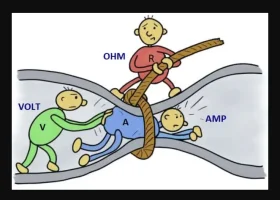
What you’re trying to prove is that the supply wiring isn’t current limited. If there’s a high resistance in the supply wiring, due to corrosion or a broken wire for e.g. Then a meter will show a voltage (which you have) but if you tested the same circuit with a load on it (a test bulb) then the high resistance in the circuit would prevent sufficient current (amps) to flow, this would cause the voltage to drop to a level where it wasn’t sufficient to drive the motor. In essence, you need 2 things to drive the motor, voltage AND current. You’ve proved the voltage but not the current. It's all down to our old friend Mr Ohm and his law.
Screenshot_3-5-2026_17119_www.circuitbasics.com.webp
 
Brilliant picture of the Ohm's Law!
I used the water / pipe analogy when I taught basic electro but this one is funnier!
 
Thinking back, I had something similar with a solenoid on a LPG system. 12v on the meter but it would not operate. Added a replacement earth and it was fine. Probably same as salty spuds has described here
 
What you’re trying to prove is that the supply wiring isn’t current limited. If there’s a high resistance in the supply wiring, due to corrosion or a broken wire for e.g. Then a meter will show a voltage (which you have) but if you tested the same circuit with a load on it (a test bulb) then the high resistance in the circuit would prevent sufficient current (amps) to flow, this would cause the voltage to drop to a level where it wasn’t sufficient to drive the motor. In essence, you need 2 things to drive the motor, voltage AND current. You’ve proved the voltage but not the current. It's all down to our old friend Mr Ohm and his law.
View attachment 325106
I get ya! Thanks for clarifying that. As you can tell, I'm not that clued up in this type of thing but I will getcto rhe bottom of it with your help. Much appreciated. I'll try the bulb test...😃👍
 
Thinking back, I had something similar with a solenoid on a LPG system. 12v on the meter but it would not operate. Added a replacement earth and it was fine. Probably same as salty spuds has described here
Yeah I'm gonna do a continuity test on pin 2 to check the ground is ok. I'm thinking it could need a repjacement ground cable fitting if it's no good. Someone suggested a blockage in the water pipe causing my issue, but surely if it was a blockage you'd still hear the pump spinning. It's got to be an issue with the plug/ground...as everything else is tested and working as it should. ??
 
Update -
Thanks to everyone who helped me by offering suggestions to get my washer pump up and running again. A process of elimination (fuse, the pump, power supply etc) ended with everything pointing towards a bad earth. I disconnected the earth wire from the connecting plug and fitted a new one, which I bolted to a spare hole on the chassis. The pump worked fine. Thank fcuk!!! SORTED! 😂😂😃😃😃👌
 
Back
Top