Thanks for the reply mmi. And no need to say sorry for not testing one particular thing out of zillions of others which you have. Although this pretty much ruins your image...

TLDR, the 12V going to the trailer socket is indeed not regulated and varies based on what the alternator does. It is indeed "smart" in terms of charging the battery much more under breaking, voltage raising even up to 14.5V. I used only OBDeleven to read live data during a short trip but the basics are known now.
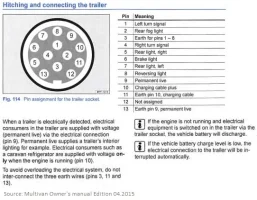
So the use case is to use my fridge on 12V while on the road. It is a large absorption type fridge using 170W ie ~14A continuously. This is huge amount of current and I was wondering whether factory wiring can withstand this load. As even pin 9 is fused 15A (pin 10 is 20A) I had some hope - until I tested it. Oh well, sidenote for not using pin 10 right from the start, my caravan has no wiring from pin 10 for some reason. Input from socket is there but wiring is not done in caravan. Wiring it out from where the trailer connector terminates wouldn't be very complicated but I wasn't sure until yesterday if it's worth the hassle. So to my test results...
Option #1: using pin 9 which is pre-wired in caravan
Drawing 14A from pin 9 overheats wiring too much to feel comfortable about it. Just hand tested it but no or very slight warmth to the wires was felt under (LHD) driver seat around the fuses, but uncomfortably warm (not hot to melt) to touch trailer connector (between van and caravan), heating up wire loom going to trailer by time and wires in the caravan. There's a huge voltage drop from around 13V to around 8-9V which along with the heat shows this setup won't work.
Option #2: using pin 10
Gave it another try by connecting quite fatty (6mm) good quality copper wires to the end of trailer wire loom pin 10 and 11, and routing it the shortest way (just under the caravan) to the fridge just to experience quite the same. Significant heat buildup at trailer connector and voltage drop to around 9V (a tiny bit less drop than by using pin 9 though).
Orion charger was used both times as power supply to stabilize output voltage around 12V. Setting up option #2 I placed the Orion very close to the fridge, having approx 1-1.5m (+/- total length) of 6mm wire between its output terminals and fridge input. And while no heat was observed I noticed there's a huge voltage drop of 1-1.5V on this very short section. I don't know why.
Worth to mention that even factory wiring of caravan from electronic box to fridge is too thin to "my taste". It is 1.5 (2.5 perhaps?) and must be approx 5 meters turnaround. It might be they have used the same cable for all caravans and then installed the fridge the customer wanted (I bought it used) and smaller fridges are just fine with thinner wires?
My conclusion so far:
#1: Trailer socket and connector seem to have poor connection or at least not up to the game to deliver 14amps either through pin 9 or pin 10. No matter the 15A and 20A fuses respectively, van wiring must be okay to withstand it, but what happens "behind" the van is not good.
#2: Caravan wires from pin 9 are too thin to withstand the load.
#3: Even fatty wires from pin 10 don't seem to work because of the trailer connector or length or amperage... or for all of this added together.
#4: As even the in-caravan wires to the fridge seem a bit skinny I'm not comfortable to run the fridge through them and see my caravan in flames in the rearview mirror.
1+2+3+4: it's a shame that I probably can't solve the problem the easy way. Re-wiring, using gas instead of 12 (well, sometime 8-9) Volts (there's Truma Monocontrol CS for using gas while driving) might work but all costly and involved to do. I'm sad.