
Solar wiring question.

PJ134

Member
VIP Member
T6 Pro
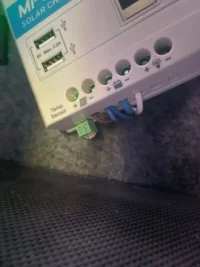
I’m starting the process of swapping our inherited Epever Triron 1206N for a Victron Smartsolar 100-20. The existing wiring doesn’t have any load connections to the Epever. Is this normal? If I just swap the wiring over to the Victron as is, should everything work properly? Also there is an earth screw on the Victron and there doesn’t appear to be one on the Epever. I assume I’ll have to put this to the chassis somewhere so does anyone know if there’s an earthing point near the rear offside?
Cheers
IMG_2388.webp
 
Those wires look pretty thin. Also why are there 2 positive and 2 negative in the solar inputs?

Yes you will need to connect the Victron to chassis. There is an OEM connection point about rear light level and about 6” forward of the D pillar.
 
Those wires look pretty thin. Also why are there 2 positive and 2 negative in the solar inputs?

Yes you will need to connect the Victron to chassis. There is an OEM connection point about rear light level and about 6” forward of the D pillar.
We bought the van with it set up like this, so I’m hoping that the wiring is sufficient. There are two flat solar panels on the pop top each with a cable so I’m assuming that they are both inserted into the terminals. Is that not ideal?
Cheers
 
Yes, just swap over the wires like for like.

Battery + -

Panels + -

Don't worry about the load terminal as your not using it anyway.
 
Thanks @Dellmassive 👍. Just curious, what would you use the load terminals for, what would normally be connected to use them?
Cheers
You might connect. say your lights and fridge for example.

The idea being that the loads are powered from the load output Via the battery...

When the battery starts running flat the controller will switch off the load output and save the battery from dropping too low.

More so for AGM/Sli battery's that will be damaged if they drop to low in voltage.

Not so important for modern lithium battery's.
 
You might connect. say your lights and fridge for example.

The idea being that the loads are powered from the load output Via the battery...

When the battery starts running flat the controller will switch off the load output and save the battery from dropping too low.

More so for AGM/Sli battery's that will be damaged if they drop to low in voltage.

Not so important for modern lithium battery's.
Thanks for your explanation. I just wanted to make sure all was well with the wiring and I wasn’t missing anything.
Thanks very much 👍
 
Back
Top