Rough idle / potential misfire after EGR replacement, probable causes? VCDS logging approach?

If you have a bent connecting rod it’s due to the rebuilt EGR cooler leaking. Forget the fact that it was renewed later, it’s irellevant.

Ask to see the evidence of coolant in the charge air cooler while you are with the van. I’m still not certain whether all dealing are with the same garage. If it is all with the same garage than they would be looking to steer you away from the badly overhauled EGR as the cause of any damage.

If you see signs of coolant in the charge air cooler air passages then pressure test it, quick job.

Find a garage / mechanic who can use a depth gauge to measure the relative distances to the piston crowns at TDC.
From what you’ve already mentioned that’s unlikely at the current estabishment.

Alternatives;
1. Measure the combustion chamber volumes.
2. Remove the sump and physically check for a bent rod/s.

Regarding injectors; up to you but there will be an incentive to sell you new injectors.
Thank you!

Sorry if this was not clear and if you feel you're repeating yourself!.

It's a separate and unlinked garage which has found the intercooler to be fouled. I asked them to measure the piston crowns at TDC and explained why... frustratingly I think this was either lost in translation from the person who answers the phone to the mechanic, or they can't use the tool as you say.

I'll try and find someone independent who can make the measurement. Pretty rural here!
 
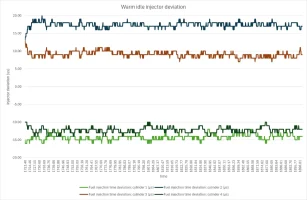
the injectors, or passages to them, are too - which could explain the deviations I measured in injection time in an earlier journey:
Injector deviations average 10 µs with maximum readings from separate injectors between 40 and 70 µs.
test and consider replacing injectors (as they’ve done 125,000 and are behaving badly)
I'm not sure if we can determine injector condition by their deviations as the root cause might be something else (possibly a bent rod). In that case indicated deviation would just indicate that ECU is trying to compensate compression imperfections by adjusting injection timings - thus a kind of chicken or egg first problem.


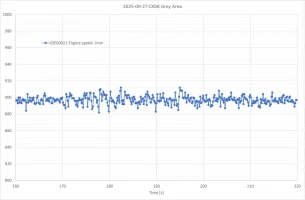
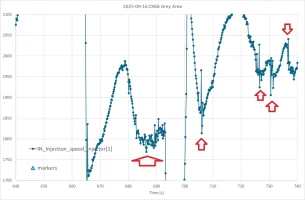
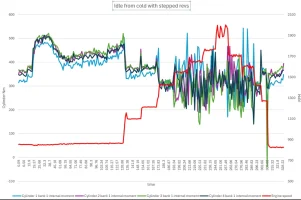
I tried to capture a cold idle for three minutes,
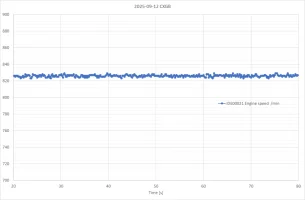
Was there significant judder then? Below a 60 second snippet of engine RPM reading which looks quite poor - compared with the recording on 12th September (with same vertical/time scaling)

1759172340908.webp
1759172264334.webp

Makes me wonder if we can trust crankshaft RPM sensor? There were some significant irregular spikes seen in the data already earlier - again chicken-egg?

1759172900842.webp
 
Oh the chickens and eggs go forever! Could a failing/unreliable crankshaft sensor be causing the problems?

The cold start in the most recent data was on a much colder day - which might account for the difference.


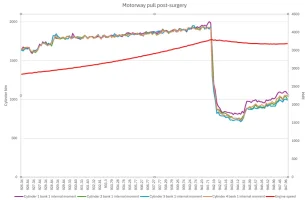
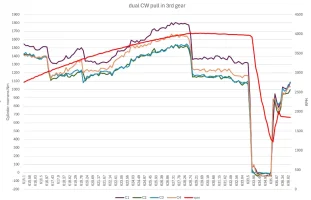
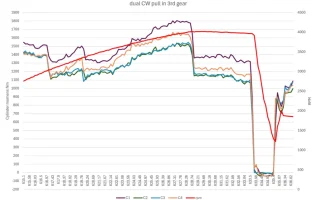
pull in 3rd.png
This in a new chart which shows hard acceleration in 3rd gear. Interesting to see that cylinders 2 and 3 are matched but underperfroming - there's about a 400Nm range. C1 and C4 are producing more.


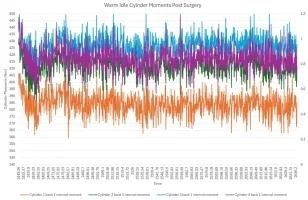
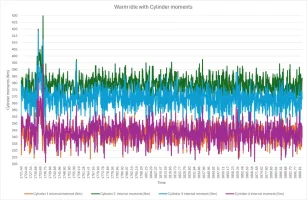
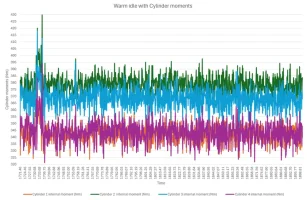
warm Idle moments.png
But here's an older chart which shows the reverse situation at idle. In this chart, i's C1 and C4 which are matched but underperforming, while C2 and C3 are producing more.I'm not sure if it's possible that the fields were somehow mislabelled.

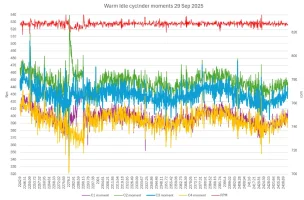
warm idle moments 29 sep.webp
[edit] here's a new chart from the latest data - this pattern seems to be a thing. At idle C1 and C4 are matched and produce less torque. Under load, C2 and C3 are matched and produce less torque.


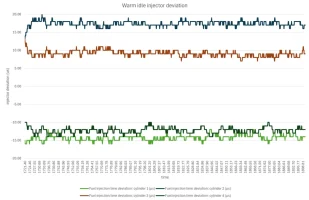
warm Idle injector dev.png
This one shows a warm idle (at the same time as the older chart). C2 and C3 have positive deviation (around +15 micoseconds) - so they are underperorming, while C1 and C4 have negative (around -12 microseconds).


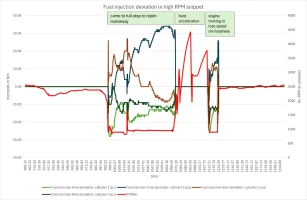
Injection deviations at high RPM snippet.png
This one shows high RPM on motorway. There is no injection deviation when under load, but there is deviation when not under load.
 
Last edited:
  • Like
Reactions: mmi
Idling:
  • Cylinders 1 & 4: Underperform (matched)
  • Cylinders 2 & 3: Normal/better - some deviation as a pair
  • Injector deviation: Present

Under Load (4000 RPM pull):
  • Cylinders 2 & 3: Underperform (matched)
  • Cylinders 1 & 4: Normal/better (100-150Nm difference between each other)
  • Injector deviation: Absent
Cylinders are paired and the problem switches depending on engine load/RPM

Intake manifold and swirl flaps gummed up by failed EGR coolant entering the intake?
 
Could a failing/unreliable crankshaft sensor be causing the problems?
It’s an induction coil, I’ve replaced a few failed ones on vehicles, they’re either good (continuity) or bad (open circuit) in my experience.
Cheap and quick to replace, quicker than discussing it.
 
Hallo folks.

I thought I'd post an update on my fun journey with the 102hp T6 van@125,000 miles. To save any rereading of this now quite long thread: a blocked EGR and cooler; mechanic chose to mechanically clean instead of replacing EGR/cooler. EGR/cooler then failed and pulled in a load of coolant, hydrolocked the engine when stationary but it had been driven on a dual carriageway. Engine then ran rough - especially being hesitant around 1500-2000RPM. Vibrations, shaking. Nothing violent, but undeniably there. The main thrust of thread before this was trying to determine the cause of the rough, though a bent rod or similar.

I called a lot of places and didn't manage to find anyone willing to take on the diagnostic side of things and measure the cylinders to determine bend rods or not. A couple of businesses were willing to put a new/reconditioned engine in, but at costs fairly in excess of the value of the vehicle. No one was up for making the measurements or doing much of anything that didn't involve replacing the engine.

In the end the mechanic (sound enough) responsible for the initial problem agreed to resolve his error.

Initially he put a fresh set of injectors on the engine to rule out fouled injectors from the coolant ingress. Apparently couldn't then get the engine to run at all.

Depth gauge at TDC was done with no discernible problem - apparently biggest difference was 0.04mm which is within tolerance.

Without agreeing anything with me, he proceeded to remove the engine and more or less take it to bits!

Block and valves were sent for testing - no issues. Injector mounts replaced, head gasket replaced, a bunch of other components I didn't recognise the names of were checked or replaced.

In short - couldn't find a discernible problem.

Put it all back together and then messed about with another two new sets of injectors, swapping them around. Apparently could get some to fire, then not others. I am a little hazy on the detail here - but it seems to have been a mission. Something about VW engines and accepting new injectors?

Eventually returned the van this week - it's supposed to be fixed. It does idle better now.

However - similar problem remains around the 1500-1800 RPM range.

Frustratingly, the issue with C4 seems to be resolved, but C1 remains an outlier in terms of torque. There are two pairs of images from before and after surgery - one pair is warm idling, the other pulling on the motorway.

Regrettably, some new fault codes now present on VCDS (but not yet triggering a light) - low refrigerant on the (still working) AC, and problems with the battery regulator.

I know this is probably getting a bit old - but I figure it worth a post to see what you folks think?

I'm going to attach a scan, blockmap (running and not) and a journey with a bunch of data points logged in case @mmi fancies a poke :)

I suppose it's possible that the C4 injector was fouled while C1 has a very small bend to its rod that has escaped detection?
I'm wondering back to @DXX 's suggestion of a poorly performing crank sensor and will see if I can check this with VCDS or just replace it. to rule it out.

If anyone has any suggestions on where to even think about going next with this - I am all ears!!


When idling cold and bringing revs up to 1500-2000 - the vehicle shakes about and the engine is't happy.
It's not so bad when warm.

1762282610906.webp


Here's a before and after of a warm idle:
1762281847465.webp

1762281882371.webp


Here are a before and after of pulling on the motorway:

1762288556442.webp


1762288600077.webp
 

Attachments

suppose it's possible that the C4 injector was fouled while C1 has a very small bend to its rod that has escaped detection?
If the head has been removed it would have been straightforward to check the relative piston crown heights, I can’t imagine a mechanic not doing this so you can probably eliminate a bent rod.
I remember another case of a hydrolocked engine causing main bearing bolts to fail, I think it was C1.
 
If the head has been removed it would have been straightforward to check the relative piston crown heights, I can’t imagine a mechanic not doing this so you can probably eliminate a bent rod.
I remember another case of a hydrolocked engine causing main bearing bolts to fail, I think it was C1.
Yeah - these were ruled out by the mech, along with lobe alignment (!?) and some other stuff. I'll ask if the main bearing bolts were changed in the hope that they were. I don't think I'll be able to convince him to take the thing to bits a second time.

There was a problem with getting the engine to accept new injectors and run at all. Something about long codes and swapping injectors around - getting problems with different cylinders and using multiple sets of new injectors (well, reconditioned Delphi ones which looked very likely to be new old stock). I'll see if I can get a more thorough explanation.

It's puzzling - the above charts seem to say that:
> when engine idling warm, cylinder 1 outputs around 30-40Nm LESS force than the other three
> when pulling under high RPM on motorway the outputs are closely grouped, but
> when the power is let off (engine braking) cylinder 1 outputs MORE torque (around 100Nm) than the others!

This used to be the case for cylinder 4 as well (though not quite as pronounced) but a new injector seems to have sorted him out.
 
Last edited:
  • Like
Reactions: mmi
Hi sports fans.

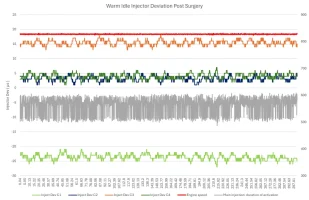
One more comparison from before / after surgery - injector deviations on warm idle.


Average injection deviations before replacement:

C1: -15, C4: -12 (both negative)
C2: +17, C3: +10 (both positive)

After replacement:

C1: -23 (worse by 8 μs)
C2: +3.2
C3: +15 (worse by 5 μs)
C4: +4


The ECU thinks C1 needs less fuel than the others and it produces less torque at idle, but more when motorway engine braking
The ECU thinks C3 needs more fuel than the others and it produces more torque at idle, but less when motorway engine braking


Before
1762362912375.png


After

1762362887189.png
 
Last edited:
  • Like
Reactions: mmi
Back
Top