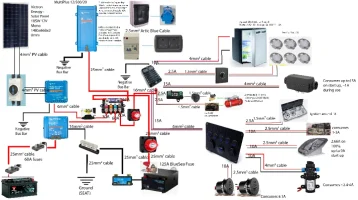
Our Off Grid Electrics - diagram and prices

VANLIFETerry

New Member
After spending weeks/days/hours researching electrics, we are finally ready to start ordering parts for our VW 2017 SWB, which we’re hoping to live off grid in for at least a year.

Posting this on here to hopefully help others, although please do your own research as we have no electronic experience and are learning on the job! It would be great also if anyone has any advice or if there’s anything you think we should do differently.

We’ve opted for the Fogstar 230Ah seat battery which will be in the driver’s seat, along with (hopefully, but probably not) the Orion XS 50A, MPPT 75/15, Mega Midi fuse box, isolation switches, Victron Smart Shunt, 12-way blade fuse holder and negative bus bar 250A.

We will have a Victron Monocrystalline solar panel 185W on the roof, with the solar isolator located in a cupboard behind the driver's seat. The cupboard will also house the Victron Multiplus 12/500/20 and the consumer unit for a double socket.

We hope to have the mains hookup located next to the starter battery in the engine bay along with an IP 66 consumer unit. However, we’re struggling to find an IP 66 consumer unit with reverse polarity so we may end up putting the consumer unit for the hook up in the cupboard behind the driver's seat – although this would be about 4.5m from the hookup point so not sure if this is a risk?

We’ve popped some links and estimated costs to items below to hopefully help others in a similar position but we’re currently still in the research stage so some of these might change.

We'd really appreciate it if someone who knows what they are talking about would have a review and see if there’s any risks or opportunities for improvements/future proofing.

Plan to post the whole electrical build from start to finish on this post.

Thanks :)
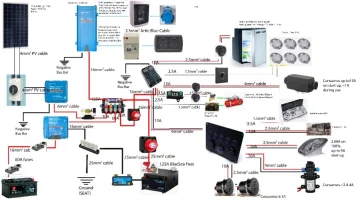


Van Electrics diagram v2.jpg
 
Last edited:
  • Like
Reactions: CAB
That looks like a comprehensive setup.

Got a lot going on there.

Just a quick glance it looks good.

But I think I would upgrade the vict, dcdc feed cable from the starter battery and the multi plus main feed cables.

To limit the voltage drop to a minimum.

500va multi plus?.. that's only around 400w? Is that big enough inverter? That won't run much.
 
Given you're hoping to live off grid for a year, the question really is what's your recharge strategy? If you're road tripping and driving every few days anyway then your DC-DC should do the job. If you're planning to be static for long periods though, your 180w solar panel won't be sufficient in winter so you will have to leave the engine running to recharge.

The other, tangential, point I'd make is that when we've done multi-week off-grid road trips the electrics is actually the easy bit (and that's with a way less flash setup then you've specced here). Considerations like water, showers, cooking and toilets are a way more binding constraint in a T6 sized van in my experience than electrical power.
 
125A Fuse is almost certainly too large to protect the 16mm2 cable to the multiplus.

I would wire your midi fuse box the other way round. - In on the left. Out on the right to the multiplus with 60Aor other appropriate fuse

Simon
 
That looks like a comprehensive setup.

Got a lot going on there.

Just a quick glance it looks good.

But I think I would upgrade the vict, dcdc feed cable from the starter battery and the multi plus main feed cables.

To limit the voltage drop to a minimum.

500va multi plus?.. that's only around 400w? Is that big enough inverter? That won't run much.
Hi Dellmassive, Thanks for your response! All of your forum posts have been really helpful and love what you've done with your van. Thanks for the advice will upgrade the cables to 25mm2. For the Multiplus, we're only planning on using the AC for charging laptops and batteries so thought the 500va would be enough. Perhaps it's worth considering an upgrade to future proof but at the same time we're limited on space and budget. If we were going to upgrade it, it would make sense in our mind to go for a 1600 Multiplus to allow use of kettle or air fryer but poses significant cost increase and space decrease. Cheers!
 
Last edited:
Given you're hoping to live off grid for a year, the question really is what's your recharge strategy? If you're road tripping and driving every few days anyway then your DC-DC should do the job. If you're planning to be static for long periods though, your 180w solar panel won't be sufficient in winter so you will have to leave the engine running to recharge.

The other, tangential, point I'd make is that when we've done multi-week off-grid road trips the electrics is actually the easy bit (and that's with a way less flash setup then you've specced here). Considerations like water, showers, cooking and toilets are a way more binding constraint in a T6 sized van in my experience than electrical power.
Hi t0mb0, we're going to be on the move a lot and probably wouldn't be stationary for more than a few days. Also planning on following the sun for the winter periods. Limited on space on the roof due to maxxair fan. Agreed that shower, cooking, water and a loo are definite considerations, we've gone for a non traditional layout idea for the internal which I'm sure will be even more pain staking when we get there but got to tackle the electrics first so we can get the carpet in and onto the next step.
 
125A Fuse is almost certainly too large to protect the 16mm2 cable to the multiplus.

I would wire your midi fuse box the other way round. - In on the left. Out on the right to the multiplus with 60Aor other appropriate fuse

Simon
Great point thanks Sim60, will look at changing to a 60a or 80a fuse but will also be upgrading the cable to 25mm2 per dellmassive's suggestion
 
Hi t0mb0, we're going to be on the move a lot and probably wouldn't be stationary for more than a few days. Also planning on following the sun for the winter periods. Limited on space on the roof due to maxxair fan. Agreed that shower, cooking, water and a loo are definite considerations, we've gone for a non traditional layout idea for the internal which I'm sure will be even more pain staking when we get there but got to tackle the electrics first so we can get the carpet in and onto the next step.

Cool, if you're following the sun and moving around a fair bit then getting enough charge in should hopefully take care of itself.

I'm sure if you put as much thought into the layout/water/etc as you have the electrics, you'll be fine on the other stuff. I'm serious when I say the electrics is the easy bit of prolonged off-grid living though, in my experience you'll be worrying a lot more about where your next water/shower/meal/toilet emptying is coming from than how much Ah is sitting in your battery!
 
I would try to take out some of the individual switches.

If your fridge has its own control panel which means the interior light is out when you switch it off with the door in the vent position, you don’t need a switch there.

For the heater, you don’t need a switch there, and it will stop you accidentally turning it off whilst it is cooling down.

Both fridge and heater are fussy about voltage, so best to minimise the number of connections.
 
I would try to take out some of the individual switches.

If your fridge has its own control panel which means the interior light is out when you switch it off with the door in the vent position, you don’t need a switch there.

For the heater, you don’t need a switch there, and it will stop you accidentally turning it off whilst it is cooling down.

Both fridge and heater are fussy about voltage, so best to minimise the number of connections.
Thank you, didn't realise that but makes total sense. We'll remove the switches for the fridge (if it has it's own control panel) and for the heater. Really good point on the diesel heater as definitely wouldn't want to switch it off during start up or cool down.
 
Thanks for all the advice, we've updated the diagram below. Is anyone able to answer if it's okay to have our electrical hook up point in the engine bay but have the consumer units in the cupboard behind the drivers seat? This will be about 4-5m of cable from the hook up to the consumer unit.

Van Electrics diagram v3.webp
 
Thanks for all the advice, we've updated the diagram below. Is anyone able to answer if it's okay to have our electrical hook up point in the engine bay but have the consumer units in the cupboard behind the drivers seat? This will be about 4-5m of cable from the hook up to the consumer unit.

View attachment 314228

I don't see why not, in terms of cable length it would be similar to a standard hook up point mounted below the rear bumper. Having said that, the engine bay is an obviously more hostile zone both for cable routing and for the hookup itself so you'd have to be pretty careful with the routing/installation - why wouldn't you stick it in the usual place at the back?
 
I don't see why not, in terms of cable length it would be similar to a standard hook up point mounted below the rear bumper. Having said that, the engine bay is an obviously more hostile zone both for cable routing and for the hookup itself so you'd have to be pretty careful with the routing/installation - why wouldn't you stick it in the usual place at the back?
Yeah that's a good point, if the consumer unit is in the vehicle anyway then we may as well put the hookup at the back. The reason why we were considering putting the hook up in the engine is because we thought it would save space if we could get the consumer unit in the engine as well. Will do some measuring as the engine space does seem quite small and see which IP 66 consumer units are available. If not we'll definitely just put it at the back. Thanks T0mb0!
 
Yeah that's a good point, if the consumer unit is in the vehicle anyway then we may as well put the hookup at the back. The reason why we were considering putting the hook up in the engine is because we thought it would save space if we could get the consumer unit in the engine as well. Will do some measuring as the engine space does seem quite small and see which IP 66 consumer units are available. If not we'll definitely just put it at the back. Thanks T0mb0!

I'm not sure if it's an actual issue but the thought of a consumer unit in the engine bay definitely gives me the shivers! Some combination of moving parts, high temperatures, moisture and high vibration doesn't really sound ideal to me...
 
Why do you feel the need for an isolator on the solar panel?

I don't have an isolator on mine, and I've never felt like I'm missing out. I do seem to remember on some (Victron?) solar controllers there's some bizarre warning in the manual about making sure the solar is never connected without the output being also connected so maybe an isolator helps there when the battery is disconnected for whatever reason? I've never seen such a warning about my MPPT though (Votronic) so it may be a victron specific thing?
 
I don't have an isolator on mine, and I've never felt like I'm missing out. I do seem to remember on some (Victron?) solar controllers there's some bizarre warning in the manual about making sure the solar is never connected without the output being also connected so maybe an isolator helps there when the battery is disconnected for whatever reason? I've never seen such a warning about my MPPT though (Votronic) so it may be a victron specific thing?
Likewise, no isolator on mine. Just another failure point and volt thief imho.
 
Back
Top