Lithium leisure setup

lukethompson86

T6.1 owner and all round VW enthusiast
VIP Member
T6 Pro
Hi all

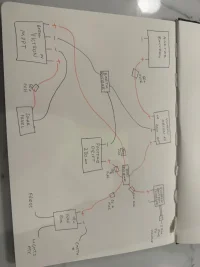
Anyone offer some advice as to how my sketch looks for my new leisure battery setup ??

Thanks all

Edit ; im
Now likely to use a 5 way fused distribution box out of the leisure to accommodate the

Dc charger
Solar
12 consumer unit
Battery charger


Save using loads of inline fuses !!

IMG_3644.webp
 
As a schematic for what gets connected where it's fine. I think you need to look at your fuses though, for one thing there are no cable sizes marked so it's not possible to say whether the fuses are correct with respect to the cables. And some fuses look odd - for example, a Victron Orion DC-DC can often push 50A on its own and if so your fuse there will blow straight away and even if it doesn't you've got many 50A going into a single 50A to the battery at the positive fusebox so once you've combined solar and DC-DC input, for example, you run the risk of blowing that fuse to the battery once things add up. Likewise on the solar panel, there's a debate about whether you even need that fuse but with your 50A one it's doing nothing anyway as there's no chance your solar panel will get anywhere near that.
 
Hi Tom

Thanks for the response .

So it seems I got the fuse situation all wrong like you mentioned . I’m not going to go for a fused 5 way distribution board and make the fuses to sort each one , ie solar , charger, bath charger and mini fuse board

Does that make sense

Thanks
 
Hi Tom

Thanks for the response .

So it seems I got the fuse situation all wrong like you mentioned . I’m not going to go for a fused 5 way distribution board and make the fuses to sort each one , ie solar , charger, bath charger and mini fuse board

Does that make sense

Thanks

There’s nothing wrong with a fused distribution box, but your fuses do need to be sized and situated appropriately both to the device and cable specifications.
 
I would start by reading your device manuals - victron manuals should specify the cable and fuse specifications for those at least.
 
I would start by reading your device manuals - victron manuals should specify the cable and fuse specifications for those at least.
Hey Tom

Hope you don’t mind me
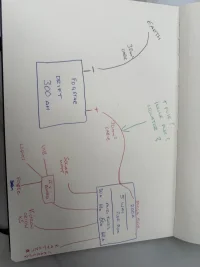
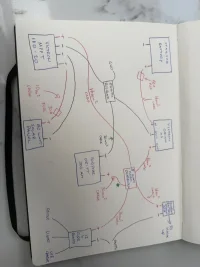
Picking your brains again on this but I had another question I’m hoping you may be able to help with.

Done some
More detailed drawings ,

Do I need another class t fuse on the 35mm2 cable from the leisure to the 250a mega fuse on the 5 way board or not ?

I can’t see that it would be relevant if it’s that close and I have that size of fuse there ?? Or am I wrong .

And also would
You put an isolator on this path or not ?

Please see drawings of what I mean.

Thank you so much for your help!!!!

IMG_3746.webp

IMG_3747.webp
 
Hey Tom

Hope you don’t mind me
Picking your brains again on this but I had another question I’m hoping you may be able to help with.

Done some
More detailed drawings ,

Do I need another class t fuse on the 35mm2 cable from the leisure to the 250a mega fuse on the 5 way board or not ?

I can’t see that it would be relevant if it’s that close and I have that size of fuse there ?? Or am I wrong .

And also would
You put an isolator on this path or not ?

Please see drawings of what I mean.

Thank you so much for your help!!!!

View attachment 316743

View attachment 316744

Currently away but will have a look in a couple of days.
 
@lukethompson86
A ‘T’ type fuse as the first fuse from your lithium battery, as close to it as possible, (as cable from battery to fuse in unprotected) or a proper MRBF fuse on the positive terminal (not a cube fuse they aren’t the same) gives max protection from a short circuit. (I’ll refer to ‘T’ fuse as I go on, but applies equally to MRBF if that’s the way you go).
Megafuses can’t cope with the extremely high currents possible and can fail in a way where current continues to flow, which can then be disastrous.
An isolator after the ‘T’ fuse and before your fuse block is useful. If fitting one, you should ensure it is rated to actually switch at the ‘T’ fuse rating or above.
Fit a ‘T’ fuse rated higher than the megafuse feed in your 5 way fuse block.
Talking of the 5 way fuse block. The majority of your currents are from chargers so will flow into your battery and they won’t all be active at once. Based on your drawing you won’t need more than 100A for the first megafuse and, so that it blows first, rather than the ‘T’ fuse, select a ‘T’ fuse of 150A which will give a good level of discrimination.
Hope that helps.
 
Thank you all! You guys have been more than helpful! I tried a page on Facebook and wish I hadn’t have bothered ! Got such conflicting info.

So just so I’m clear ,

Lithium battery 300ah fogstar-
T fuse
Isolator
Then 5 way Board made up of 1 mega fuse

And 4 midi fuses serving the ;

Solar mppt 20a - 30a fuse ?

Victron 30a battery charger - 40a fuse ?

Victron Orion xs 50a - 60a fuse ?

12v distribution board - serving
Fridge - crx50 - 4ah
Lights -5ah
USB chargers - 4ah
2 amplifiers - 40ah each
Total 93 ah so a 100ah fuse


So I made a total of 230 ah so was gonna do a 250ah mega fuse

And then a t fuse of 300ah???


Does this sound ok or am I going crazy?

I know it may be overboard but im
So paranoid with stuff like this!

Thanks all
 
  • Like
Reactions: CAB
And I assume if this is correct like
You say may sure the isolator is larger than the mega fuse ?
 
@lukethompson86
The amplifiers weren't on your drawing.
So you've added another 80A of current drain on your "12V distribution board" that wasn't known.
You can feed that with 125A midi fuse on your 5 way fuse block, increase the mega fuse feeding all fuses to 150A and increase the 'T' fuse to 175A.
The current flowing from the chargers is going in the opposite direction to your loads, so you don't just add up all the currents.

Increase the cable size from the 5 way fuse to 12V distribution board from 16mm2 to 25mm2 due to the increased current draw from the amplifiers.

BUT then how are you fusing down the individual cables for fridge, lights, USB, amplifiers on your "12V distribution board" and is the 12V distribution board rated for over 125A?

You will need to fuse each of these with smaller fuses rated for the cable you'll be using to feed these smaller circuits.
Remember the fuses are to protect the size of cable.

The isolator should be rated to switch current equal to or above the fuse rating of the 'T' fuse so you can isolate in a fault condition that doesn't blow the 'T' fuse without the isolator arcing and failing.
 
Sorry it dawned on me afterwards that’s I hadn’t included these . Originally I was going to just connect these straight to the starter battery but given the space I have I just figured it would make more sense.

Ok
So this all
Makes sense . I think!!

Updated cable that’s fine , no problem.

Rated fuse board I will check this !

And in terms of fuses for each individual one are we talking inline midi fuses or will the fuses in the appliances themselves be enough?

Honestly can’t thank you enough for your share and wealth of knowledge!!
 
@lukethompson86
Ok so I think I now know what your 12V distribution board is. Is it a CBE unit with 4 blade fuses? If so then the blade fuses can be selected to protect the size of cable feeding your fridge, lights, usb. However it will have a max rating and (if it is the 4 way CBE unit, that is only 30A).
The fuse feeding this distribution board should therefore be fused accordingly, so:
Don't try connecting your 2 amplifiers to this.
Reduce the midi fuse feeding the 12V distribution to 30A. Cable to distribution board can now be 4mm2 or increase to 6mm2 if it's a distance away.
Take an additional cable output from the megafuse (where it connects to the bus bar) to feed a small external bus bar or power post (use 16mm2) and then feed a couple of extra single midi fuses from this each rated for 50A to power each amplifier. The amplifiers power cables can then be 10mm2 each.
 
Absolute legend !!

Yes so this is the one I have or at least close to it!
See pic

Ok great so the other large post on the mega fuse , come off of that ?? To a bus bar like the other pic ?

And I assume I should still be sizing this mega fuse to suit ?

I might do another sketch if you don’t mind .

And lastly I’m assuming all negative cables including the one on the lithium can run to the negative bus bar I bought.

Or multiple of these if need be ? And sounds silly but should a negative bus bar be earthed to ground ?

Thank you
 
The general principles of choosing cables and fuses are:

1) Choose a cable size which is comfortably rated for the maximum current the cable will realistically need to carry. (With longer cable runs, the voltage drop might also come into play as a consideration).

2) Choose a fuse which is comfortably under the maximum rated current capacity of the cable (such that it blows first, rather than the cable) but over the amount of current the cable will realistically need to carry in normal operation. Situate this fuse as close to the source of power for the cable as possible.

Quite often, for specific devices, both cable size and fusing will be specified in the manual.

In terms of some of your specifics:

Isolator - Yes you can fit one of these if you think it would be useful to isolate the whole thing. The downside is additional expense, additional space required and an additional component to go wrong. I don't have one and after eight years using the van, have never missed it.

Main fuse - Yes, as @EAN says above, fitting an MRBF or T fuse is a good idea, as close to the battery terminal as possible. It should be sized following principles 1&2 above. Note that this isn't equivalent to the sum of all downstream fuses both because it's not realistic for them all to be pulling the max current at the same time, and because you have loads and chargers which will net flow off against each other.

Distribution board - Given you're going to use a main fuse as above, your input fuse on your main distribution box isn't really doing much. Given that you could potentially use something like this (Module For 6x Maxi Blade Fuses) which would give you six outputs and enable you to add your amplifier circuit (although see point below) directly on to there with a spare output for expansion later. Note - I haven't seen a max current capability for that unit I linked to, you'd need to check that, but given a single maxi fuse itself can go to 100A, I wouldn't imagine it's below that.

Amplifiers - Are these really a 80A draw?? If they're drawing anything like that in normal operation, I wouldn't put them on the leisure battery circuit. The reason is that if you're using these solidly whilst driving your DC-DC charger could be spending a big chunk of its 50A just keeping the amplifiers going, your leisure battery charging will be heavily impacted and you might even be draining your leisure battery whilst driving (depending on just how thumping you like your music!). If the draw really is going to be anything like that heavy, I'd put them on your starter such that the alternator is effectively powering them.

Secondary fuse box - This will happily provide fuses for all your smaller devices - just follow the principles 1&2 above to choose fuse and cable sizes there. As @EAN says, make sure the fuse that feeds this in the distribution box is under the rating of the secondary fuse box itself. Don't skimp on the cable size for the fridge, they can be sensitive to voltage drop which can come into play on longer cable runs.

Units - You've used A and Ah somewhat interchangeably above. The amps (A) is a measure of instantaneous current whereas Ah is a measure of energy (assuming a nominal voltage to transfer to Wh anyway) - it's the amps (A) you care about for the purposes of cabling and fusing.

Other fuses - just check them individually, there are still some odd ones, for example, I'd expect the 50A one on the input side of the DC-DC to blow in normal operation assuming that's a 50A DC-DC.

 
Another, more general, comment - you've got a pretty premium setup planned here with a huge leisure battery and a bunch of premium components. However, the only thing you appear to be actually powering is a fridge, some lights and a handful of usb outputs? Usually, people run setups like because they're trying to power inverters with induction hobs and the like. As a counterpoint, I'm running a similar bunch of loads with a nine year old 75Ah factory AGM...
 
@lukethompson86
Another sketch of your installation after you’ve digested @t0mb0 and my input would be a good idea.
Detail all cable sizes and fuses and list what you are using for distribution, bus bars etc.
With regard to your question regarding the negatives.
The van chassis is the ultimate negative bus bar.
You aren’t showing a shunt to measure current draw and battery consumption in your sketches, so assume you aren’t fitting one and what I say following is based on no shunt being fitted.
The negative cabling has to carry the same current as the positive cabling.
So the main cable from the battery to the van chassis should be, in your case, 35mm2 to match.
Whether you use a negative bus bar is up to you.
You can take the 35mm2 to your bus bar and then another 35mm2 from your bus bar to the van chassis and connect other negatives to the bus bar, or you can connect your negatives directly to the van chassis, if you have a more local chassis GND connection., or do a mixture of both. All chassis GND connection points can be found in the VIP downloads.
All other negatives from equipment should be sized to match the positive feeds.
 
Back
Top