Help with Cable Sizing Please :)

T6ChrisO

AutoCAD engineer
VIP Member
T6 Legend
Hi all,

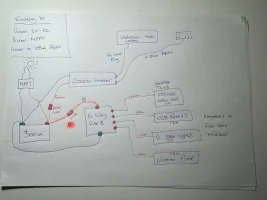
I need a little help with my first fix wiring so I've jotted some stuff down on the below sketch.

First off, are my cable sizes correct that I have shown? I think they are but best to double check. no cable run will be long than 3m and I've checked for Voltage Drop.

I currently have a 105ah AGM under my seat which will be removed and replaced with a Renogy 300ah. I'll reconnect the existing DC-DC and MPPT to new battery.

I'll then wire in 50mm cable c/w a 300A fuse to my Renogy 2000w Inverter.

I'll then wire from the 300ah LB to a 6 way fuse box in (CABLE SIZE UNKNOWN) and fuse with (UNKNOWN)

From there its 4mm to the fridge, 1mm to USB Ports, 1mm to Water Pump and 1mm to existing spot Lights - All these fused at the fuse box

It all might be massively wrong but you told me to have a go myself ha ha :think smile bounce: . I'm sure I've missed something important (I do need an isolator somewhere actually)
IMG_2200.webp
 
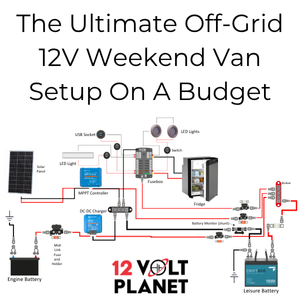
12V planet has a great resource for calculating cable sizes and volt drop. You’ll get a definitive answer there rather than the varied opinions of the collective.
P.s. I’m not being dismissive, I’m just pointing you to a great source of info.

 
12V planet has a great resource for calculating cable sizes and volt drop. You’ll get a definitive answer there rather than the varied opinions of the collective.
P.s. I’m not being dismissive, I’m just pointing you to a great source of info.

What confuses me is the cable size from LB to fuse box as the loads appear minimal (like 10A total) but people use 16mm for example so I just think I must be missing something
 
What confuses me is the cable size from LB to fuse box as the loads appear minimal (like 10A total) but people use 16mm for example so I just think I must be missing something
16mm is way overkill for a LB /Fusebox link in a typical van setup. Many installations on here are over engineered to the nth degree. I see some of the wiring proposals, and some of the “advice” given and shake my head. That’s why I steered you to the 12V planet site. It’s based purely on electrical principles and not wannabes wiring up the next mission to Mars. The guiding principle should be KISS, keep the switches/fuses/relays to an absolute minimum sufficient for a safe and reliable installation. Remember that every terminal/joint/switch/relay is a potential failure for the future. When the lights go out and it’s peeing down with rain in the dark, or even worse, the beer’s warm, you need to know where to start.
 
Last edited:
You just need your loads. Everything else is on the internet, ohms law on DC is a doddle…

I wouldn’t worry about volt drop, the runs aren’t really long enough unless you’re looping the van over and over…
You’ve got the most important one, to the inverter. As above, most people like to over engineer these things and to be fair, the price difference between 2.5mm and 4mm is negligible.

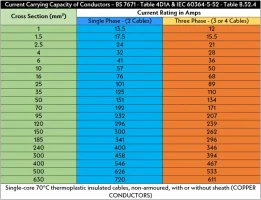
Good table for required cable size.
IMG_0882.webp
 
Whereas with a degree in astronautical engineering I could wire up a mission to Mars, but wouldn't have a clue where to start on a camper!
 
Based on the above im thinking 4mm cable from LB to FB and a 20A fuse
Have you checked all your loadings? What you expect to happen if say the fridge compressor fires up as you switch the lights on etc?

For the length of the cable I’d be tempted with 6mm just to future proof. But only you’ll know what you think you’ll ever use the van for in the future. You don’t want to be ripping your van apart to replace a cable if a fuse keeps blowing etc…

Is your sketch above your total equipment list? Anything you think you might want to add?
 
Have you checked all your loadings? What you expect to happen if say the fridge compressor fires up as you switch the lights on etc?

For the length of the cable I’d be tempted with 6mm just to future proof. But only you’ll know what you think you’ll ever use the van for in the future. You don’t want to be ripping your van apart to replace a cable if a fuse keeps blowing etc…

Is your sketch above your total equipment list? Anything you think you might want to add?
Yeah total load currently would be approx 12A BUT I would like to add a diesel heater in the future now you mention it
 
Just read a diesel heater draws 8-12A on start up so maybe so 4mm would be ok but could go to 6mm for future proof and uprate the fuse too :thumbsup:
 
Just things to check.

1) Your starting current on your fridge. Make sure it’s not stupidly high.
2) USB ports, personally I’d go for 2.1 Amp x2 for faster charging. So you’ve got roughly 5 amp there (always best to add a bit).
3) Water pumps usually have a decent start up current too (but nothing compared to a fridge!), so I’d double check the numbers.

But looks like you’re on the right track now!
 
4mm cable is rated around 40A. It’s plenty for your needs. Even if by some miracle your fridge and heater started up at exactly the same time, and you had some lights on and were charging your phone, you’re not getting close to overloading the cable. And assuming that the fuse box is close to the LB and the cable is short (less than a metre) the volt drop will be minimal. 4mm is good to go. The bigger you go the more awkward it is to fit the cable into sensible sized terminals and crimps.
 
4mm cable is rated around 40A. It’s plenty for your needs. Even if by some miracle your fridge and heater started up at exactly the same time, and you had some lights on and were charging your phone, you’re not getting close to overloading the cable. And assuming that the fuse box is close to the LB and the cable is short (less than a metre) the volt drop will be minimal. 4mm is good to go. The bigger you go the more awkward it is to fit the cable into sensible sized terminals and crimps.
Thank you for the input. I do have 4mm cable here, 6mm I'd have to order so maybe back to where I was and stick with 4mm because like you say, the chances of the fridge and heater firing up at the same time is unlikely
 
Re. Cable. If it was me wiring my van, my extravagance would be to use tinned multi strand cable similar to the Ocean Flex. I’ve rigged a few boats in my past and that’s all we used. Being tinned you don’t get the dreaded black corrosion creeping up the cable when there’s been some water ingress. It’s very flexible and is designed for high vibration environments. It’s more expensive than ordinary cable, but the difference in price isn’t huge in the big scheme, and you’re not going to be using rolls and rolls of the stuff.
 
Back
Top