What size cable and fuse for a 314ah lithium battery.

Rioja John

Neckender
VIP Member
T6 Legend
I'm replacing my 3 lithium batteries with a 314 ah lithium battery and the cable size that I have installed at the moment is 16mm square, so would I need to upgrade to 35mm square cable and also what size fuse would I need.I also use a 3000 watt pure sine wave inverter,what size fuse would I need for that.
Thank you in advance.
 
W=v*a

3000w=12v*250A

300w inverter will pull 250-300A+ full whack.

....

So you will be looking at twin-50mm2 -120mm2 cable with 400A supply fuse.

35mm2 will melt at 3000w

3000w is massive power on 12V - best check your battery can deliver that power.... Most are 160-200A.

What 315ah battery is it?.. What's the BMS max continuous Amps?

(FYI I run twin 230ah Roamers on my 3kva Victron inverter)


.....

For a 12V 3000VA / 3000W Victron MultiPlus inverter, the standard official Victron manual specification calls for a 400 Amp DC fuse alongside doubled-up (parallel) 50 mm² (1/0 AWG) cables for both positive and negative lines.Because a 3000W load at a nominal 12 volts can pull roughly 250 to 300+ Amps continuously (accounting for DC efficiency losses and battery sag) and up to 550+ Amps during surges, utilizing heavy-duty wiring is vital to mitigate hazardous voltage drop and heat buildup.

..

Cable Size: 2x 50 mm² (Parallel 1/0 AWG) for Positive AND 2x 50 mm² for Negative.Fuse Size: A single 400A Class T fuse installed on the main collective leg before the distribution block (e.g., a Victron Lynx Distributor or a heavy-duty busbar).

...


Option 2: Single Thick Cable (Alternative Method)If you prefer managing one large, flexible line rather than two, you can combine the connection down to a single run.Cable Size: 1x 120 mm² (4/0 AWG) for Positive and Negative.Fuse Size: A single 400A Class T fuse.

.
 
With that amount of current flowing either buy the correct termination tools or get the cables professionally terminated. A bad joint will get very hot and that’s not good in a confined space full of flammable stuff.
 
I used to wrestle these sizes of cables in my mining days, they ran huge (100hp+) motors at 1100V, it’s mad to think that we are now putting them in vans to make a coffee and cook some oven chips.
For the curious ones, it is not madness.
That is obviously because you got there much higher voltage (1100 V).
BTW in electrician jargon 1100 V is considered "medium" voltage :) but it is nothing to play with!
Higher voltage V lets you transport the same power P with less current I , given
P=V*I
But cable conductor sizes are calculated based only on the current.
Infact the thermal effect (dissipated power) on a cable of a given intrinsic resistance R depends on the SQUARE of the current:
P=I²*R

That is the main reason that high voltage lines exist, to transport huge quanties of energy with smaller cables (and less thermal losses).
BTW what changes between the two application requirements is the insulation.
Your 1100V mining cables would have way much better insulation that our 12V ones.
 
Last edited:
  • Like
Reactions: CAB
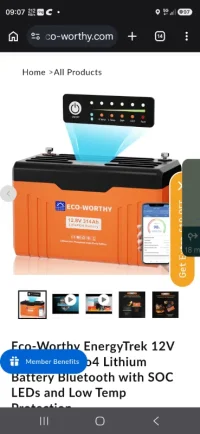
This is the battery that I've ordered.
Will my existing 16mm square cables to bus bars be adequate and double up 50mm square pos and neg with 400 amp fuse to inverter be OK.
The biggest output items that I will use are 1800 watt coffee maker, 800 watt microwave, 1000 watt kettle and a 1200 watt halogen heater. I know that I can't use these all at once.I just want to be self sufficient with my 200 watt solar Panel with another 200 watt of portable solar for back up.
Thanks again for your help.

https://duckduckgo.com/y.js?ad_domain=www.ebay.co.uk&ad_provider=bing&ad_type=prad&click_metadata=5Hg6ePdY%2DOSdtrYsreEuL5zj68cOyKzzQnlVIUkquRs0eyiDVvrIClIkuYNshvRhpw34IGYvmoB0a3i5U9rjiD2eyGN56BVeb2jmU5T6Ej6d0jQQ%2DHL6UxLO%2DX1IR_16VGAoCl26YIcT7zyVrl15uA.u4gOW3_sEKK_cf8iJu6ahA&eddgt=UgSyhkM307OACEFu9IcrnQ%3D%3D&rut=fbc87d7813112c6da19a49d20232d81ee5616073a2df119d0eab22cd5c4de761&u3=https%3A%2F%2Fwww.bing.com%2Faclick%3Fld%3De8Py1%2DoWtsNEMU0N6apO1gJTVUCUxlr%2DYbHokEhJoQFk5veCUYA8wgL5Iry3pnhYNMMpgbfX4xVwoerxP49QpHWbFzJ8Gd46JzakFtBqCFg5rOAvI_x_096UXK5898RMj%2DIldMRL4ynHkEBb4wkWBPTRUGCfBeKi4oUGcXpCMkxgpBHJEUGUTSt7p26%2DzpZrDtz_gVMjSTdBF%2Dvc7hX_axELEh1N4%26u%3DaHR0cHMlM2ElMmYlMmZ3d3cuZWJheS5jby51ayUyZml0bSUyZjMyNzE3MTg4NTY4NCUzZmNobiUzZHBzJTI2bm9yb3ZlciUzZDElMjZta2V2dCUzZDElMjZta3JpZCUzZDcxMC0xNjc1MzgtNTEyNTgzLTIlMjZta2NpZCUzZDIlMjZpdGVtaWQlM2QzMjcxNzE4ODU2ODQlMjZ0YXJnZXRpZCUzZDQ1ODUxNjk2NTU1NjQ1OTclMjZkZXZpY2UlM2RtJTI2bWt0eXBlJTNkJTI2Z29vZ2xlbG9jJTNkNDE1MDYlMjZwb2klM2QlMjZjYW1wYWlnbmlkJTNkNTU1NjI5MTc0JTI2bWtncm91cGlkJTNkMTMwNTEyMTU0MDE3OTU5MyUyNnJsc2F0YXJnZXQlM2RwbGEtNDU4NTE2OTY1NTU2NDU5NyUyNmFiY0lkJTNkMTA1MTQzMDUlMjZtZXJjaGFudGlkJTNkODc3NzklMjZtc2Nsa2lkJTNkNmJmMTUyZGVlMGVkMWJiZWU1ZjczOGY4OThiZjkyMTc%26rlid%3D6bf152dee0ed1bbee5f738f898bf9217&vqd=4-190775737603979387666836503630582200694&iurl=%7B1%7DIG%3D52EB1A30EB574B29A50F7A5E6C2793BA%26CID%3D0D23F056785765DB031FE724792C640E%26ID%3DDevEx%2C5043.1
 
Last edited:
If it's this one,

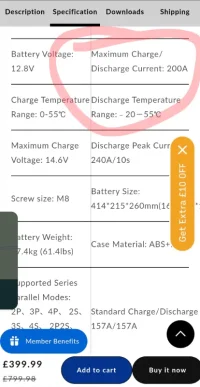
It's rated at 200A max. So you need two of them too get the 300A you need.

.
Screenshot_20260608_090739_Chrome.webpScreenshot_20260608_090700_Chrome.webp


..
 
628ah capacity would be awesome.

Might have issues charging them though in a2hr drive... Lol
 
So would I be better with a 2000 watt inverter?
Are my cable assumptions ok, 16mm square to my bus bars and 50mm square doubled to inverter.
 
So would I be better with a 2000 watt inverter?
Are my cable assumptions ok, 16mm square to my bus bars and 50mm square doubled to inverter.
I dont think a 2kw inverter will power the 1800w coffee maker due to the initial power draw
 
Thanks for that @T6ChrisO I have not bought the coffee maker yet so I will look for a lower wattage coffee machine.
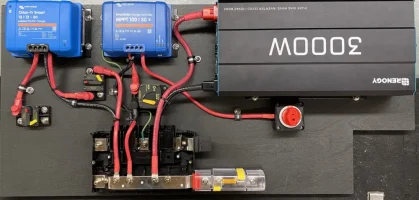
My original set up is 16mm square cable to Victron 50 smart charger, the same to batteries and again 16mm square to bus bars to lighting, 12 volt circuits diesel heater, all fused.
Will this be OK with the 314 ecoworthy battery forgetting the 3000 inverter.
 
Last edited:
So would I be better with a 2000 watt inverter?
Are my cable assumptions ok, 16mm square to my bus bars and 50mm square doubled to inverter.
no, 16mm2 cable is tiny. . . the 50mm2, or 70mm2 or 90mm2 need to go direct to battery, same for neg to chassis.

or fit a Busbar inbetween.

if your pulling 200A+ you need chunky cables and proper crimps from the source of the power to the load.

ie battery to the inverter,.


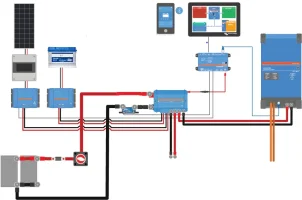
see example from van junkies website.

1780910573248.webp


here is another example

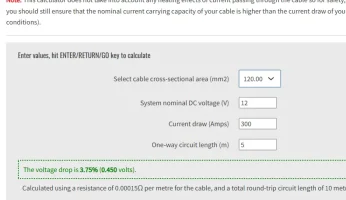
but with very short cable runs of they gone for smaller cable.

so depending on where the LB is installed?


1780911152654.webp
 
More juice than a MMA welder using 4.0mm electrodes, just to cook your dinner?
 
We manage with a 2kw inverter as we still use gas as well but another alternative if rather than one big load you want to run more than one piece of kit at a time is to run two 2kw inverters ie. spread the demand.
Ideally for larger DC loads though increasing the voltage to 48v calms things down regarding cable sizes required.
@Salty Spuds as an apprentice at Corby steelworks I remember working on motor generator sets where the DC output controlled the conveyor motors on the tube rolling mills.
The beauty of these beasts was that if the tube being formed cooled to quick and was thrown sidewards out of the die then the conveyor could be stopped instantly and reversed after cutting out the affected tube, the ultimate regen braking and unbelievable in action.
 
Back
Top