Hello from texas

Texas780

New Member
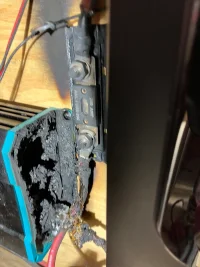
Have a question. Recently I had a fire in my van. My 60 amp Renogy dc/dc battery suddenly caught fire and the fuse did not blow. Had worked flawlessly for several years. Not on a long trip, just running to town. Has anyone else had this problem?
 
  • Wow
Reactions: CAB
What.....?

Have you got some pics?

What burned.? Battery? Cable? Charger?

I've heard of a renogy dcdc charger blowing and causing some burning smell.
 
Have a question. Recently I had a fire in my van. My 60 amp Renogy dc/dc battery suddenly caught fire and the fuse did not blow. Had worked flawlessly for several years. Not on a long trip, just running to town. Has anyone else had this problem?
Hi Tex, welcome.
I won't mess with you :), promise.
But from your data (60A, dc/dc) I think you mean a battery *charger* isn't it?
Anyway never heard about such case, Renogy is usually decent stuff. Looks like some MOSFET has internally blown up, but that shouldn't start a real fire. Some smoke and melt plastic maybe, but not a fire. Some pictures may be interesting.
Also the fuse should blow only if it is in the DC current path, maybe you are looking at the wrong one, just saying.
 
What.....?

Have you got some pics?

What burned.? Battery? Cable? Charger?

I've heard of a renogy dcdc charger blowing and causing some burning smell.
Charger. It was the cable in from the fuse, but it was the charger that actually burned. I think my rover might be okay but I have to figure out how to test it. It was not burned but the flame was right beside it.
 
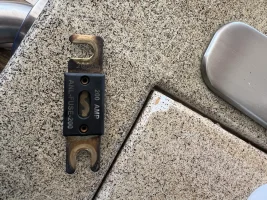
If that wire is 6awg then a 200amp fuse is way out of spec. Too late now but if you decide to replace like for like then an 80amp fuse is more suitable.
 
If that wire is 6awg then a 200amp fuse is way out of spec. Too late now but if you decide to replace like for like then an 80amp fuse is more suitable.
Thanks. That makes sense. At the time we put it in, someone recommended the 200 to me. I can’t remember who. We have a Promaster van and my wife and I built it out during covid because we were tired of pulling a 5th wheel. The entire project was based on watching a million U tubes. No idea of what we were doing, depending on internet to figure it all out.
 
Hi Tex,
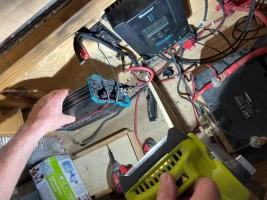
Yeah, it looks like something went pretty wrong dimensioning and installing all that circuit.
As someone said already, wire size vs fuse size and maybe vs something else like load (i.e. dc/dc charger) size.
Also minimal clearance and cooling requirements must be taken in account and are not always easy to meet in a camper.

Possibly, yes, you did have an electric fault in your charger, but the whole circuit should have been able to protect itself from catastrophic failure. Also I am not really a fan of combustibile (i.e. wood) base panels, especially if there are cooling fans involved nearby.

Basically that is why qualified electricians exist and looks like you learnt it the hard way. U tube is not a reliable solution, while it may work for a number of iterations. The problem lays in the few ones where it doesn't. Car batteries and alternators generate power in the kW range and that is nothing to take lightly, especially in a confined environment stuffed with other highly combustibile stuff.
Good that nobody got hurt (as I understand and hope).

That said, maybe Renogy would be interested to see those pictures, too, and may have something to say or to help you.

 
  • Like
Reactions: CAB
You can’t tell definitively from pictures but it does look like that positive running very close to the DC-DC was running way over its rated current and so heated up enough to set fire to the DC-DC unit next to it with the fuse being far too oversized to prevent it.
 
  • Like
Reactions: CAB
Scary stuff...

It looks like the fire may have started inside the dcdc charger... With hot gas/flame then melting the blue plastic end cap and the the cables on the right.

Was the charger running at the time?

Was you in the van at the time?

How did you put it out?

Can you get any pics on the inside of the charger?... The end caps unscrew and the pcb would normally slide out.

FYI that 200A fuse will need nearly 400A to blow, but fire from component failure inside the charger would only need a lot less current.... Though I'm surprised there is enough stuff inside to keep a flame going.

Can you get a better pic of the model number?.... Is it a 20/50/50/60A charger?

And have you got a fuse on the input side?

Is it a dcdc charger from the vans starter battery to the leisure battery?
... Or in a 5th wheeler, talking a feed from the tow car via a plug?

Glad you and the wagon are ok though.
 
Back
Top