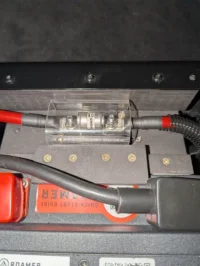
Fusing a Roamer seat base battery.

Skyliner33

#rallyeroamer
VCDS User
VIP Member
T6 Master
Hi all.

If you have a Roamer 230 seat base battery, i"m interested in how you fused it.

What type of fuse did you use, T-Class, MRBF aka Blue sea Systems, or another type of fuse?

Pics to show how you fitted it would be great. Thanks in advance.
 
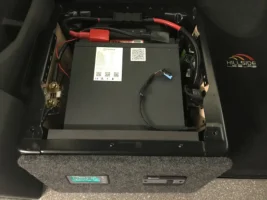
I currently just have a mega fuse mounted in front of the battery on the securing bracket I made to hold the battery in position.
Am now aware that the mega fuse interrupt current of 2000A doesn’t meet the short circuit current of the battery but when I installed it I’m pretty sure the Gen2 Datasheet had no figure for short circuit current and just said it was protected (suppose via internal BMS), so I do need to update it. I’m currently thinking of just either adding in a MRBF onto the positive terminal leaving the mega fuse in line (but haven’t looked at clearances on the battery terminal) or replacing the mega fuse with an ANL fuse and fuse holder which has a 6000A interrupt current rating (meeting the requirements) but a faster normal blow. T-class (the best) are just too expensive.
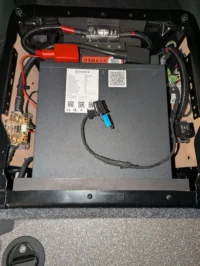
I’ve attached a pic (it’s out of date as I now have added in an isolating switch but don’t have a photo of that to hand)

IMG_0890.jpeg
 
Last edited:
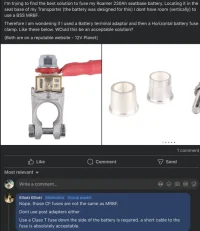
These are my fuse of choice for first line protection on batteries, I use them on the boat & van.
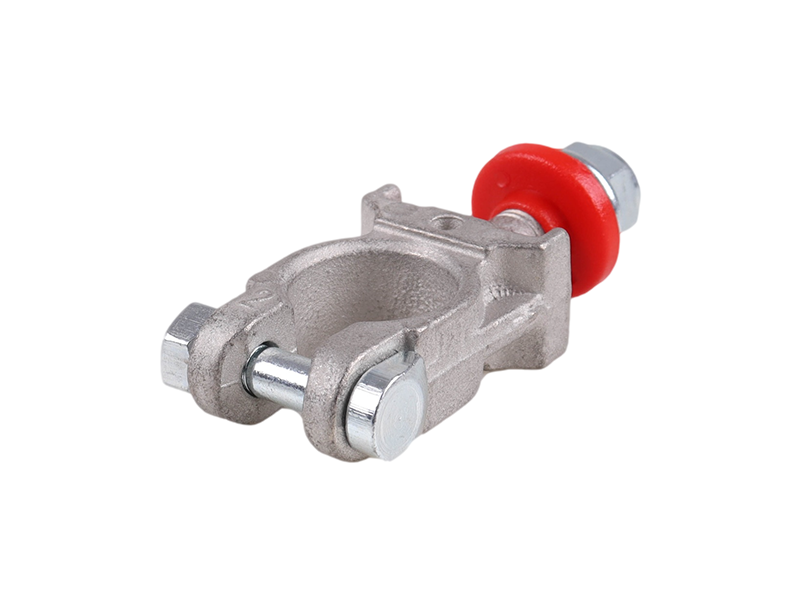
Wish they did a version like that for M8 terminals (as Roamer use) with the fuse mounted horizontally like that rather vertically.
 
Wish they did a version like that for M8 terminals (as Roamer use) with the fuse mounted horizontally like that rather vertically.
You can get M8 to post adapters that fit on the threaded terminal. They are on the same page as the fuses above in the “you may also be interested in” section. Not an ideal solution but they work. TBF I can’t see it being a difficult job to fabricate a fuse holder that bolts straight onto an M8 terminal “a la Roamer” it’s probably been done already.
 
There is a blog article on the Roamer website about fusing. Their recommendation is a Class T or MRBF for lifepo4 batteries.

Battery Fuse Article
That’s where I first read that my main mega fuse probably isn’t suitable in a short circuit case; although I can’t now find the short circuit current of a Roamer Seatbase2 to double check against as I thought it was around 2000A: And the BMS short circuit protection has to fail as well.
 
@Salty Spuds @EAN @ginkster

Thanks for the replies.
That blog is partly the reason for me starting the thread.

Those adapater posts on 12V planet seem conical and the clamp looks like it is cylindrical, makes me wonder how good a contact it would be.
 
The advice Eliot gave me was to use a proper (not CF) Eaton-Bussman MRBF on my 160AH Roamer Batt. If you check TaulPauls MTB Caravel thread he got round the height issue of using an MRBF on a (fogstar) seatbase battery by extending the fuse past the battery using a copper bussbar and fitting the fuse upside down.
 
The advice Eliot gave me was to use a proper (not CF) Eaton-Bussman MRBF on my 160AH Roamer Batt. If you check TaulPauls MTB Caravel thread he got round the height issue of using an MRBF on a (fogstar) seatbase battery by extending the fuse past the battery using a copper bussbar and fitting the fuse upside down.
Yes, I saw that. I think that is probably the route I will take.
I wonder if those Skyenrgi MRBF are as good as the Eaton-Bussman ones as they seem a bit cheaper - maybe not paying a premium for the name.
 
I dont know. The advice they gave me was to buy Eaton-Bussman MRBF & main isolator switches as they have seen failures in other similar fuse types & switches, but they didnt say which. Both are components I really dont want to compromise on.

I have used busbars in a couple of places on my build and I prefer them for a very short connection over crimped cable as they remove two termination points. I sized them over the mm2 cable I was using.
 
Finally replaced the megafuse on my Seatbase 3 with a Class T (MP001924 -150A): used in electric vehicle charging protection boards.
Has an interrupt current rating of 50,000A @ 150V DC.

PXL_20260128_142133201.webpPXL_20260128_142748590.webp
 
Back
Top