Hi, I used the van last weekend and on route to campsite EML came on, felt like the van wanted to regen but engine wasn’t up to temp and I was in slow moving traffic. I scanned van and got fault code P245900 - DPF regen frequency bank 1. I cleared the fault and the EML went off but the fault code returned. I kept the revs high on the motorway and the van ran ok. Got home and the van did a regen on the drive. Fault code now cleared but the soot level only dropped 1g is still at 24g. Does this sound right? I thought it should have dropped to around 8g after the regen

You are using an out of date browser. It may not display this or other websites correctly.
You should upgrade or use an alternative browser.
You should upgrade or use an alternative browser.
Fault P245900
- Thread starter Cowood3223
- Start date

Thanks for replying, I will need to check ash level when I get back on Thursday.

Post some screenshots of the app screen.
Hi, just connect Vag DPF app don’t look good to me!Post some screenshots of the app screen.
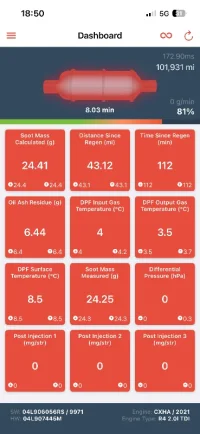
Updated screenshot with the van ticking over on cold start.
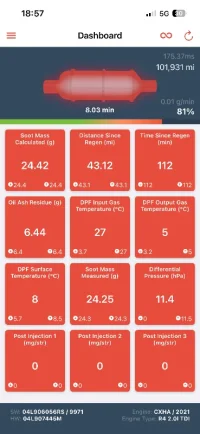
So I have driven the van a few times since last post on mix of journeys. The soot level seems to increase quickly between 15g - 25-28g at lower speeds. It does triggers regen and lower back to 8g and then resets but on slow roads around the Lake District it regen’d every 120mins even though only 30-35mile had been driven. Couple of examples from the DPF app.
Has anyone had this before? Wondering if a sensor is on it way out. The DPF has been cleaned by previous owner but assume no sensor have been replaced.
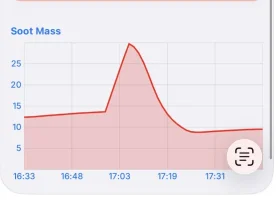
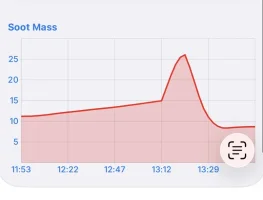
Has anyone had this before? Wondering if a sensor is on it way out. The DPF has been cleaned by previous owner but assume no sensor have been replaced.

Similarities below?Has anyone had this before?

Clogged DPF - indicated by Soot Mass Measured value being much higher than Soot Mass Calculated.why Regens might happen more often than not
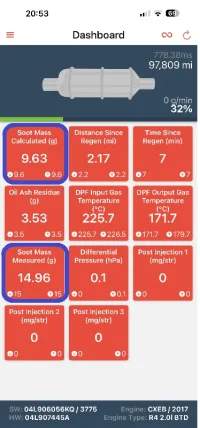

Please post VCDS engine blockmap files - please turn off the Stop/Start
1) ignition ON/engine off
2) cold engine idling
3) hot engine idling (after a minimum of 20+ minute journey
How-to create a blockmap file:
Note: only VCDS HEX-V2 or HEX-NET cables have the capability
Ignition ON
[VCDS]
[Applications]
[Controller Channel Map]
- Single Controller Address = 01
- Login or security access code: Leave blank
- Function: Measuring values
- Output: CSV file
[Go]
The result files (.csv) are saved into directory C:\Ross-Tech\VCDS\Logs
This is a screenshot of when the van was warm and idling. The soot mass calculated and measured are a similar amount unlike the other post. The DPF it self is clean in the tip with no soot present when I checked so I believe it’s working
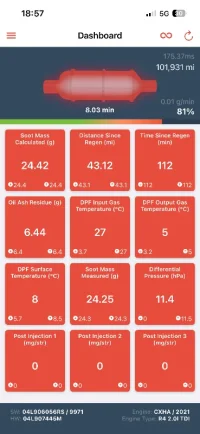
Apologies for inaccurate wording. I think your case is exactly the same - the calculated have "jumped up" to match the measured, hence they look now the same.The soot mass calculated and measured are a similar amount unlike the other post.
Please check thw post below - hopefully it explains better.
Hmmm.... looks like the log is an earlier one as it stops at 238907 km.
Thanks for sharing - very intriguing data!
Anyways, the same phenomena can be seen - e.g. below from 238579 km to 238763 km = 184 km, 2 hours.
Plotted the two soot mass parameters (calculated & measured) which are used by ECU to monitor and trigger DPF regeneration.
Normally "soot calculated" (blue) is the dominant one. Here it's a kind of opposite. As soon as "soot measured" reaches the DPF regeneration trigger level (30 grams) also the "calculated" is jumped to 30 grams which then forces the DPF regeneration to...
Thanks for sharing - very intriguing data!
Anyways, the same phenomena can be seen - e.g. below from 238579 km to 238763 km = 184 km, 2 hours.
Plotted the two soot mass parameters (calculated & measured) which are used by ECU to monitor and trigger DPF regeneration.
Normally "soot calculated" (blue) is the dominant one. Here it's a kind of opposite. As soon as "soot measured" reaches the DPF regeneration trigger level (30 grams) also the "calculated" is jumped to 30 grams which then forces the DPF regeneration to...
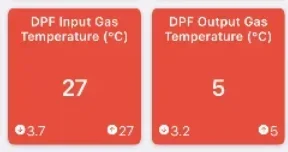
Hmmm... looks to me more like a cold engineThis is a screenshot of when the van was warm and idling.

Please post the engine blockmap files.
Thank you for the info, I will post the block maps over the weekend.
Hi @mmi
I've attached the blockmap files as requested.
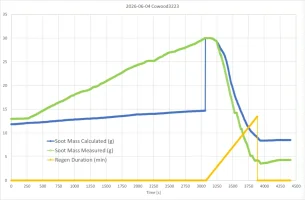
Whilst I was out in the van getting up to temp, I monitored the VAG DPF app and notice the soot mass measured was rising twice speed as the soot mass calculated. Once soot mass measured hit 30g the soot mass calculated jumped from 14.55g to 30g and regen started.
When the regen was taking place the soot mass measured dropped quickly stopping at 4g whilst the soot mass calculated dropped steadily down to 9g and then the regen completed.
Could this be a sensor on it way out rather than dpf damaged or blockage? I have attached the export from the VAG DPF app which shows the jump.
I've attached the blockmap files as requested.
Whilst I was out in the van getting up to temp, I monitored the VAG DPF app and notice the soot mass measured was rising twice speed as the soot mass calculated. Once soot mass measured hit 30g the soot mass calculated jumped from 14.55g to 30g and regen started.
When the regen was taking place the soot mass measured dropped quickly stopping at 4g whilst the soot mass calculated dropped steadily down to 9g and then the regen completed.
Could this be a sensor on it way out rather than dpf damaged or blockage? I have attached the export from the VAG DPF app which shows the jump.
Attachments
-
DPFMonitorForVAG-DataExport-2026-06-04T184320.819Z.csv1.4 MB · Views: 1
-
blockmap-01-04L-906-056-RS_WV1ZZZ7HZMH003679-20260604-1642 - Copy.CSV155.5 KB · Views: 5
-
blockmap-01-04L-906-056-RS_WV1ZZZ7HZMH003679-20260604-2112.CSV155.7 KB · Views: 5
-
blockmap-01-04L-906-056-RS_WV1ZZZ7HZMH003679-20260604-1642.CSV155.5 KB · Views: 7
Also looking at the DPF differential pressure it seems very high and erratic jumping from 83 hpa to 462 hpa in the space of 6 second whilst the soot measure were around 18g and soot calculated 13g.
Thanks. It seems the COLD ENGINE IDLING blockmap is missing, instead the HOT ENGINE IDLING was duplicated.Hi @mmi
I've attached the blockmap files as requested.
Anyways, the DPF differential sensor reported plausible values - engine stopped close to zero. Hot engine idling was 11.2 mbar/hPa which is a bit on high side I believe (immediately after DPF regen, already cooled exhausts).
A data plot of the above. Indeed the soot measured (green) takes the controls and triggers the regen well before the soot calculated would have done.Whilst I was out in the van getting up to temp, I monitored the VAG DPF app and notice the soot mass measured was rising twice speed as the soot mass calculated. Once soot mass measured hit 30g the soot mass calculated jumped from 14.55g to 30g and regen started.
When the regen was taking place the soot mass measured dropped quickly stopping at 4g whilst the soot mass calculated dropped steadily down to 9g and then the regen completed.
Also looking at the DPF differential pressure it seems very high and erratic jumping from 83 hpa to 462 hpa in the space of 6 second whilst the soot measure were around 18g and soot calculated 13g.
DPF differential pressure indeed does change fast because it reflects exhaust flow which do change rapidly - e.g. foot on throttle/foot off. Below an example sampled at 10 Hz rate. Didn't manage to get more than about 130 mbar of differential pressure.
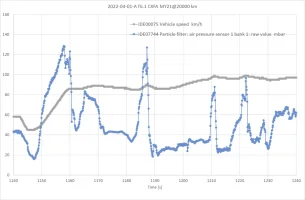
Also a plot of DPF soot calculated/measured behaviour on a T6.1 CXFA engine on a two-hour journey. Soot measured stays well below soot calculated.
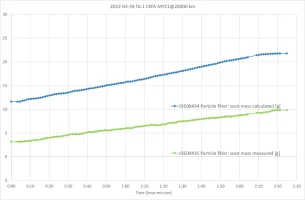
[EDIT]
Found a recording across a DPF regeneration on a T6.1 CXFA engine - of MIN/MAX values
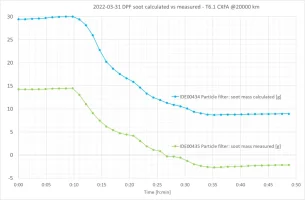
Last edited:
Hi @mmi
Apologises I've attached a new block map file of cold engine idling
Thank you for the plotting the information, from what I can understand, the issue is a related to pressure so the DPF is likely to be blocked or damaged when the previous owner had it cleaned.
If it is blocked, I am wondering what has caused it, clogged EGR valve or leaky injectors just don't want to pull the trigger on new DPF without finding the cause as something must have caused it to block.
Unless the previous owner did a lot of short journeys and didn't allow it regen
Apologises I've attached a new block map file of cold engine idling
Thank you for the plotting the information, from what I can understand, the issue is a related to pressure so the DPF is likely to be blocked or damaged when the previous owner had it cleaned.
If it is blocked, I am wondering what has caused it, clogged EGR valve or leaky injectors just don't want to pull the trigger on new DPF without finding the cause as something must have caused it to block.
Unless the previous owner did a lot of short journeys and didn't allow it regen
Attachments
This is a bit confusing as 11.2 mbar is not too far from normal, however at 17 mbar I have noticed l noticed issues arising.Hot engine idling was 11.2 mbar/hPa which is a bit on high side I believe
@Cowood3223 could you please make a VCDS log - I'm interested to see the DPF process more closely.
Please set up data recording of the following:
Ignition ON
VCDS > Select > 01-Engine > Adv. Meas. Values
Tick data items
IDE00021 Engine speed
IDE00075 Vehicle speed
IDE00347 Air mass: actual value:
IDE00434 Particle filter: soot mass calculated
IDE00435 Particle filter: soot mass measured
IDE04090 Exhaust temperature bank 1
IDE07738 Charge air cooler inlet: pressure sensor 1 bank 1: raw value
IDE07744 Particle filter: air pressure sensor 1 bank 1: raw value
IDE07757 Exhaust recirc.valve 1 bank 1: posit.feedback - Actual value
IDE08340 Particle sensor: measuring current calculated
IDE08721 Particle sensor: time in op. mode measurement
IDE10817 Lambda value at inlet of particulate filter
Tick Log > filename > Start (the logging - IMPORTANT!!!)
- wait 10 seconds
- let engine idle 10-15 seconds before setting off, for the journey turn off the Stop/Start (if possible) to prevent engine stopping
- ideally would need more than 30 minutes to capture all DPF process phases (e.g. soot detection).
at the end of journey:
- let engine idle 30 seconds, turn on Stop/Start - should stop the engine, if not turn ignition off and back on
- keep recording on for 10 seconds engine stopped
Thanks!
Unfortunately, it seems that unfortunately the DPF is clogged - based on DPF pressure readings.
Of course a sensor giving erroneous readings is a possibility. You could use a hand pump to compare readings of the pump and VCDS. The sensor reports "zero" correctly when engine is stopped. 300-400 mbar would be a good test pressure (now was observed 382 mbar).
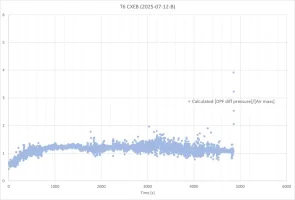
Anyways, calculated a kind of normalised figure to estimate DPF condition - DPF pressure/air mass - would give a fairly constant number over large range of engine operation. Higher number = higher pressure loss in the DPF. Varying EGR rate of course puts in some scattering.
In average 2.82 (engine running)
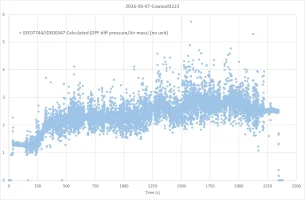
For comparison a log of mine
In average 1.15
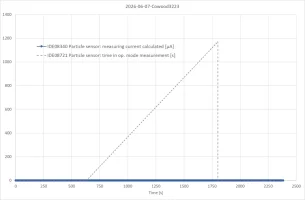
Also in the data no soot was detected.. Dashed line indicates when the soot detection process was active .
Unfortunately, it seems that unfortunately the DPF is clogged - based on DPF pressure readings.
Of course a sensor giving erroneous readings is a possibility. You could use a hand pump to compare readings of the pump and VCDS. The sensor reports "zero" correctly when engine is stopped. 300-400 mbar would be a good test pressure (now was observed 382 mbar).
Correct - it's too high at those conditions = exhaust gas temperatures in/out DPF slightly above 200 °CI spotted that when idling when I got back the DPF pressure sat at 19hpa
Anyways, calculated a kind of normalised figure to estimate DPF condition - DPF pressure/air mass - would give a fairly constant number over large range of engine operation. Higher number = higher pressure loss in the DPF. Varying EGR rate of course puts in some scattering.
In average 2.82 (engine running)
For comparison a log of mine
In average 1.15
The DPF it self is clean in the tip with no soot present when I checked so I believe it’s working
Also in the data no soot was detected.. Dashed line indicates when the soot detection process was active .
Similar threads
- Replies
- 7
- Views
- 639

- Replies
- 2
- Views
- 255

- Replies
- 15
- Views
- 620

