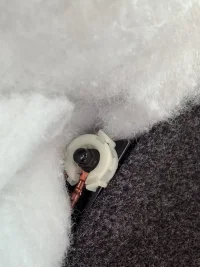
Sorry. Can I just double check. Can I take the earth wire from my electric hookup to this?
View attachment 318774
yes, thats a standard chassis earth.
follow this guide. . .
Unravel the mysteries of campervan wiring regulations! This straightforward guide simplifies the essentials to ensure your campervan wiring system is safe.

vandercampadventures.com
++++++++++++++++++++++++++++++++++++++++++++++++++++++++++++++++++++++++
8. Earthing And Bonding
What do we mean when we refer to earthing and bonding?
What Is Earthing?
‘Earthing’ refers to the earth wires in a cable, such as a 3-core flex. These wires connect sockets, lights and accessories to the main earth terminal (MET). To ensure appliances and exposed conductive parts are earthed.
What Is Bonding?
‘Bonding’ on the other hand, involves using single-core green/yellow wires to connect various parts together. This is also known as equipotential bonding. The aim is to connect exposed metal parts (extraneous and exposed conductive parts) together so they form a continuous bonded system.
8.1 – All bonding conductors must be
at least 4mm².
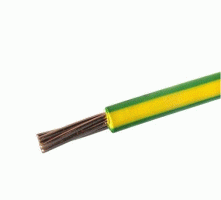 4mm Earth Cable
8.2 –
4mm Earth Cable
8.2 – The
chassis of the campervan must be bonded using a bonding cable that is at least 4mm². This cable should be connected to the main earth terminal (MET), where all the installation earths connect. The MET is typically inside the consumer unit but can be a separate terminal. It’s crucial to ensure that the chassis bond is accessible for inspection and maintenance, so it shouldn’t be installed behind boarding, furniture, or hidden under the van. The chassis bond must be touching the bare metal to ensure a good connection, and then it must be protected from corrosion using rust/corrosion protection paint/spray.
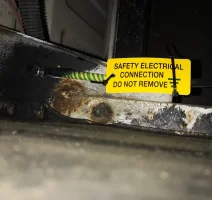
Chassis Bond
8.3 – It’s also important to note that the AC and DC chassis bonds must have a
separate chassis bond connection. They should have two separate chassis bonding points. This is to prevent any potential electrical hazards.
8.4 – Finally, bonding cables must be installed from the main earth terminal onto all
exposed and extraneous conductive parts.
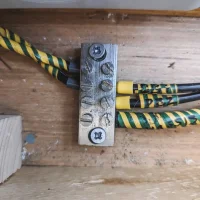
Main Earthing Terminal (MET) with chassis, fuseboard and bonding conductors connected to it.
Exposed Conductive Parts
Exposed conductive parts refer to the conductive parts of equipment that can be touched and are not normally live but can become live under fault conditions.
Examples are metal casings of electrical equipment like inverters, DC-DC chargers, solar chargers, metal sockets, etc.
Extraneous Conductive Parts
Extraneous conductive parts, on the other hand, are conductive parts that are liable to become live but are not part of the electrical installation.
Examples are copper gas pipes, metal sinks, hobs, etc.
.