
You are using an out of date browser. It may not display this or other websites correctly.
You should upgrade or use an alternative browser.
You should upgrade or use an alternative browser.
Adblue quality Vs price, is it all the same?
- Thread starter StratosFearXX
- Start date

Buy from the pump, less chance of crystal build up

Crumbs, yes 2017 MK4 2 litre. Will check with garage and son, it was down to about 1200 miles last time I saw it, garage said 10 litres put in, do you mean 5 litres to fill it?Presume it’s a 2.0 mk4 Caddy?
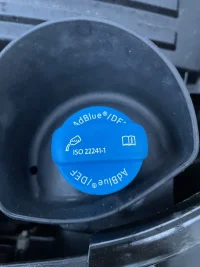
Adblue must be iso 22241-1 a lot of adblue is just iso 22241.
It would only take a maximum 5 litres if it was showing that it was low, warning comes on at 1500 miles remaining & takes 5 litres.
Yes, the warning comes on at 1500 miles remaining & it tells you how much it needs to fill the tank.
I can take a photo of mine tomorrow if you want as it’s on 1400 miles remaining, I only use Redex iso 22241-1.
There are many debates on the Caddy forum that overfilling the tank can damage the sensor but not sure if that is correct.
I can take a photo of mine tomorrow if you want as it’s on 1400 miles remaining, I only use Redex iso 22241-1.
There are many debates on the Caddy forum that overfilling the tank can damage the sensor but not sure if that is correct.
Yes photo please, and I'll get my son to get one as well, many thanks.Yes, the warning comes on at 1500 miles remaining & it tells you how much it needs to fill the tank.
I can take a photo of mine tomorrow if you want as it’s on 1400 miles remaining, I only use Redex iso 22241-1.
There are many debates on the Caddy forum that overfilling the tank can damage the sensor but not sure if that is correct.

I used to do that at the Shell near the M1. It was 78p a few months ago bargain. Then I went the other week as I was passing, waited ages behind an HGV then when I got to the pump it had gone up to £2 per litre. The UK just loves to rip people off. Anyway, it was £10 for a tub at ALDI and another big plastic container on its way to landfill.I fill up at the local truck stop from their pump - That way I can just add the requested amount, it is about 1/2 the price of buying a 10 litre container, and a lot less faffing around.

Unless i have mis understood this the 22241-1 (the -1 bit) is just one of 4 criteria that Adblue must meet to have its 22241 specification ?
If you see “ISO 22241” on an AdBlue specification, it means the product has met stringent requirements designed to keep SCR systems operating correctly and to ensure that NOx emissions are reduced as intended.
The ISO 22241 standard is divided into four parts:
At Fleetmaxx Solutions, every batch of FleetBlue AdBlue we manufacture in the UK undergoes strict, documented laboratory testing. This ensures consistency, stability, and compliance before the product goes into any Fleetmaxx-branded container.
Together, these four sections ensure that AdBlue can do its job without causing unintended damage.
Understanding ISO 22241
ISO 22241 is the international standard that governs the manufacture, chemical composition, testing, handling and refilling systems for AdBlue (also known chemically as Diesel Exhaust Fluid, or DEF).If you see “ISO 22241” on an AdBlue specification, it means the product has met stringent requirements designed to keep SCR systems operating correctly and to ensure that NOx emissions are reduced as intended.
The ISO 22241 standard is divided into four parts:
ISO 22241-1 — AdBlue Quality Requirements
This is the core of the entire standard. ISO 22241-1 specifies the exact chemical purity needed to protect an SCR system:- 32.5% high-purity automotive-grade urea
- 67.5% demineralised water
- Extremely low levels of impurities
- Strict limits on metal ions such as iron, copper, zinc and calcium
ISO 22241-2 — Test Methods
This section outlines the specific laboratory processes required to verify that a batch of AdBlue meets ISO 22241-1.At Fleetmaxx Solutions, every batch of FleetBlue AdBlue we manufacture in the UK undergoes strict, documented laboratory testing. This ensures consistency, stability, and compliance before the product goes into any Fleetmaxx-branded container.
ISO 22241-3 — Handling, Transportation and Storage
Even if AdBlue is produced correctly, contamination can occur if handling procedures are poor. ISO 22241-3 covers:- Approved transport containers
- Protection against heat and sunlight
- Strict cleanliness requirements
- Avoiding contact with metals
- Preventing exposure to dust, oils or chemicals
ISO 22241-4 — Refilling Interface
This part covers the design of vehicle filling points, nozzles, connectors, and the equipment used to transfer AdBlue into SCR systems. Its purpose is simple: prevent contamination at the point of use.Together, these four sections ensure that AdBlue can do its job without causing unintended damage.
Why ISO 22241 compliance matters
1. Protecting SCR systems
SCR components are extremely sensitive. The catalyst alone can cost thousands to replace. Non-compliant AdBlue can contain metals or minerals that deposit onto the SCR surface, reducing its ability to convert NOx and eventually causing complete failure. ISO 22241 minimises that risk.2. Avoiding downtime and breakdowns
Most fleet operators underestimate how many AdBlue-related issues stem from contamination. Injector blockages, NOx sensor faults, crystallisation and dashboard warnings often trace back to poor-quality fluid. Using AdBlue that meets ISO 22241 keeps your vehicles operational and avoids costly workshop time.3. Maintaining Euro 6 compliance
SCR systems rely on consistent AdBlue quality to reduce nitrogen oxide emissions. If the fluid isn’t to ISO 22241 standard, the system cannot meet Euro 6 limits — which can in turn trigger derates, limp-home modes or legal non-compliance.4. Consistent vehicle performance
ISO-compliant AdBlue ensures that:- dosing rates are accurate
- freezing and thawing performance is stable
- fluid density is correct
- there are no unexpected sensor errors
5. Protecting manufacturer warranties
Vehicle manufacturers are very clear: damage caused by non-compliant AdBlue is not covered under warranty. Using fully ISO 22241-approved AdBlue eliminates that risk.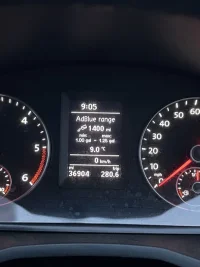

2017 MK4 2 litre.
A quote from VW Service Training - Self-study programme 560 - The Caddy 2016
Filling the tank for reducing agent
In addition to the fuel tank with a capacity of about 55 litres (front-wheel drive), there is also a reducing agent tank with a capacity of about 9 litres in the engine compartment. This capacity achieves a range of about 6000 km.
The tank for reducing agent is replenished via a filler connection in the engine compartment at the front left out of replenishment containers, and is closed by a blue tank cap.
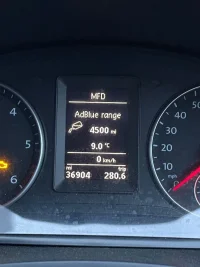
Adblue tank is 9l capacity but you will never reach that level. Your van will not start because the warning comes on with 1500 miles remaining which requires 5l to fill up & reset to 4500 miles.
I have done a lot of research on this subject as I had trouble with my caddy, there is some really good information & findings on the caddy forum.
I hope this helps.
I have done a lot of research on this subject as I had trouble with my caddy, there is some really good information & findings on the caddy forum.
I hope this helps.
I have a lot to learn! Thank you everyone, will report back.
Many thanks for all the info.Adblue tank is 9l capacity but you will never reach that level. Your van will not start because the warning comes on with 1500 miles remaining which requires 5l to fill up & reset to 4500 miles.
I have done a lot of research on this subject as I had trouble with my caddy, there is some really good information & findings on the caddy forum.
I hope this helps.
Caddy2k.com?
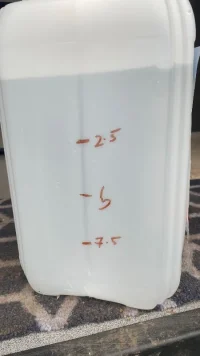
Just done mine. It wanted about 7.5 litres.Just wondering what you guys measure it out of the 10l containers, or do you wait until it asked for that amount?
This is what I do as it’s a rough range not an exact amount. I’d normally top it up around the 5 litre mark, but kept forgetting.
Your council doesn’t give you a recycling bin?another big plastic container on its way to landfill.
Yes it does, but Kirklees is amongst the worst councils in the UK with a recycling rate of about 20%, although their data is about 3 years out of date. I really don't trust them to actually recycle much.Your council doesn’t give you a recycling bin?
Edit : 26% in 2021/22. They have mixed collection recycling in one bin and no glass recycling. Consequently they have one of the highest rejection rates in the UK. So my guess is anything with the 'wrong' recycling bin just goes to landfill. It's a shockingly run council.
I'll say that again - NO GLASS recycling in place. We take ours to the local supermarket glass bin, but most don't.
Last edited:

Certainly in Barnsley, the whole recycling system is a sham. We used to have a grey/brown/blue & green bin, and everything got separated on pain of a snotty sticker and a fine. Just after COVID, the council took away our rainbow bins, along with those of the neighbouring farm and gave us a single communal bulk bin at the end of the track that serves our house. They removed our “doorstep” collection and made it a “kerbside” collection, which means that we have to take our rubbish 1/2 a mile up the lane to the roadside. When I queried the fact that all the rubbish from 3 households was now just being tipped randomly into one bin, and not being separated, the official response from the council was “Oh, it’s ok, it all goes to the same place and gets sorted”Your council doesn’t give you a recycling bin?

Just topped mine up with the £10 b&q stuff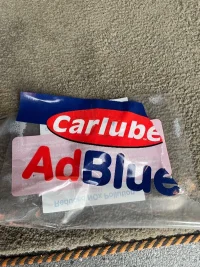
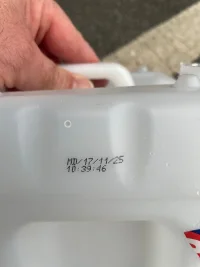 The garage wanted £25 for 10 litres and it was a old manky looking bottle, didn’t look for a manufactured date on that but on the b&q stuff said November 2025 and branded so happy with that for a tenner. Now up to 5000 miles again!
The garage wanted £25 for 10 litres and it was a old manky looking bottle, didn’t look for a manufactured date on that but on the b&q stuff said November 2025 and branded so happy with that for a tenner. Now up to 5000 miles again!
Our authority, Calderdale (which neighbours Kirklees), had a recycling figure for 2021/22 of 51.2% and "sends very little waste to landfill".Your council doesn’t give you a recycling bin?
Apparently this places them in the top 10 nationally, which speaks volumes as to how poor we are as a nation at recycling.
I always try and leave the packaging with the supplier (they supplied it their problem to dispose!) filled up at b&q and left the waste with them (they had recycling bins in the car park although not actually big enough to take the bottle it was left next to it)
To be fair that is probably more effective than letting most the general public work out what to do even when you give them simple text and pictures to go on.was “Oh, it’s ok, it all goes to the same place and gets sorted”
I’ve worked at places that outsource waste sorting like this, I know someone that owns such a company plus I’ve visited a plant that sorts waste too. It does work quite well. Lot of it is still done by hand using cheap labour but the big companies have some amazing machines that use all sorts of processes to sort waste. When I saw it it was before AI got involved too much too.
Similar threads
- Replies
- 42
- Views
- 6K


- Replies
- 23
- Views
- 6K


- Replies
- 7
- Views
- 4K

- Replies
- 13
- Views
- 6K
