I just need a bit of clarification connecting my Dual DC to DC & MPPT Controller to the vehicle battery. I have run a 16mm cable through a 60A fuse from the positive terminal to the DC to DC. I have been given conflicting info regarding the negative. Can that go to ground or does that also need to go the charger? I have also been advised to run an ignition live to the Dual DC to DC & MPPT Controller. Does all this sound about right?

You are using an out of date browser. It may not display this or other websites correctly.
You should upgrade or use an alternative browser.
You should upgrade or use an alternative browser.
Wiring Dual DC to DC & MPPT Controller
- Thread starter dean1971
- Start date
I would run a positive and negative cable to the dc/dc charger from van battery. It would eliminate any bad connection problems. The dc/dc charger should pick up a change in voltage when you start the engine I don't think you would need an ignition live. I have the victron dc/dc charger and that has the factory settings for all that also the victron dc/dc charger specifies different units that need a separate negative conductor and there's a link for the ignition live so I just left that in and it works fine.
I would run a positive and negative cable to the dc/dc charger from van battery. It would eliminate any bad connection problems. The dc/dc charger should pick up a change in voltage when you start the engine I don't think you would need an ignition live. I have the victron dc/dc charger and that has the factory settings for all that also the victron dc/dc charger specifies different units that need a separate negative conductor and there's a link for the ignition live so I just left that in and it works fine.
Running a separate negative cable with the positive cable from the starter battery to the input of the DC-DC isn't a great idea. For one thing, the resistance of your cable is far higher than the van chassis so you are increasing the voltage drop for no good reason. Another reason is that you can't hook it up to the actual negative terminal of the starter anyway because bypassing the shunt like this seriously messes up the starter charging logic - given this you're going to end up connecting to the chassis anyway so you may as well hook it up to the chassis somewhere convenient near to the DC-DC itself.
I forgot to add I'd also connect the negative to the chassis this would eliminate any poor chassis connections, as far as voltage drop. I'd presume you would use the same length and size negative conductor as positive so it won't make any difference because the resistance of the 2 conductors would be the same. Also you can purchase different victron units that specifies a direct separate negative conductor or a chassis negative, technology has come a long way in the 20th century you can even get an app on your phone to control the inputs and outputs hiw wonderful is thatRunning a separate negative cable with the positive cable from the starter battery to the input of the DC-DC isn't a great idea. For one thing, the resistance of your cable is far higher than the van chassis so you are increasing the voltage drop for no good reason. Another reason is that you can't hook it up to the actual negative terminal of the starter anyway because bypassing the shunt like this seriously messes up the starter charging logic - given this you're going to end up connecting to the chassis anyway so you may as well hook it up to the chassis somewhere convenient near to the DC-DC itself.
Anyway that's how I'd do it

I forgot to add I'd also connect the negative to the chassis this would eliminate any poor chassis connections, as far as voltage drop. I'd presume you would use the same length and size negative conductor as positive so it won't make any difference because the resistance of the 2 conductors would be the same. Also you can purchase different victron units that specifies a direct separate negative conductor or a chassis negative, technology has come a long way in the 20th century you can even get an app on your phone to control the inputs and outputs hiw wonderful is that
Anyway that's how I'd do it
Yes, Victron do an isolated version of their DC-DC units although I can't think of a scenario where you'd need this in a van setup. On the voltage drop, I'm afraid the drop accrues over both the positive and negative runs so they would sum - it's why online voltage drop calculators often double the length you put in on the assumption that you have a run there and back. By using the vehicle chassis you substitute the resistance of the negative cable run with the (much lower) resistance of the chassis itself. I'm not sure exactly what you mean by 'also' connecting to the vehicle chassis but, assuming you have a good connection to the chassis, the return negative cable run to the starter would be superfluous.
Iol voltage drop does not accrue pmsl let's say your connection to the chassis became loose then you would have a high resistance connection a possible fire hazard if you had a separate negative conductor this would not be the case because you would still have a solid return path for current to flow. Presumably you have the correct protection devices in placeYes, Victron do an isolated version of their DC-DC units although I can't think of a scenario where you'd need this in a van setup. On the voltage drop, I'm afraid the drop accrues over both the positive and negative runs so they would sum - it's why online voltage drop calculators often double the length you put in on the assumption that you have a run there and back. By using the vehicle chassis you substitute the resistance of the negative cable run with the (much lower) resistance of the chassis itself. I'm not sure exactly what you mean by 'also' connecting to the vehicle chassis but, assuming you have a good connection to the chassis, the return negative cable run to the starter would be superfluous.
Iol voltage drop does not accrue pmsl let's say your connection to the chassis became loose then you would have a high resistance connection a possible fire hazard if you had a separate negative conductor this would not be the case because you would still have a solid return path for current to flow. Presumably you have the correct protection devices in place
Maybe reading the link below would be helpful. It explains that voltage does, in fact, sum across both the positive and negative connections and even explains explicitly that this can be reduced by connecting directly to chassis:
Voltage Drop Calculator | 12 Volt Planet Cable Calculator
Use our Voltage Drop Calculator to select the correct Cable for your campervan, motorhome or boat wiring application. Cable Calculator for Auto and Marine Electrical Components from 12 Volt Planet - Cable Size Calculator
www.12voltplanet.co.uk
Your redundancy argument is both technically correct and also patently ridiculous. Are you proposing that for every connection in your van you run two cables just in case? Maybe two steering wheels in case one develops a fault?
I appreciate you are a new poster here, but this stuff has been done to death over hundreds of post as a cursory search will reveal. I'm sure you have a lot to contribute, but starting off with dubious advice on electrics probably isn't the way to go.
I'm not here for a debateMaybe reading the link below would be helpful. It explains that voltage does, in fact, sum across both the positive and negative connections and even explains explicitly that this can be reduced by connecting directly to chassis:
Voltage Drop Calculator | 12 Volt Planet Cable Calculator
Use our Voltage Drop Calculator to select the correct Cable for your campervan, motorhome or boat wiring application. Cable Calculator for Auto and Marine Electrical Components from 12 Volt Planet - Cable Size Calculatorwww.12voltplanet.co.uk
Your redundancy argument is both technically correct and also patently ridiculous. Are you proposing that for every connection in your van you run two cables just in case? Maybe two steering wheels in case one develops a fault?
I appreciate you are a new poster here, but this stuff has been done to death over hundreds of post as a cursory search will reveal. I'm sure you have a lot to contribute, but starting off with dubious advice on electrics probably isn't the way to go.
I've explained why I'd use a separate negative conductor and my reasons why
I'm not interested if you agree or disagree
This is how I've done my install
Dubious advice??
I haven't given any dubios advice. I simply stated how I did my van and my reasons, when questioned.
If this upsets you, for you to start a debate with me. That's not my problem.
I've stated electrical facts not fictitious nonsense.
I'm not here for a debate
I've explained why I'd use a separate negative conductor and my reasons why
I'm not interested if you agree or disagree
This is how I've done my install
Dubious advice??
I haven't given any dubios advice. I simply stated how I did my van and my reasons, when questioned.
If this upsets you, for you to start a debate with me. That's not my problem.
I've stated electrical facts not fictitious nonsense.
That's fine, your negative cable run isn't going to actively hurt other than a bit of extra voltage drop, but it's certainly not best practice so it's worth making the OP, and others reading this, aware of that before everyone starts running extra negative cables around the place. I'm assuming it's actually attached to the chassis somewhere around the starter battery and you haven't actually attached it directly to the starter negative terminal - then you actually would have a problem.
If you read what I stated, I've explained how I connected my dc/dc chargerThat's fine, your negative cable run isn't going to actively hurt other than a bit of extra voltage drop, but it's certainly not best practice so it's worth making the OP, and others reading this, aware of that before everyone starts running extra negative cables around the place. I'm assuming it's actually attached to the chassis somewhere around the starter battery and you haven't actually attached it directly to the starter negative terminal - then you actually would have a problem.
I haven't indicated to run separate negative conductors all over the place or connect it to the alternater negative. Your making a mountain out of a mole hill and presuming I've suggested you cut a hole in the van floor for better air flow.
Take your time and read what I said it might benefit you.

You seem to have nailed it. Negs to nearest chassis earth point, and an ignition/engine run signal live. Could you just clarify “Dual DC to DC & MPPT controller” though? Which unit is this. Is it a combined “all in one” box? Normally the MPPT controller doesn’t involve the vehicle battery or an ignition live. It’s purely between the solar and LB.I just need a bit of clarification connecting my Dual DC to DC & MPPT Controller to the vehicle battery. I have run a 16mm cable through a 60A fuse from the positive terminal to the DC to DC. I have been given conflicting info regarding the negative. Can that go to ground or does that also need to go the charger? I have also been advised to run an ignition live to the Dual DC to DC & MPPT Controller. Does all this sound about right?
SR-MD1250N05 SRNE MD1250 Dual DC to DC & MPPT Controller. SRNE MD1250 Dual DC to DC & MPPT ControllerYou seem to have nailed it. Negs to nearest chassis earth point, and an ignition/engine run signal live. Could you just clarify “Dual DC to DC & MPPT controller” though? Which unit is this. Is it a combined “all in one” box? Normally the MPPT controller doesn’t involve the vehicle battery or an ignition live. It’s purely between the solar and LB.
That’s a new oneSR-MD1250N05 SRNE MD1250 Dual DC to DC & MPPT Controller. SRNE MD1250 Dual DC to DC & MPPT Controller


Neg goes to the closest ground, IE chassis point.I just need a bit of clarification connecting my Dual DC to DC & MPPT Controller to the vehicle battery. I have run a 16mm cable through a 60A fuse from the positive terminal to the DC to DC. I have been given conflicting info regarding the negative. Can that go to ground or does that also need to go the charger? I have also been advised to run an ignition live to the Dual DC to DC & MPPT Controller. Does all this sound about right?
As the vans bodywork is the best return path back for the power.
POS needs to go direct from the starter battery via a fuse, (fuse located as close to the battery as possible)
That's the way it's done in boats and caravans as they do don't have a metal chassis...I would run a positive and negative cable to the dc/dc charger from van battery. It would eliminate any bad connection problems. The dc/dc charger should pick up a change in voltage when you start the engine I don't think you would need an ignition live. I have the victron dc/dc charger and that has the factory settings for all that also the victron dc/dc charger specifies different units that need a separate negative conductor and there's a link for the ignition live so I just left that in and it works fine.
In a T6 van with metal body work, the chassis is best used for the neg return.
Last edited:
Looks like that company are resellers.SR-MD1250N05 SRNE MD1250 Dual DC to DC & MPPT Controller. SRNE MD1250 Dual DC to DC & MPPT Controller
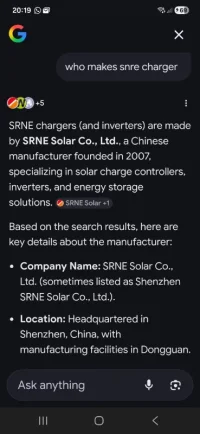
Snre is a Chinese clone charger company.
Yep concur, no huge ground plane on a boat so lots of negative wires. Lets not get into the need for anodes (lumps of zinc bolted to hull) lol.That's the way it's done in boats and caravans as they do don't have a metal chassis...
In a T6 van with metal body work, the chassis is best used for the neg return.
SR-MD1250N05 SRNE MD1250 Dual DC to DC & MPPT Controller. SRNE MD1250 Dual DC to DC & MPPT Controller
That’s quite an interesting unit, it’s got a higher max solar voltage than most combined units and reverse trickle charge for the starter too by the look of it. It’ll be interesting to hear peoples real life experience of it.
My whole electric system is SRNE and it looks great. Half the price of Victron this is website where they have all the other stuff. They do provide Vicron stuff too Lithium Batteries solutions for Home & Campervan Power Systems (UK)That’s quite an interesting unit, it’s got a higher max solar voltage than most combined units and reverse trickle charge for the starter too by the look of it. It’ll be interesting to hear peoples real life experience of it.
Similar threads
- Replies
- 0
- Views
- 394

- Replies
- 8
- Views
- 847

- Replies
- 6
- Views
- 1K
- Replies
- 15
- Views
- 1K
