Rough idle / potential misfire after EGR replacement, probable causes? VCDS logging approach?

Small world! I saw the corrupted table so replaced it with an image instead.

Good point about the injection speeds! I didn't realised that's what was being measured.

A good point also about the lack of original files! I forgot to check the CSV box, so it's outputted as an Excel file. Problem?
 

Attachments

  • Like
Reactions: mmi
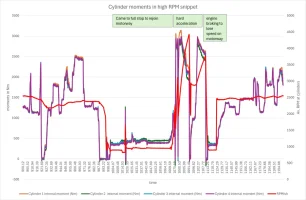
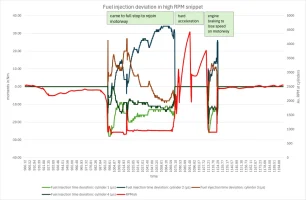
Interesting. So with the new information (that I had also recorded RPM via the cylinders!!) there is quite a different picture.

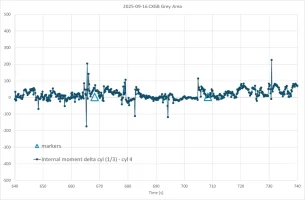
There is no deviation under hard acceleration, but quite a lot of deviation when idling (I had to wait for a minute or so to rejoin to motorway from a dead stop. I decided to accelerate hard to test that, which meant I caught the other traffic quite fast and had to let the engine slow itself down by lifting my foot off the accelerator.)

It's fun to play with the data, but I think I'll need to apologise if I'm posting nonsense.

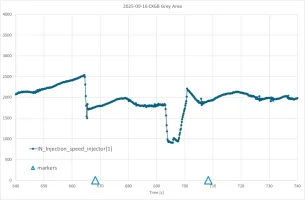
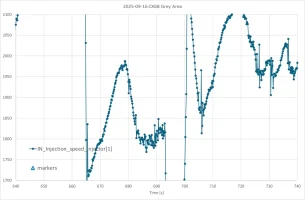
Injection deviations at high RPM snippet.png

Cylinder moments at high RPM snippet.png
 
  • Like
Reactions: mmi
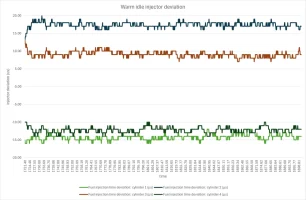
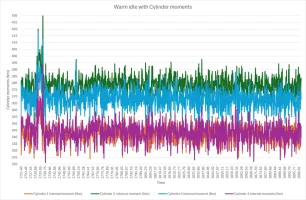
Also seeing this on warm idle for three minutes after a journey:
warm Idle injector dev.webp


warm Idle moments.webp


I think the cylinders are generally paired in how they work... so it kinda looks like &4 are pretty close at idle in terms of cylinder moments, generally within a few Nm on average. 1&4 are close in injector time deviation too - around 3 micoseconds variation. 2&3 are notably further apart in terms of cylinder moments. Around 10Nm on average.2&3 are up to 10 microseconds apart in injector time deviation.

So perhaps the coolant ingress cooked injector 2 or screwed with cylinder 2?
 
There is no deviation under hard acceleration, but quite a lot of deviation when idling
The deviation falls back to zero when RPM climbs above 1300 - thus I'm not sure if there is anything useful available.
 
The deviation falls back to zero when RPM climbs above 1300 - thus I'm not sure if there is anything useful available.
With a bent rod the compression ignition is affected at idle RPM until increased RPM increases boost pressure and cylinder pressure thus correcting compression ignition?
 
engine wobble at 1200rpm
Is it still present?

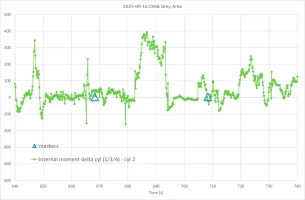
Perhaps we can isolate "problematic" sections e.g. as below -

1) Calculated average of internal moments of cylinders 1, 3, 4 (presumably good) and subtracted by moment of cylinder 2 (suspicious)

1758055588873.png

So what was done after marker 3?

1758056029707.png

2) For comparison calculated average of cylinders 1, 3 (good) and subtracted by cylinder 4 (good) - would expect less variation as all good ones?

1758055645879.png
 
Calculated average of internal moments of cylinders 1, 3, 4 (presumably good) and subtracted by moment of cylinder 2 (suspicious)
This is an ingenious approach!

So what was done after marker 3?
Between markers 3 and 4 I was trying to get the engine to perform poorly. This involved sitting in the inside lane in the 1800 - 2100 RPM range and annoying other drivers. After marker 4 I accelerated until I could find a place to turn around. This is probably not the best approach as it's quite hard to maintain such a slow speed on a fast road while also being aware of other drivers.

Is it the juddering at 682 - 693 seconds?
I would say so - though some of this will be me trying to maintain a fairly low speed on the motorway using the throttle (engine braking).


So it would seem that the issue could be caused by injector contamination or poor compression caused by a partially bent rod as @DXX has suggested.

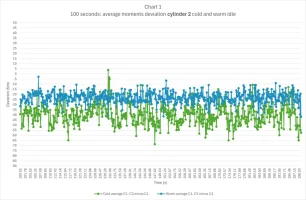
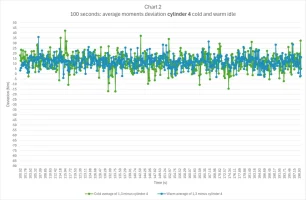
I plotted a couple of charts but I'm not overly clear on what I'm seeing. Using @mmi 's idea I compared 100 seconds of cold and warm idling data for cylinder 2 subtracted from the average of C1 and C3. I did the same for cylinder 4.

Compared to C1 and C3, C4 seems to have a similar torque deviation when cold and warm and be in the range of +5-20Nm.

Compared to C1 and C3, C2 seems to vary in torque deviation when cold and warm and be in the range of -20Nm to -40Nm. Does this mean it is underperforming (compared to the others) both when hot and cold, but less so when hot?


C2 cold and warm.png

C4 cold and warm.png
 
Last edited:
  • Like
Reactions: mmi
A little update - the van is going for compression test and piston measurements tomorrow. It’ll have a good run to get there, so I’ll record some data. I’ll try and get some good solid runs at different rpm. @mmi , any suggestions on what to log?
 
  • Like
Reactions: mmi
I would stick with the usual ones - cylinder moments + a couple of general ones to examine the DPF:

IDE00021 Engine RPM​
IDE00075 Vehicle speed​
IDE00347 Air mass: actual value​
IDE00435 Particle filter: soot mass measured​
IDE04090 Exhaust temperature bank 1​
IDE07738 Charge air cooler inlet: pressure sensor 1 bank 1: raw value​
IDE07744 Particle filter: air pressure sensor 1 bank 1: raw value​
IDE07757 Exhaust recirc.valve 1 bank 1: posit.feedback - Actual value​
IDE09327 Cylinder 1 bank 1 internal moment​
IDE09328 Cylinder 2 bank 1 internal moment​
IDE09329 Cylinder 3 bank 1 internal moment​
IDE09330 Cylinder 4 bank 1 internal moment​
 
Well - unfortunately there was a bit of confusion in the comms and the garage did not perform a compression test or measure distance to pistons.

What they did do is put a boroscope in the intercooler and have said it is contaminated with coolant and should be replaced. They have recommended the injectors be tested.

They seemed to be of the opinion that even if they did measure the pistons, on a modern engine like this it wouldn't be possible to measure with enough accuracy.


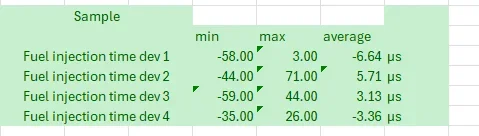
Given that the intercooler is contaminated it seems probable that the injectors, or passages to them, are too - which could explain the deviations I measured in injection time in an earlier journey:

1759005909100.webp

I suppose the next thing to do is either send the injectors for testing / cleaning, or just buy a new set (as the van has done 125,000 miles).

However, it would make more sense to perhaps first find a way of assessing the cylinder damage (if present) from the hydrolocking.

I took a log using the channels @mmi suggested above on the journey back from the garage, adding the spreadsheet here. I tried to capture a cold idle for three minutes, then a rev in neutral up into the 2000s, then several pulls up to 4000 and back while under load, then a warm idle.
 

Attachments

From post #4
You could remove the sump and turn the engine by hand to check the rods. This maybe the best method.
Maybe the intercooler is contaminated, the coolant won’t cause the symptoms you are experiencing. The intercooler can also be cleaned it doesn’t need renewing, it’s an air cooled radiator on a 102ps not a liquid cooled charge air cooler.
It sounds like they don’t know how to use a depth gauge.
How do they think coolant could find its way into the intercooler??

EDIT: so you have a 102 CXGB with a liquid cooled charge cooler NOT a 102 CAAB with an air cooled intercooler?
Was it still loosing coolant after the initial EGR work?
 
Last edited:
Another way to check for bent connecting rod is to compare the cylinder volumes (combustion chamber) at TDC at the top of the compression stroke (valves closed).
Using a calibrated syringe inject engine oil in through the injector or glow plug port until brimming.
Record the exact volume of oil filled. Extract the oil with the syringe, remove as much as possible. A wet shop vac with a tube can get the remainder.
Any dregs will burn off.
Turn engine by hand and repeat on the next cylinder.
This isn’t a job to rush or to be given to somebody who has the attention span of a 3 year old.
 
Last edited:
From post #4

Maybe the intercooler is contaminated, the coolant won’t cause the symptoms you are experiencing. The intercooler can also be cleaned it doesn’t need renewing, it’s an air cooled radiator on a 102ps not a liquid cooled charge air cooler.
It sounds like they don’t know how to use a depth gauge.
How do they think coolant could find its way into the intercooler??
Weird - they thought it was liquid cooled. They didn’t seem to have an opinion on how…. nor be drawn into a conversation about the likelihood that the failed EGR could have circulated the coolant into the intercooler instead of/with gasses.

I’m not having much luck with mechanics I think!
 
Weird - they thought it was liquid cooled. They didn’t seem to have an opinion on how…. nor be drawn into a conversation about the likelihood that the failed EGR could have circulated the coolant into the intercooler instead of/with gasses.

I’m not having much luck with mechanics I think!
I just added an edit to post #32, is your engine a more modern CXGB with a liquid cooled charge air cooler of top?
 
So from post 1;
You had an EGR with insufficient gas flow but no issues with coolant loss.

Garage strips the EGR cooler from the EGR valve, cleans and rebuilds. You haven’t mentioned if they tested the EGR unit before or after re-installing, this is important???

Engine consumes the coolant while driving due to a leaking EGR cooler. Was the EGR unit pressure tested after this to prove it was leaking???
How far / long was the engine driven with low coolant level???

A new EGR unit installed and refilled with coolant. Hopefully they renewed all coolant otherwise there could be exhaust gases products in the coolant which could give false results in future tests. Was the system vacuum filled???

Engine has a vibration that didn’t exist before the ingestion of coolant. Was the engine still consuming coolant???

From post #31; Garage finds traces of coolant in the charge air cooler. Was the coolant level still at normal level???
………………………………………

Can you answer the ??? above with certainty?

IMO;
It’s highly unlikely that the garage pressure tested the original cleaned EGR cooler BEFORE it was installed in the van as if they had it would not have developed a leak and ingested the coolant. It’s also unlikely they pressure tested the coolant system after they installed the rebuilt EGR.
They should have pressure tested the suspect EGR after they removed it from the van to prove that it was A reason for the coolant loss.
They should have fitted the new EGR and performed a system pressure test to prove that there were no additional coolant system leakage either as a result of overheating due to loss of coolant or less likely more than one component failed at once.
The coolant should have been renewed and vacuum filled / bled according to VW procedure.

I suspect that the charge air cooler was damaged due to overheating (partial plastic construction) when the coolant was lost through the EGR that wasn’t correctly pressure tested prior to re-installation.
The garage then refilled coolant after installing the new EGR unit and didn’t pressure test the system which would have identified a further leak (charge air cooler).

Hopefully you’re not still using the same garage that started the issues in the first place.
 
Heya - thanks for the response.

Yeah, CXGB engine. I can’t answer your ??? with much certainty. This is all fairly new to me and I was simply trusting the professionals.

I think the engine is still consuming a small amount of coolant, the reservoir is 1 cm lower than it was when I topped it up after the new EGR was put on.

The garage cleaned the blocked-solid EGR and put it all back together without consulting with me. I’m not a mechanic and I trusted them - so didn’t think it that strange (although as the original seller of the van would be paying for the work, I had preferred a replacement).

They told me it has a ‘rough idle’ which I’m pretty sure it didn’t exist before.

I collected it, and drove half a mile at 20 mph before white clouds of smoke. I took it right back. A junior mechanic decided this was the DPF regenerating now that it had correct flow He drove it away to “clear it”. I believe it would’ve been driven up to 60 or 70 mph on a dual carriageway for about 10 minutes. On returning, he idled the vehicle which then stalled. He could not restart it.

Chief mechanic then came out, had a look and then became very sad. He told me coolant had been pulled into the engine (about half the visible reservoir was missing).
At the time I had no idea what this really meant.

The garage apparently then flushed, cleaned, replace replaced with new EGR from VW, tested - but I don’t know the details.

This business is very well thought of, the mechanic is fastidious and seemingly honest and competent… I’ve been given no reason to not trust them until now.

Since then, van has the rough idle and weird vibrations at around 2000 RPM. Injector deviations average 10 µs with maximum readings from separate injectors between 40 and 70 µs.

It’s going back to them this week so they can put the issue right. I might just ask that they replace the intercooler (given the history of cleaning components) and send the injectors away for testing. I told them I was concerned the hydrolock could have damaged the rods, but this was dismissed as not possible (only the starter motor). None of the places I have contacted seem very interested in helping… south west Wales. Perhaps they recognise this as too much trouble.

 
Heya - thanks for the response.

Yeah, CXGB engine. I can’t answer your ??? with much certainty. This is all fairly new to me and I was simply trusting the professionals.

I think the engine is still consuming a small amount of coolant, the reservoir is 1 cm lower than it was when I topped it up after the new EGR was put on.

The garage cleaned the blocked-solid EGR and put it all back together without consulting with me. I’m not a mechanic and I trusted them - so didn’t think it that strange (although as the original seller of the van would be paying for the work, I had preferred a replacement).

They told me it has a ‘rough idle’ which I’m pretty sure it didn’t exist before.

I collected it, and drove half a mile at 20 mph before white clouds of smoke. I took it right back. A junior mechanic decided this was the DPF regenerating now that it had correct flow He drove it away to “clear it”. I believe it would’ve been driven up to 60 or 70 mph on a dual carriageway for about 10 minutes. On returning, he idled the vehicle which then stalled. He could not restart it.

Chief mechanic then came out, had a look and then became very sad. He told me coolant had been pulled into the engine (about half the visible reservoir was missing).
At the time I had no idea what this really meant.

The garage apparently then flushed, cleaned, replace replaced with new EGR from VW, tested - but I don’t know the details.

This business is very well thought of, the mechanic is fastidious and seemingly honest and competent… I’ve been given no reason to not trust them until now.

Since then, van has the rough idle and weird vibrations at around 2000 RPM. Injector deviations average 10 µs with maximum readings from separate injectors between 40 and 70 µs.

It’s going back to them this week so they can put the issue right. I might just ask that they replace the intercooler (given the history of cleaning components) and send the injectors away for testing. I told them I was concerned the hydrolock could have damaged the rods, but this was dismissed as not possible (only the starter motor). None of the places I have contacted seem very interested in helping… south west Wales. Perhaps they recognise this as too much trouble.
60-70 MPH for 10 minutes was probably enough to cook the almost certainly now dry charge air cooler.
No garage will want to pickup part way through a job which has a strong sniff of malpractice, there’s easier ways to make £.
To my mind the cause of the rough idle is the incomplete procedure for the EGR rebuild - it can’t have been pressure tested.
Add the fact that a ‘mechanic’ stated that the clouds of steam emissions were a re-gen’! If that were the case we would all see vehicles belching steam out everyday as people go about their business. This alone is grounds for compensation.
Regardless of what you think of the business I’d give them a wide berth once you get the compensation for whatever damage is found.
I’d advise that when you take the van for repair you tell them what you want done in an email rather than letting them decide what they feel like doing.
 
To my mind the cause of the rough idle is the incomplete procedure for the EGR rebuild - it can’t have been pressure tested.

Would this still be the case given that there is now a genuine new one but the rough idle persists?

60-70 MPH for 10 minutes was probably enough to cook the almost certainly now dry charge air cooler.
Even though the coolant reservoir was about half depleted (ie, only just below minimum)?

“I’d advise that when you take the van for repair you tell them what you want done in an email rather than letting them decide what they feel like doing.”

Good advice. My current thinking is replace intercooler, test and consider replacing injectors (as they’ve done 125,000 and are behaving badly) but first thoroughly test the cylinders for hydrolock damage - as if it’s there it might not make sense to put more money into the engine.

Does that sound sensible?

Thanks again for support.
 
If you have a bent connecting rod it’s due to the rebuilt EGR cooler leaking. Forget the fact that it was renewed later, it’s irellevant.

Ask to see the evidence of coolant in the charge air cooler while you are with the van. I’m still not certain whether all dealings are with the same garage. If it is all with the same garage than they would be looking to steer you away from the badly overhauled EGR as the cause of any damage.

If you see signs of coolant in the charge air cooler air passages then pressure test it, quick job.

Find a garage / mechanic who can use a depth gauge to measure the relative distances to the piston crowns at TDC.
From what you’ve already mentioned that’s unlikely at the current estabishment.

Alternatives;
1. Measure the combustion chamber volumes.
2. Remove the sump and physically check for a bent rod/s.

Regarding injectors; up to you but there will be an incentive to sell you new injectors.
 
Last edited:
Back
Top