Rough idle / potential misfire after EGR replacement, probable causes? VCDS logging approach?

Grey Area

Member
VIP Member
T6 Pro
Hello m'hearties.

I do seem to be posting a lot. A new T6 owner... !I hope this will calm down at some point. You might recall that my partner was sold a T6 with an EGR valve/cooler made almost entirely of coal.

The business refused to accept a return (and my partner is a business, not a consumer) so now she owns Tony the Transporter - 2017 T6 panel van, 5-speed 102hp, 125,000 miles. Court case to pay for the repairs. Hopefully, not too many more nasty surprises - but I'd not find anything surprising at the moment. For example - discovered that the bastardos replaced the spare wheel with... an old, bald tyre!

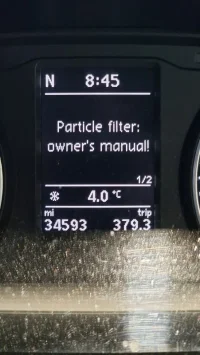
The vehicle has had a shiny new EGR now. Before that, our trusted mechanic tried to clean the one that was present. Unfortunate this didn't work - the cleaned EGR cooler had a small rupture and Tony drank half a tank of coolant right through his engine hole. The coolant was removed and a genuine new EGR fitted (no extra labour charged). There was also a persistent issue with the oil pressure switch, which was tracked down to be a high-pressure valve which only opens about 2500rpm.

Tony now has a rough idle when cold which I'm pretty certain wasn't present before. Fairly minor, but there. Clears up after a short drive. He also has what could be a misfire or an engine wobble at 1200rpm - I can still get this to happen in neutral after a 100-mile motorway journey at 70mph. Generally feels a bit juddery on the motorway under acceleration - but I don't have anything to compare it to, as I'm not used to these vehicles. Doesn't feel underpowered. Start-Stop is available after a long journey like that, but is no longer available the following day.

Flywheel and clutch were replaced recently according to service history. No smoke from exhaust.

I am now the proud owner of a VCDS. I ran the auto scan and didn't get anything relevant back other than:

31103 - SCR NOx Catalyst Bank 1
P20EE 00 [01100000] - Efficiency too Low
Intermittent - Not Confirmed - Tested Since Memory Clear

This is the DPF (joy) and was also picked up originally.

I have had the ECU out and can report it is stock firmware.

Mechanic says that the rough idle may sort itself out as the vehicle 'learns' the new unobstructed EGR and adapts it's 'active map' (which is apparently a map based on sensor data such as temperature and driving conditions).

I was hoping, as ever, for a bit of advice.

It seems likely to me that the rough idle / mis(ish)fire are probably related to the mechanical work - would you guys agree?

I’ve read that the MAF sensor might want cleaning/recoding - but not sure what that really means.

I’ll be looking to teach myself how to log live data and make analysis via VCDS. Until that wonderful day - might one of you suggest an approach for logging this? The rough idle isn’t concerning, but the potential misfire is.

Thanks as always!

X
 
Last edited:
  • Sad
Reactions: CAB
Partial hydrolock resulting in a bent connecting rod/s is my suspicion. Not uncommon with a severe EGR coolant leak.
 
Partial hydrolock resulting in a bent connecting rod/s is my suspicion. Not uncommon with a severe EGR coolant leak.
Can you hear me crying inwardly from over there?

The chain of events was:
mechanic cleaned and replaced EGR, tested thoroughly. Reported solved. I drive away.
After a mile at no more than 20mph, thick white smoke. I turn around and go back
They assume DPF regen due to clear EGR, junior mechanic took van for a dual carriageway spin to clear it - so he would have smashed it.
It comes back, stops and won't start again. Senior mechanic spots the low coolant and looks upset, says he'll drain coolant out immediately (I should correct, it was half of the coolant reservoir, as opposed to half of all the coolant).
New EGR then fitted.
Yesterday was Tony's first proper drive - 150 miles on the motorway. He can easily do 70, but symptoms as above.

Unless there's a way of testing from VCDS I think my next step would be a compression test to see if one or more rods got bent during this latest addition to the T6 cabaret!?
 
Can you hear me crying inwardly from over there?

The chain of events was:
mechanic cleaned and replaced EGR, tested thoroughly. Reported solved. I drive away.
After a mile at no more than 20mph, thick white smoke. I turn around and go back
They assume DPF regen due to clear EGR, junior mechanic took van for a dual carriageway spin to clear it - so he would have smashed it.
It comes back, stops and won't start again. Senior mechanic spots the low coolant and looks upset, says he'll drain coolant out immediately (I should correct, it was half of the coolant reservoir, as opposed to half of all the coolant).
New EGR then fitted.
Yesterday was Tony's first proper drive - 150 miles on the motorway. He can easily do 70, but symptoms as above.

Unless there's a way of testing from VCDS I think my next step would be a compression test to see if one or more rods got bent during this latest addition to the T6 cabaret!?
If the mechanic didn’t replace the gasket on the EGR cooler / valve interface and then pressure test the unit before fitting back on the vehicle they are negligent IMO.
This is normal engineering practice, obviously ignoring any one of the above has consequences. You may have a fight on your hands with the garage that did the work.

A compression test may not spot the issue especially if there is enough compression for ignition.
You could remove the injectors or glow plugs and compare the piston heights at TDC,
You could remove the sump and turn the engine by hand to check the rods. This maybe the best method.
Before you strip the engine I would take an oil analysis sample and see what you are dealing with regarding potential engine damage.
There is a possibility that the coolant may have damaged the DPF so check that.

Edit; the VCDS compression test function seems to work by comparing the cranking speed on the starter motor with regard to each cylinders compression stroke.
This doesn’t seem like a reliable method.
 
If the mechanic didn’t replace the gasket on the EGR cooler / valve interface and then pressure test the unit before fitting back on the vehicle they are negligent IMO.
This is normal engineering practice, obviously ignoring any one of the above has consequences. You may have a fight on your hands with the garage that did the work.

A compression test may not spot the issue especially if there is enough compression for ignition.
You could remove the injectors or glow plugs and compare the piston heights at TDC,
You could remove the sump and turn the engine by hand to check the rods. This maybe the best method.
Before you strip the engine I would take an oil analysis sample and see what you are dealing with regarding potential engine damage.
There is a possibility that the coolant may have damaged the DPF so check that.

Edit; the VCDS compression test function seems to work by comparing the cranking speed on the starter motor with regard to each cylinders compression stroke.
This doesn’t seem like a reliable method.
Le sigh. I'll speak with the (decent) bunch who did the original work and ask them to do the TDC test.
They said they had road tested it pretty thoroughly before I collected it... it seems I was lucky enough to have the mechanically cleaned EGR fail on my watch. I bit of a shit that their guy then razzed it up the dual carrigeway to clear what he thought was DPF regen. All that said, I see no reason to not believe them.

I can have a go at VCDS compression test when I next drive the van.
 
Thanks, I'll see if I can find the parameters to log from this. It does sound similar, though my concern is it running a bit lumpy at motorway speeds and wobbling at 1200rpm when stationary after a long 70mph journey.
If the rod/s is bent causing the vibration you mention it won’t be great for the crankshaft, main bearings and DMF.
 
I’ll be looking to teach myself how to log live data and make analysis via VCDS. Until that wonderful day - might one of you suggest an approach for logging this? The rough idle isn’t concerning, but the potential misfire is.
First things first :thumbsup:

Interested to see if we could see anything peculiar in engine data. Perhaps you could post the following please:

1) Full VCDS Auto-Scan
2) Engine blockmap - Ignition ON/engine OFF
3) Engine blockmap - Engine running at idle


How-to create a blockmap file:

[VCDS]​
[Applications]​
[Controller Channel Map]​
- Single Controller Address = 01
- Login or security access code: Leave blank​
- Function: Measuring values
- Output: CSV file
[Go]​

The result CSV files are saved into dircetory C:\Ross-Tech\VCDS\Logs
Please attach the files here.


Some good VCDS samples in here
 
Thanks @mmi !

I will look to get that done tomorrow.

I had a play with VCDS this evening and managed to get the following which I think points to something (gulp).

cylinder moments vs time 2.png

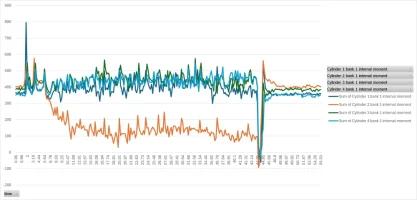
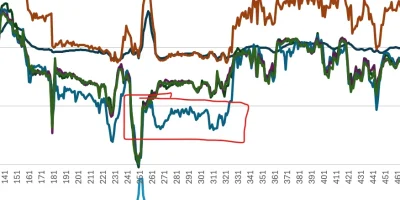
This chart is the four cylinder 'moments' - force created by motion I think. Plotted against a timestamp. This is a cold start, with me then pushing the engine in neutral up to about 2500 rpm and back down. you can see the how cylinder 2 likes to be different from about 1000rpm. The van vibrates around 1200rpm but then it's not that noticeable.

This is me just poking around though. For all I know, cylinder 2 is supposed to do this to balance the engine or something...... but then, surely there would be two pairs mirroring each other in that scenario :/
 
  • Wow
Reactions: mmi
Here we go @mmi and folks - a data dump! Attaching here an autoscan, a blockmap not running and a blockmap running, then four logs - one of which is a variation on the data I posted above.

In all the logs I ran the engine in idle for three minutes then made a marker and brought the rpm up to about 2000, made a marker and let it drop again.

I feel like the engine in getting worse. Pretty sure I can smell fuel/exhaust from in the cab. It can still drive around, but it's pretty juddery. Something certainly not right.

Mechanic said he'd have a look but not for a couple of weeks. He reckons even though it was hydrolocked this couldn't have bent a rod/s because the starter motor can't produce enough torque.

I'd be really interested (and relieved) if anything in this data points to a problem with injectors, coding etc.

The DMF was replaced recently before this van was purchased. These symptoms have arrived after the replacement EGR (and hydrolocking event) I described above, which took place after I got ownership.

Thousands of thanks for any insight or suggestions!
 

Attachments

  • Like
Reactions: mmi
Perfectly possible with a depth gauge through the injector ports without removing the cyl’ hd.
 
Here we go @mmi and folks - a data dump! Attaching here an autoscan, a blockmap not running and a blockmap running, then four logs - one of which is a variation on the data I posted above.
Thank you for sharing. Fascinating... although I'm not sure that's the word you would use.

In all the logs I ran the engine in idle for three minutes then made a marker and brought the rpm up to about 2000, made a marker and let it drop again.
Excellent procedure :thumbsup:

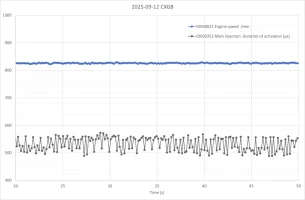
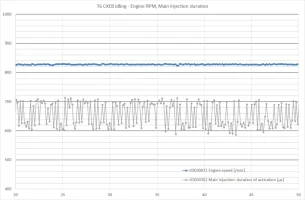
I would start by checking the injectors - because at idle the engine is very "stable" - there is minimal injection duration compensation and practically no RPM fluctuation. If it was a bent rod I would expect it manifest itself at all revs?

1757708990946.png

The DMF was replaced recently before this van was purchased.
For comparison mine - slightly bigger variation - makes me wonder if we could estimate even DMF condition this way :geek:

1757709282583.png


Injector failure


Engine with bent rod
 
This is interesting, a thousand thanks @mmi - imagine having a database from all the users on here!

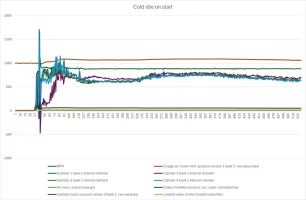
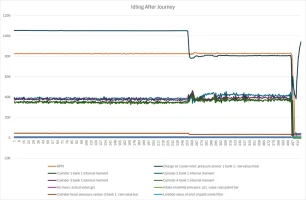
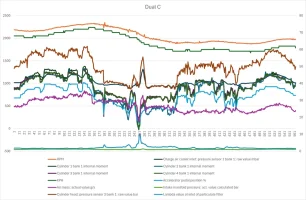
I tried some logging using the Injector Failure thread above. I have noticed that the lumpy start has improved a little recently, but the juddering around 2000rpm is still there. The dual carriageway snippet is where I think the juddery was juddering.

I'm not the best at plotting the data (I'm just using Excel and mostly guessing), but it could be that there are still issues with cylinder 2?
  • It's definitely late to the party on cold start (it's the purple line) and then while it does match the others on the dual carriageway,
  • has a bit of a wobble on the idle after the run, at about 281 on the horizontal axis,
  • it wangs out of sync with the other three at about 260-331 on the horizontal axis (at 45-50mph) the others are so close they blend together:


1757952206245.png


My plots make this hard to see though (they keep changing colour!).

If you guys have any input, I'm all ears. The VCDS I have is a shiny new one, so it has the 'boost' option if that's any help.

This is probably related to the coolant getting into the engine - even though it was drained within an hour.


Cold Idle.pngwarm Idle.pngDual C.png
 

Attachments

Last edited:
  • Love
Reactions: mmi
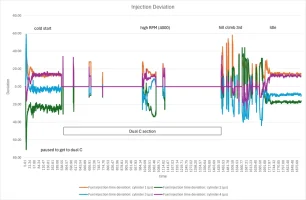
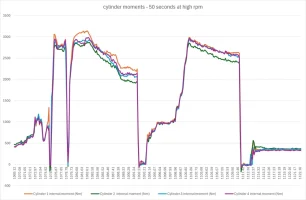
@mmi - I've done some logging today with the setup from the bend rod thread above, that's cylinder moments, injection timing deviation and injection speed.

I took the van on a drive - I did three minutes cold idling, the paused the logging to get to the dual carriageway. Ran a little way up the dual carriageway then did a U turn, accelerated hard from a standstill (up to 4000rpm in 3rd and then in 4th) and then took him home via a steep hill on a slow road. Three minutes idling at the end. Because the test had 12 data streams I didn't collect speed or RPM, which would have been useful.

I'm getting the hang of the graphing, but not too sure what to look for.

I have read that the timing deviation upper acceptable range in a high load event is 20-30microseconds...? so this isn't looking wonderful.

Also plotted the cylinder moments from the same log while under heavy load... variation between cylinder 2 and cylinder 1 at 1082 seconds is about 400 Nm....


Injection deviations.png


cyclinder moments high rpm.png
 
Last edited:
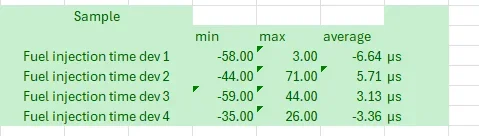
Finally for today - I found some expected values for this or a similar known good engine from the Ross-Tech forum.

My values (recorded over a short journey - perhaps 20 minutes)

1758043488328.webp


and the known values:


CXFARecording over 2 hours 24 minutes (114 measurements)MINMAXAVERAGE
IDE12085Fuel injection time deviation: cylinder 1
-12​
6​
-0.175​
us
IDE12086Fuel injection time deviation: cylinder 2
-20​
18​
-0.018​
us
IDE12087Fuel injection time deviation: cylinder 3
-2​
22​
0.632​
us
IDE12088Fuel injection time deviation: cylinder 4
-27​
3​
-0.746​
us

: /
 
  • Like
Reactions: mmi
Because the test had 12 data streams I didn't collect speed or RPM, which would have been useful.
Wasn't the set of injection speeds logged? Thus individual RPMs for each cylinder :geek:

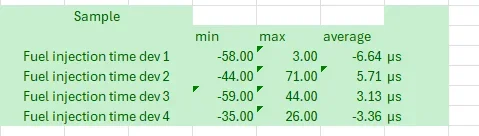
Finally for today - I found some expected values for this or a similar known good engine from the Ross-Tech forum.

My values (recorded over a short journey - perhaps 20 minutes)

View attachment 303451
Interestingly the table alignment gets sometimes corrupted - I have noticed that, too - @Pauly
But even more interesting is that replying your post restores it - or did you repair it while I was typing :oops:
1758045017043.png


Finally for today - I found some expected values for this or a similar known good engine from the Ross-Tech forum.
1758044466872.png1758044568976.png

Quite a coincidence :inlove:

 
Last edited:
Back
Top