Renogy Inverter with AC Priority Function

I have no experience of the Renogy devices, but have you considered perhaps the Victron Multiplus inverters/chargers which
1) have the appropriate relays to allow RCD's to work on the output side.
2) Eliminate the need for the charger
3) Act as a UPS if the EHU fails
4) Can limit current from EHU - so if the campsite say has only a 6A supply and you need to use a device that draws 8A the inverter will provide the "missing" 2A from your leisure battery.

We have this set up, and it is extremely clever/efficient at what it does.
 
  • Like
Reactions: CAB
I have no experience of the Renogy devices, but have you considered perhaps the Victron Multiplus inverters/chargers which
1) have the appropriate relays to allow RCD's to work on the output side.
2) Eliminate the need for the charger
3) Act as a UPS if the EHU fails
4) Can limit current from EHU - so if the campsite say has only a 6A supply and you need to use a device that draws 8A the inverter will provide the "missing" 2A from your leisure battery.

We have this set up, and it is extremely clever/efficient at what it does.
Hi, it’s a great shout and if I was building from scratch I would deffo go this route, but the electric system is installed already and I have the charger etc - the Renogy way only sets me back the price of the inverter and they’re currently sitting around the £130 mark.
 
Hi all,

I appreciate I'm a little late to the party on this one, but have had my van for three years running on just solar, but doing my first 10 day trip and finally going to add the inverter and EHU for a bit of backup and so i can charge laptop etc - we currently only use 12v stuff.

I've read a lot of posts about the Renogy inverters and the pass through/switching facility which sounds great, and i want to keep the circuit as minimal as possible as I really don't want to do a full strip & refit in the van.

I was hoping to wire as my crude diagram below suggests - idea is that the socket will only work on EHU for larger appliances or a 6A charger for the leisure battery on the odd occasion. If not connected to EHU and just using the inverter, I'd just be plugging into the inverter directly.

Thought, critique or confirmation would be greatly appreciated!

View attachment 301708
Yes that will work as you expect.

The external RCD will work when on EHU, the van chassis needs to be PE bonded (earthed to the green yellow)

When you switch over to battery inverter you will be on floating power and the inverter runs on 110v/110v L/N...... Which is fine in the pic above as you show no down stream RCD.

The 12v charger will also work as expected.

This was the setup I was originally going for myself.

Just ensure that when on EHU that the van body is connected though to earth pin of the EHU plug/socket.
 
Yes that will work as you expect.

The external RCD will work when on EHU, the van chassis needs to be PE bonded (earthed to the green yellow)

When you switch over to battery inverter you will be on floating power and the inverter runs on 110v/110v L/N...... Which is fine in the pic above as you show no down stream RCD.

The 12v charger will also work as expected.

This was the setup I was originally going for myself.

Just ensure that when on EHU that the van body is connected though to earth pin of the EHU plug/socket.
Thanks Dell,

Just to be sure then, run earth from the flex to sockets as normal but add an earth tail out to the van either at the EHU end of the flex or from the socket to the van body?
 
There is a PE Earth bar in the consumer unit.

You need to connect:
In coming EHU Earth.
Out going socket Earth.
Van chassis.
Inverter case Earth.

You also need double pole rcbo in the CU.

Or rcd and mcb combo, but again double pole.

This is due to protect against reversed polarity EHU. Which is very common a apparently.
 
There is a PE Earth bar in the consumer unit.

You need to connect:
In coming EHU Earth.
Out going socket Earth.
Van chassis.
Inverter case Earth.

You also need double pole rcbo in the CU.

Or rcd and mcb combo, but again double pole.

This is due to protect against reversed polarity EHU. Which is very common a apparently.
Thanks again Dell,

Final question if ok!...

I saw in another thread your use of the Wylex box which is what I'm going to go for - I know MCB should be 16A, but should i be going for a larger A on the RCD? There's so many 'premade' examples online and it seems pretty inconsistent as to what people are using - in some cases I've seen 60A+ on the RCD.

I was originally going to go for the 6A & 10A combo in one of your earlier posts, however if i can just run one cable out from the consumer unit it kinda makes sense to do the RCD/MCB double pole option.
 
The RCD is not a circuit breaker....

It's trip rating will be 10mA or something tiny.... The 60A rating will be the max throughput.

The MCB is the fuse in effect, ie 6A or 10A.

You can get the combo RCBO which will have the 10A MCB, and 10mA RCD in one device.
 
So, I have been looking to replace my Renogy 1000W inverter with UPS due to it not working with an RCD.
It has always bugged me and now that my inverter wiring is getting more complicated than just a single socket and I’m using equipment which is not double insulated it’s becoming a necessity to have an RCD imho.
Renogy have stated to me in writing that it can’t be used with an RCD and my previous testing has shown it to be the case.
However, what I had never tried, due to not wanting to damage the unit, was to add my own N-E link to the output of the inverter.
Today I did just that. My view was that if it worked I could save myself a load of cash and if it didn’t then I’d carry on with replacing it anyway.
I did some initial testing to prove it wouldn’t destroy itself by putting a 40W bulb load across L-E and N-E, and the bulb stayed unlit….Promising.
Then I progressed to adding a N-E link on the output… And it worked.
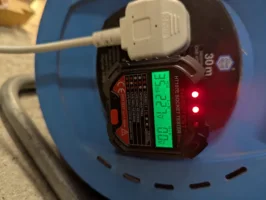
I plugged in an RCD protected extension lead to the inverter and put a RCD plug tester on the end of it.
The voltages and polarity were as they should be and the RCD test function tripped the upstream RCD.
Absolute RESULT!!!
So the Renogy 1000W inverter with UPS can be N-E bonded to allow an external RCD to be fitted for additional protection meaning I can then safely use multiple sockets and equipment that isn’t double insulated.

Of course:

MAJOR CAVEAT - I don’t and won’t be using the UPS function and don’t have anything plugged into the mains input. Having a N-E bond on the output whilst using the UPS input would definitely breach electrical regs as it would create more than one N-E bond which would be dangerous and probably just trip the incoming RCD on the main consumer unit.


PXL_20260417_160145130.webp
 
  • Like
Reactions: CAB
Back
Top