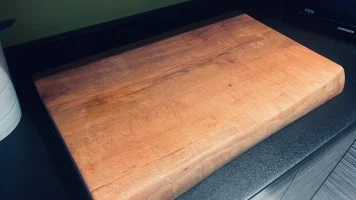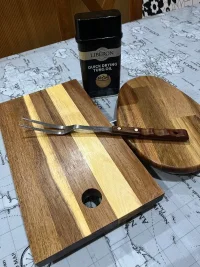
Oiling Chopping Boards

Paynewright

Senior Member
VIP Member
T6 Legend
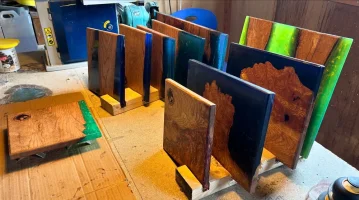
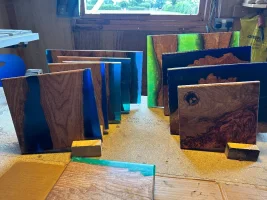
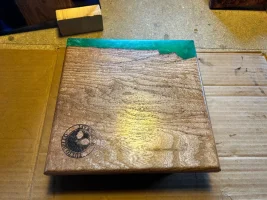
We’ve decided to switch back to wood chopping boards, from plastic, with the exception of one for raw meat / fish so we can put through the dishwasher.

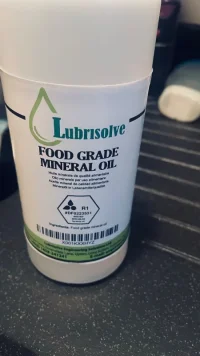
The boards we’ve bought need oiling and I’ve gone down the wormhole of ‘chopping board oils’. Mineral oils seem to be a no-no due to hydrocarbons. Plant based oils go rancid. Arrrhghhh!!

We have oak worktop in the kitchen on which I use liberon, which doesnt specifically mention chopping boards.

I’m on the (creosoted) fence on what to use?

Any advice greatly received - I know there are a few carpenters / avid DIYers in the house!
 
Being a musician who's made a few guitars and basses over the years I've used tung oil for chopping boards and kitchen work tops. I've no idea if its the correct product, but its always worked very well with no adverse effects, although all my hair did fall out.
 
I have always made my chopping blocks from greenheart and I put them through the dishwasher. Why don't you put yours through the dishwasher? I have used sunflower oil when I fancied tarting them up again but I don't really see the need for oiling them - it isn't as though they are worktops or ornaments.
 
Walnut oil is good , however sycamore is the best for chopping boards, I made a 70 mm thick board for the kitchen I just bleach and poor boiling water over it ,still mint after 15 years. I would never ever recommend the dishwasher if it's laminated timber it will f*** it up
 
Being a musician who's made a few guitars and basses over the years I've used tung oil for chopping boards and kitchen work tops. I've no idea if its the correct product, but its always worked very well with no adverse effects, although all my hair did fall out.
It's a nut oil and fine
 
Laminated timber - yuck! :) , 4" thick block of greenheart doesn't move under the knife ( or if you try to pick it up either ) or warp. Trouble is you have to look hard for a supplier of suitable small pieces. I have only one poor split section after years of making the blocks for people.
 
To quote online sources:
Colour/Appearance: Heartwood can be highly variable in colour, and is sometimes sold sorted into colour categories of black, brown, yellow, and white—though there doesn’t seem to be any difference in strength or physical properties between the different colours. Generally the heartwood tends to be a pale brown to olive green colour, sometimes with darker streaks. Yellowish sapwood is not clearly demarcated from the heartwood.
Grain/Texture: Grain tends to be straight to interlocked, with a fine to medium grain and good natural lustre.
Rot Resistance: Greenheart is rated as very durable, with excellent insect/borer resistance. It’s also considered to be one of the best-suited woods for use in marine environments, and has good weathering and wear characteristics.
Workability: Generally somewhat difficult to work on account of its density, with a moderate to high blunting effect on cutters. Sections with interlocked grain should be machined with care to avoid grain tearout. Gluing can be difficult in some pieces, and precautions for gluing tropical species should be followed. Turns and finishes well. Responds moderately well to steam-bending.

The wood is sometimes called Demerara greenheart (Demerara is a historical name for a Dutch colony that more or less corresponds to modern-day Guyana) to help distinguish it from other woods sometimes called greenheart. Although not common, ipe (Handroanthus serratifolius) is sometimes referred to as Suriname greenheart, while okan (Cylicodiscus gabunensis) is sometimes called African greenheart—though neither species bears close relation to true greenheart.

Greenheart is one of the stiffest woods in the world, with an average modulus of elasticity of 3,573,000 lbf/in2. The wood has also earned a strong reputation for its durability and pest-resistance in marine environments. Greenheart was even used as cladding on Ernest Shackleton’s expedition ship Endurance, with the wreckage being discovered in nearly pristine condition in 2022 after sinking in 1915.[2]
 
I had a good supply many years ago as I was operating a safety boat for the welders working on the top of 50 ft piles whilst they were building the new quays for Felixstowe Docks in the 70's. Plenty of offcuts lying around as the quay facings were constructed. I gave a friend a 20 ft length that I picked up in the sea - it took 3 of us to carry it! He made a hefty table from it. It barely floats so I went to pick up this small piece of wood that was sticking out of the water and got a shock when I couldn't move it or get it in the boat - I had to tow it to the beach.
 
I had a good supply many years ago as I was operating a safety boat for the welders working on the top of 50 ft piles whilst they were building the new quays for Felixstowe Docks in the 70's. Plenty of offcuts lying around as the quay facings were constructed. I gave a friend a 20 ft length that I picked up in the sea - it took 3 of us to carry it! He made a hefty table from it. It barely floats so I went to pick up this small piece of wood that was sticking out of the water and got a shock when I couldn't move it or get it in the boat - I had to tow it to the beach.
We make street furniture from reclaimed Greenheart, it is a bit toxic, not sure it's food safe lol , still it don't seem to have done you any harm .
I have a few hundred tons of it on my yard all huge sections.
For me I want kitchen stuff that you don't need to be presious about sycamore won't blunt knives it's naturally food safe a scrub with bleach and boiling water and it's ready to go.
Beach is another option,you don't need to oil either.
Oak is a pain in the arse ,I made a 50 mm thick oak worktop for an old kitchen I made it was a pain as you need to maintain it.
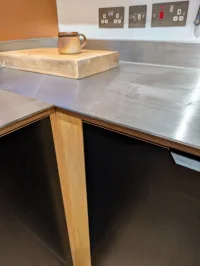
I now have a solid 4 mm stainless steel worktops
Got my pal to lazercut it and weld a sink in .
The old sycamore block in the back.

PXL_20251002_060714495.webp
 
Liberon Finishing oil is an excellent for finishing chopping boards. Personally used it on many work projects for over 28 years now and still wouldn’t use anything else. Food safe and the nicest smelling of all of the oils available.
 
Back
Top