For a bit more physics the forward voltage of a red LED is around 1.8v so the reason you see a slightly lower voltage than the main battery voltage is that you are effectively measuring the main battery voltage less the voltage drop across the LED.
Red LED tend to be the lowest forward voltage, with green/yellow next and Blue/White highest.
Sometimes knowing the rough voltage drops is useful diagnostics. If the drop is around 2v it's likely going through an LED, if it's around 0.7v it's likely going through a standard diode. In power electronics you tend to find Schottky diodes that have a drop of around 0.2v - more expensive but with a lower voltage drop less energy is lost as heat across them.
Also can be useful if you have to replace an LED on a prebuilt light fitting, so long as one of the chains is still working. A lot of modern "chip" type LED packages used in lights have several LEDs in series in them so you need to know how many to replace. You can sometimes see them by looking through sunglasses to drop the brightness but the other trick is to use a multimeter across one of the "chips" to see the voltage drop across it and divide by 2.

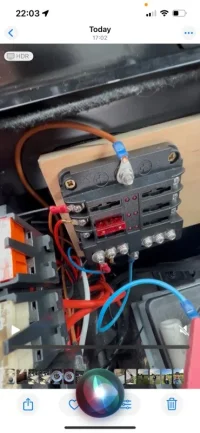


 how those fuse boards work, is in effect the LED bridges the fuse holder. lets go with an example....Imagine an output from one of the fuse holders gose to a bulb, then the other side of the bulb goes to 0V chassis ground.


