
Daughter asked me about this on Alevel Physics sample paper. Not a real paper, so could have some dodgy information in it.
Setup is a bit like charging a leisure battery from the starter battery, hence I’m asking for expert thoughts here.
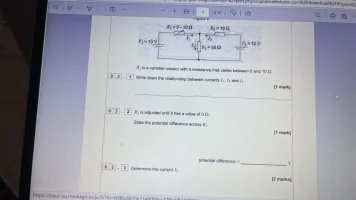
Two batteries in parallel, with different emfs.
In part 2, the mark scheme suggests the voltage across the 30ohm resistor when variable resistor is set to 0 is 10V.
I don’t understand how the voltage across one battery is independent of the other battery. If that was the case, a split charge unit would never work?
Setup is a bit like charging a leisure battery from the starter battery, hence I’m asking for expert thoughts here.
Two batteries in parallel, with different emfs.
In part 2, the mark scheme suggests the voltage across the 30ohm resistor when variable resistor is set to 0 is 10V.
I don’t understand how the voltage across one battery is independent of the other battery. If that was the case, a split charge unit would never work?


