Ecoflow Delta 3 Plus to run all 12V through a fusebox, Anyone done it?

RogueOne

Member
T6 Pro
Looking for some help, advice and inspiration on this please, as well as photos of your similar set ups.

For some context:

We have a 2020 T6.1 Kombi twin sliders that we are installing rear slide pods in to make into a camper when we need it.
I have on order an Ecoflow Delta 3 plus to use as the main power source when camping and not on EHU (Yet to install). Will probably also have portable solar.

So what I was thinking was to run the 12v power from the Ecoflow to a fusebox that will then power all and any 12 V items (Lights etc) anyone don ethis or have this set up?

Will not be installing a leisure battery as we want the flexibility and ease of use of a power station and we will also be on EHU most of the time.

Many Thanks
 
It's not an ideal setup.

The EF D3 is same as the D2.

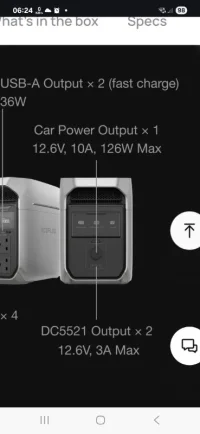
It's a regulated 12.6v @ 10A max.

Which is not enough to run the 12v system in a campervan, unless your just running the basic LED lights.

It won't run a fridge or diesel heater.

And you get volt drop straight away over the cable runs.

Then there is the capacity with is around 1000wh, which is ok. But you need the mains or alternator charger to charge up quick.

You will need 200w solar to get any decent charge into it.


Screenshot_20250620_062404_Chrome.webp
 
Its perfectly feasible, I power my entire van with just a small Bluetti AC70 which powers everything in the van, fridge, diesel heater, lights, water pump ect. the only difference is I use the AC70 to power a 30A 240v to 12v PSU which then sends power to a 12v fuse box then onto my appliance's, this gets around the limitations of the 12v 120w socket on the PowerStation

I use a 200w solar panel on the roof which more than covers all of our power usage during the day, combined with one of the new DC fast chargers. (a Bluetti charger 1)
I have been really testing our set up over the last 18 months during all weathers including -8 in January and it works great, the absolute game changer is the DC fast charger, we are just back from weeks wild camping in the borders and not once did we need or go near an EHU, between the Solar & Fast Charger we are completely self sufficient now.

Read this thread for more information on how I did it:

 
Soz, extra but from above that didn't send.

...


You would be bettery off making a 12v batterys box from a 100ah lithium,

Them charge that at home.

Or use the 12v charger on the EF D3
 
Its perfectly feasible, I power my entire van with just a small Bluetti AC70 which powers everything in the van, fridge, diesel heater, lights, water pump ect. the only difference is I use the AC70 to power a 30A 240v to 12v PSU which then sends power to a 12v fuse box then onto my appliance's, this gets around the limitations of the 12v 120w socket on the PowerStation

I use a 200w solar panel on the roof which more than covers all of our power usage during the day, combined with one of the new DC fast chargers. (a Bluetti charger 1)
I have been really testing our set up over the last 18 months during all weathers including -8 in January and it works great, the absolute game changer is the DC fast charger, we are just back from weeks wild camping in the borders and not once did we need or go near an EHU, between the Solar & Fast Charger we are completely self sufficient now.

Read this thread for more information on how I did it:

That's great, so it can be done then. Will check out your post now. Many thanks
 
Its perfectly feasible, I power my entire van with just a small Bluetti AC70 which powers everything in the van, fridge, diesel heater, lights, water pump ect. the only difference is I use the AC70 to power a 30A 240v to 12v PSU which then sends power to a 12v fuse box then onto my appliance's, this gets around the limitations of the 12v 120w socket on the PowerStation

I use a 200w solar panel on the roof which more than covers all of our power usage during the day, combined with one of the new DC fast chargers. (a Bluetti charger 1)
I have been really testing our set up over the last 18 months during all weathers including -8 in January and it works great, the absolute game changer is the DC fast charger, we are just back from weeks wild camping in the borders and not once did we need or go near an EHU, between the Solar & Fast Charger we are completely self sufficient now.

Read this thread for more information on how I did it:

There are a few members on here with this type of setup,

Using a vicron charger in power supply mode, A10, 15, 20, 30 amp charger depending on your loads.

Please set up does work well but is very inefficient with all the conversion.

Ia 12V to charge up the 54 volt battery pack to change up change up to 230v, to run the charger which then converts back down to 12v to run your kit.

If you can find a way to overcome the inefficiencies then this works fine..

I need your case you have 200 watt solar and the engine dc dc charger, which will easily overcome the inefficiencies and losses in the system.

But at that point you might as well just drop a battery under the seat and be done with it.

portable power packs are awesome I have about 12 of them, I've got eco flows anchors, blue etis, jacqueries, mobile solar and the vectron chargers etc etc etc.

Excuse the typos trying to do this using Google voice to text in a bad signal area.
 
Its by no means a perfect system compared to the standard camper electrical setup of leisure batteries, split charge, solar ect as there is some significant compromises to be made using Powerstations, but the main advantage is complete modularity & flexibility.

I have been doing a lot of testing with my setup and really been putting it through the wringer, I have gathered quite a bit of data on endurance times, power usage, lessons learned ect, which I have written down in my diary. once I am finished testing and have a bit more data I will write up a "How I did it/How to" guide on the forum so other folk can assemble their own Powerstation setup armed with the pros & cons beforehand.
 
Its by no means a perfect system compared to the standard camper electrical setup of leisure batteries, split charge, solar ect as there is some significant compromises to be made using Powerstations, but the main advantage is complete modularity & flexibility.

I have been doing a lot of testing with my setup and really been putting it through the wringer, I have gathered quite a bit of data on endurance times, power usage, lessons learned ect, which I have written down in my diary. once I am finished testing and have a bit more data I will write up a "How I did it/How to" guide on the forum so other folk can assemble their own Powerstation setup armed with the pros & cons beforehand.
Look forward to seeing that, and pictures of your set up please.
Many Thanks
 
It's not an ideal setup.

The EF D3 is same as the D2.

It's a regulated 12.6v @ 10A max.

Which is not enough to run the 12v system in a campervan, unless your just running the basic LED lights.

It won't run a fridge or diesel heater.

And you get volt drop straight away over the cable runs.

Then there is the capacity with is around 1000wh, which is ok. But you need the mains or alternator charger to charge up quick.

You will need 200w solar to get any decent charge into it.


View attachment 292559
Thanks for the Info Dell. I plan to run an Alpicool G22 compressor Car Fridge freezer from the Ecoflow Delta 3, tha Alpicool has a DC cord so I'll probably use that.

Was thinking of having some 12v USB sockets and Led lighting with switches off a 12v fuse box!

What do you think?

 
Look forward to seeing that, and pictures of your set up please.
Many Thanks


Here is the link to my van & setup its changed a bit since this post, and there is no information on how its set up electrically, see the other thread I gave you.
But it will give you some idea how I have laid it all out. its taken nearly 2 years to design, build & iron out all the kinks but it now works great for the two of us. :thumbsup:

My First Build.......


As for your lights & USB, yes put the lights through the PSU & Fusebox, but save yourself some hassle and just use the USB ports on the Powerstation that what we do.
 
Last edited:
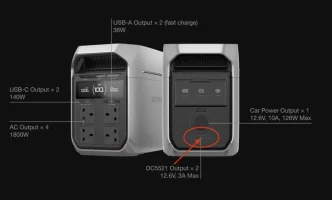
Looking at the available ports on the Ecoflow, I was wondering if it's not easier to run any LED Lights from these 12v 3Amp DC5521 Bullet ports, as most 240 volt LED light sets come with a these connectors which then plug into a 240v-12v converter! Can I not just do away with the converter and plug straight into these?

Screenshot 2025-06-24 at 08.47.08 copy.webp
 
Should be able to,

as the LEDs lights are the 12v versions.
 
Looking at the available ports on the Ecoflow, I was wondering if it's not easier to run any LED Lights from these 12v 3Amp DC5521 Bullet ports, as most 240 volt LED light sets come with a these connectors which then plug into a 240v-12v converter! Can I not just do away with the converter and plug straight into these?

View attachment 293094


As Dell said, it should work fine but you might need to solder on some bigger 5.5 x 2.1mm Male plugs depending on what comes with your LED lights. this is what I did before I moved my lights over to use the Victron PSU.

 
I've had this suggested to me, what do you think, given that the Cig socket on the EF D3 plus is only 10amp / 126w max?

----------------------------------------------------------
I wouldn’t use the 240v mains side of the EcoFlow with a 12v converter to power the lights and fridge as this method will use a lot more of the battery power.
I would use the 12v cigarette socket outlet and run the feed into a fuse board and then spur off for the led lights and Alpicool coolbox with separate fuses for protection.

The earths from the lights and the fridge need to be connected to an earth block with a chassis earth connected. I would also put some switches on your wall for the lights and fridge to turn off when not needed.
 
If you are running a compressor fridge remember a motor draws about 8 times the running current briefly at start up - if the system cannot supply that then generally the motor stalls and after a few attempts then controller locks out. That's why a nominal 40w device has such large cables and fuses at 15/30 amps.

Unfortunately, as you are discovering, most power pack system do not provide a robust reasonable current 12v connection like an Anderson or XT60.

I'd be very wary of a long term connection to the traditional 12v cigarette style socket. The design is renowned for overheating with currents over about 8A/100W continuous and with the central tip design it's also very prone to disconnection if the plug moves, or even shorting in some socket designs. It's fine if you plug in every time you need to use it and check it, but I'd not personally wire any permanent cabling to it.

If you want high power out of these devices then generally that's only available via 240v route. Keep in mind that as @Dellmassive says most of them run the internal pack at higher voltages (20-50v) as a compromise between needing to run at 5v USB/12v DC/20-50v MPPT/240v AC so there is still power conversion going on on every output. It might be a little less on the DC out but most of them are not very efficient and have a lot of idle losses.
 
I've had this suggested to me, what do you think, given that the Cig socket on the EF D3 plus is only 10amp / 126w max?

----------------------------------------------------------
I wouldn’t use the 240v mains side of the EcoFlow with a 12v converter to power the lights and fridge as this method will use a lot more of the battery power.
I would use the 12v cigarette socket outlet and run the feed into a fuse board and then spur off for the led lights and Alpicool coolbox with separate fuses for protection.

The earths from the lights and the fridge need to be connected to an earth block with a chassis earth connected. I would also put some switches on your wall for the lights and fridge to turn off when not needed.
Na...

That doesn't work...... Limited to 8A output and regulated at 12.6v.

Whoever suggested that, ask them for proof pics of there system.

I've tried it and it only works for low power lights etc.

It won't run a diesel heater for example.
 
I've had this suggested to me, what do you think, given that the Cig socket on the EF D3 plus is only 10amp / 126w max?

----------------------------------------------------------
I wouldn’t use the 240v mains side of the EcoFlow with a 12v converter to power the lights and fridge as this method will use a lot more of the battery power.
I would use the 12v cigarette socket outlet and run the feed into a fuse board and then spur off for the led lights and Alpicool coolbox with separate fuses for protection.

The earths from the lights and the fridge need to be connected to an earth block with a chassis earth connected. I would also put some switches on your wall for the lights and fridge to turn off when not needed.


This is something I did when I first set up the van, but once I introduced the diesel heater and a vastly more complicated LED light system it quickly became way beyond the capabilities of the Powerstations 12v DC limits, and the only way forward to make it safe & reliable was to put it through a 240v PSU and convert back down to 12v DC.

I have found through pretty significant real world testing that the power losses are actually pretty minimal to the point that your not going to notice unless you are using a very small Wh PowerStation.

As an example here is some data from my diary where the only thing running is the fridge (50w) and all other systems are plugged in & powered up but on Standby (ie plugged in & ready to be used) remember my unit is only 768Wh.

Ambient temperature at the time of testing 19c.
Bluetti AC70 768wh
240v socket ----> Victron 240-12v PSU, with water pump, diesel heater and 12v LED strip light.
240v socket ----> Loox 24v Driver powering 3 capacitive dimmers with 50w LED strip & six 5w LED downlights total = 80w
12v Dc socket ----> 12v Dometic TCX14 Running intermittently at max power setting.

From 100% to 0% the 768Wh battery lasts 18-19 hours which I am still surprised at. A bigger capacity like the Delta 3 PowerStation will last much longer
 
This is something I did when I first set up the van, but once I introduced the diesel heater and a vastly more complicated LED light system it quickly became way beyond the capabilities of the Powerstations 12v DC limits, and the only way forward to make it safe & reliable was to put it through a 240v PSU and convert back down to 12v DC.

I have found through pretty significant real world testing that the power losses are actually pretty minimal to the point that your not going to notice unless you are using a very small Wh PowerStation.

As an example here is some data from my diary where the only thing running is the fridge (50w) and all other systems are plugged in & powered up but on Standby (ie plugged in & ready to be used) remember my unit is only 768Wh.

Ambient temperature at the time of testing 19c.
Bluetti AC70 768wh
240v socket ----> Victron 240-12v PSU, with water pump, diesel heater and 12v LED strip light.
240v socket ----> Loox 24v Driver powering 3 capacitive dimmers with 50w LED strip & six 5w LED downlights total = 80w
12v Dc socket ----> 12v Dometic TCX14 Running intermittently at max power setting.

From 100% to 0% the 768Wh battery lasts 18-19 hours which I am still surprised at. A bigger capacity like the Delta 3 PowerStation will last much longer
Thank you, this info is superb. I think you may have made my mind up that it may be best to go down the 240-12v PSU route then into a fuse box and then run all 12v items off that.

Is the Victron the best option? Pricey at £145!
 
Thank you, this info is superb. I think you may have made my mind up that it may be best to go down the 240-12v PSU route then into a fuse box and then run all 12v items off that.

Is the Victron the best option? Pricey at £145!


No problem happy to help, it is pretty much the only way to get powerful & reliable 12vDC from a PowerStation to give you enough headroom to power bigger devices like diesel heaters.
The Victron is really pricy and there are much cheaper alternatives on Amazon but frankly i wouldn't trust them in my camper, fine if you are powering some Xmas lights from your garden shed, but in my camper No Thanks !
There is 3 versions of the Victron Blue Smart Charger a 15A, 20A & 30A i went for the 30A version so i had room for expansion and it was on special offer in the January sales !

 
Back
Top