Oil Ash Residue Limit

SlothBurger

Member
VIP Member
T6 Pro
Mine is a 2019 Kombi & oil ash residue is at approx. 79g.

I read on the other threads that limit is set at 110g in total for this DPF. Not sure if this is the same for my van.

Should I be looking at replacing the DPF at this stage?
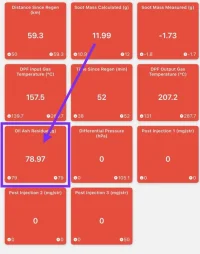
IMG_5879.webp
 
Depends on which country you are.
Here in Slovenia, cleaning is 200-300 EUR if you bring DPF to the shop. Restoration with new core is 600 EUR. They say hot air cleaning is most effective, second being liquid.
According to Autodoc, new Walker unit is 1500 EUR. I guess thats with catalyst included as it is all one compact unit.
 
Depends on which country you are.
Here in Slovenia, cleaning is 200-300 EUR if you bring DPF to the shop. Restoration with new core is 600 EUR. They say hot air cleaning is most effective, second being liquid.
According to Autodoc, new Walker unit is 1500 EUR. I guess thats with catalyst included as it is all one compact unit.
Worth a holiday in Slovenia!
Makes sense that a hot medium would be best at cleaning as the residue has been forced in while the unit is hot and when it’s cooled the matrix compresses around it.
 
Have you tried a forced regen using a diagnostic tool?
Not yet. I have Carista & thought it might be risky to force a regen as it's only to be done under certain conditions?

Normal regens are happening about every 150 kilometres currently.

If I do a forced regen do I drive it when I start that or lesve it standing while it completes?
 
There is Soot and there is Ash.
SOOT is something that DPF catches and burns off regularly every 300-400 km.
ASH is Soot burning residue that stays in DPF and cannot be removed by forced regeneration. It can only be removed by the shop in special ovens/cleaning machines.
Soot and Ash values are mostly calculated rather than measured. There is DeltaP measurement value across DPF which is authoritative for how much DPF is really clogged. I dont know why that value is not considered by the ECU exclusively.

If Ash value is high that doesnt neceserily mean your DPF is full, it is a presumption of the ECU (and ECU considers that value rather than DeltaP). You can only change that with OBD tool and adaptation-usualy when you clean or replace DpF. I dont know what happens if you change it without cleaning. My Ash value is nearing the limit (there is a parameter in the OBD that tells you what is the limit for your DPF) and I am waiting to see what will happen then. I expect engine light to come on. DeltaP is low though indicating DPF is not clogged yet.
 
Not yet. I have Carista & thought it might be risky to force a regen as it's only to be done under certain conditions?

Normal regens are happening about every 150 kilometres currently.

If I do a forced regen do I drive it when I start that or lesve it standing while it completes?

You have two forced regeneration scenarios. One while stationary, second while driving.
Stationary regen is normal procedure. You can start it with OBD tool (VCDS, Carista…).
I usually move the car a bit further away from the house in case it catches fire 😀.
It takes around 30min to complete.
 
It looks like your van is doing the regens required, so no need for forced regens. The only reason for needing forced regens is if you are doing mostly short trips, so the van never gets to meet the conditions required to do a normal regen.
As @merdzo says the regens only burn off the soot, and the ash is what is left and cannot be burnt off. - A bit like the residual ash that gets left in a household woodburner/fire that needs to be cleaned out (if they are still a thing in the UK)
 
There is Soot and there is Ash.
SOOT is something that DPF catches and burns off regularly every 300-400 km.
ASH is Soot burning residue that stays in DPF and cannot be removed by forced regeneration. It can only be removed by the shop in special ovens/cleaning machines.
Soot and Ash values are mostly calculated rather than measured. There is DeltaP measurement value across DPF which is authoritative for how much DPF is really clogged. I dont know why that value is not considered by the ECU exclusively.

If Ash value is high that doesnt neceserily mean your DPF is full, it is a presumption of the ECU (and ECU considers that value rather than DeltaP). You can only change that with OBD tool and adaptation-usualy when you clean or replace DpF. I dont know what happens if you change it without cleaning. My Ash value is nearing the limit (there is a parameter in the OBD that tells you what is the limit for your DPF) and I am waiting to see what will happen then. I expect engine light to come on. DeltaP is low though indicating DPF is not clogged yet.
Thanks. This is very informative. Where can I see the DeltaP measurement in mine? I don't see it on the DPF Monitor app nor in Carista.
 
It looks like your van is doing the regens required, so no need for forced regens. The only reason for needing forced regens is if you are doing mostly short trips, so the van never gets to meet the conditions required to do a normal regen.
As @merdzo says the regens only burn off the soot, and the ash is what is left and cannot be burnt off. - A bit like the residual ash that gets left in a household woodburner/fire that needs to be cleaned out (if they are still a thing in the UK)
Yes. Time-wise they are happening about every 2 hours of driving time. Distance-wise they seem to start between 150km and 170km and finish at about 205km depending on types of journey I have done in that 2 hours. Usually the van is used for mostly longer journeys with tank always filled to full when it gets to half empty. A "long journey" definition to me is more than 1 hour running on mostly motorway between 100kph & 120kph. The trigger to start the regen seems to be 24g (80%) of soot measured and when finished it is at 5.6g (20%) of soot measured. After each regen I noted the Oil Ash Residue measurement creeping up by 0.2g.
 
Regen while driving is not as exhaustive as stationery as the engine revs are not constant with traffic, in my experience the stationery regen will clear it to very nearly 0. Is a bit nerve wrecking with the engine revving high and the exhaust temp 600+.
 
Regen while driving is not as exhaustive as stationery as the engine revs are not constant with traffic, in my experience the stationery regen will clear it to very nearly 0. Is a bit nerve wrecking with the engine revving high and the exhaust temp 600+.
If a regen starts passively while on a journey but then I come to end of journey and I leave the van running while stationary then the regen seems to finish running (it goes from "Regenerating" to "Normal" in the app) and the engine revs go to normal too. This has recently happened twice where when I stop but leave it running to complete the regen then it doesn't seem to complete fully i.e. finishes at 8g or 10g left. Whereas if I keep driving it then the regen goes to 5.6g and stops. I've tried leaving it in neutral with handbrake on & in park with handbrake on. Both times it didn't seem to complete fully.
Do I need to leave it in drive with foot on the brake to keep the regen going while parked?
 
Thanks. This is very informative. Where can I see the DeltaP measurement in mine? I don't see it on the DPF Monitor app nor in Carista.
It would be easy to drill a hole in the exhaust either side of the DPF and connect a differential pressure gauge with tapered fittings.
The ports could be plugged with blank tapered fittings.
The issue is once you have the differential pressure reading there doesn’t appear to be a published acceptable range to compare to.
 
Car already has differential pressure sensor across DPF. There are metal and later rubber pipes running from each side of DPF to somewhere near firewall, above the engine where actual sensor is placed. Often there are two sensors, one for each side of the dpf. Sensor itself is black plastic. Acceptable value when dpf is clean is a few hPa at idle.
I dont remember how the parameter is called exactly but look for something like: Particle differential pressure sensor or root of those words. Parameter names are taken from ECU so it doesnt matter what software you are using it should always be the same. So you can look at VCDS forum for more info about OBD, parameter and procedures.
 
  • Like
Reactions: DXX
Mine is a 2019 Kombi & oil ash residue is at approx. 79g.

I read on the other threads that limit is set at 110g in total for this DPF. Not sure if this is the same for my van.

Should I be looking at replacing the DPF at this stage?

View attachment 297624
You have a while to go to get to 110g of ash. If it's working ok I would leave it and maybe start planning cleaning the dpf.
Freat thread on this forum with cleaning methods and removal:
 
I got a price for a new DPF replacement - €2500 just for the part - then labour for removal of old & fitting of new. This is from my regular indie garage. So guts of €3k for full job. I'll be getting the one on it cleaned instead as that is crazy bean money.
 
Aye, get it cleaned. Nothing wrong with that at all, provided its physically undamaged.

"New" ones from VW actually utilise used matrix (matrices?) from exchange units anyway, presumably,y because theyre chuffing expensive to manufacture. The casing costs pennies to produce, its the gubbins that costs.
 
This has recently happened twice where when I stop but leave it running to complete the regen then it doesn't seem to complete fully i.e. finishes at 8g or 10g left.
If you have a regen in progress it's better to do a short drive, the ECU will only run a regen at idle for about 5 minutes before bringing it to a controlled halt - it will start again next drive as soon as it can.

It's still very much worth letting it do that, if you just turn off then everything is at a high temperature and the excess fuel injected to get those temperatures can drain into the oil sump while parked.

That's the difference with a forced regen - it will try and complete no matter what and as noted things will get very hot. Keep that in mind this summer if you park up in a handy layby to save disturbing the neighbours - check for tinder dry vegetation and rubbish!

I monitor mine on long trips using VAG DPF and try to keep in the habit of dropping a couple of gears and getting the revs up to about 3k to both help the temperature and put the engine under load occasionally.

Your regen times/distances seem largely the same as mine. No harm in doing the research and making a plan but I'd leave it alone for now your first clue it's actually full will be when those start happening more frequently.
 
Back
Top