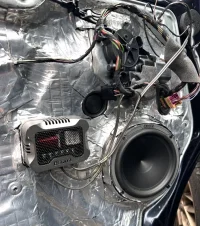
Is this Hertz install ok, or could it be improved?

roooms

Senior Member
VIP Member
T6 Guru
This is the first time I've removed my door cards, and I was a bit surprised to see the crossover screwed into the inner door skin.
The speaker/crossover install was carried out by the original owner/company. Then, I had a different company sound-deaden the doors and cab floor.

I took this apart as I was getting some buzzing/rattling from the door, and I think now it could be a number of things.
  • The crossover is screwed in with two screws, and one has worked loose as the mounting position means the back plate is slightly twisted, as the surface isn't flat
  • The crossover cover was held in place with a cable tie, as the twisting of the back plate meant it couldn't clip in place securely
  • The speaker cables are loosely cable-tied in place and were possibly rattling/vibrating against the door card
I can fix most of this up easily enough, but I wanted to get your thoughts on whether I should reposition the crossovers elsewhere. Is there a better place for these behind the dash on the driver and passenger side? Or should they be close to the speakers to minimise cable run? I'm a complete novice when it comes to audio, so I would appreciate suggestions from the many folks on here who really know about this.

Thanks!
CleanShot 2025-09-27 at 13.20.06@2x.webp
 
Be careful with any non standard screws in that inner door skin as the window regulator is very close behind it.
It’s a classic case of customer can’t see it so it’s OK, to be frank the VW standard loom isn’t much better.
If you haven’t done it already try covering the door cards with 10mm self adhesive foam (cheap on Amazon), it makes a big difference and will prevent any rattling against the card.
 
Yeah, that's a good point. These have been in the door the whole time I've owned it, and I haven't had any issues with the screws, but I'd like to consider relocating the crossover if there is a better place to install it. Good suggestion on the foam. I've watched a few videos where some folks install it over the silent coat on the door, and others stick it to the back of the door card itself. Any consensus on the best approach, or does it not really matter?
 
Yeah, that's a good point. These have been in the door the whole time I've owned it, and I haven't had any issues with the screws, but I'd like to consider relocating the crossover if there is a better place to install it. Good suggestion on the foam. I've watched a few videos where some folks install it over the silent coat on the door, and others stick it to the back of the door card itself. Any consensus on the best approach, or does it not really matter?
I did the back of the door card which is way easier as no obstructions.
While you have the door card off it’s worth taking the speaker out and fitting the biggest piece of butyl sound deadening you can on the outer door skin, that panel is like a drum.
 
The outer door skin has already been done, thankfully. That was part of the cab deadening job I had a garage complete. Floor and doors. I wasn't sure, but it's obvious now it was just silent coat though. No foam in the doors.
 
Being blunt, that cabling is dog sh!t. Our apprentice knows better than that. Cabling not secured or cloth taped. Wouldn't of put the crossover there either as you can get creaks and rattles if it's close by. What's the sound deadening like on the door cards?
 
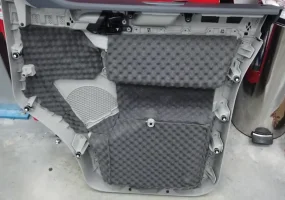
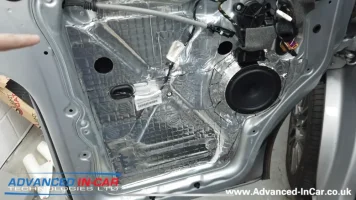
That's the kind of feedback I appreciate @Dav-Tec, thanks for replying. DXX gave me some solid suggestions about sound deadening that confirm stuff I've seen and read before. There's currently no deadening at all on the door cards, so I've bought some acoustic foam, which I plan to install by copying the attached screenshots I took from an Advanced In-Car Technologies YT video. I was also going to try to copy the wiring setup, but the audison crossovers in the picture look much smaller than my hertz ones, so I just need to either install them more securely in the same position or move them somewhere else.

Yes, the wiring is... disappointing. I wondered what it might be like when I had the headunit out and found the soldering of the new wires to the existing loom. If I tidy this up but leave the crossovers on the inner door skin, am I ok to cloth tape all three audio wires (from headunit, to tweeter, to door speaker) together? Or is there any kind of interference concern having them all bundled tightly together? If you have any pictures of similar installs you are willing to share so I can try to copy something, I'd appreciate it. I'm fairly particular when it comes to this kind of thing, so while I don't know much about audio setup specifically, I'm happy to spend some time cleaning up the install now that it's effectively in place and already working. I'd like to avoid pulling the dash out, but I won't rule that out if someone can show me good space behind the dash where the crossovers would be better positioned.

Thanks!

CleanShot 2025-09-28 at 19.25.44@2x.webp

CleanShot 2025-09-28 at 19.26.15@2x.webp
 
Ok. Well our basic rule of thumb if in doubt rip it out. If you have doubt of the connections start again.

I'd relocate the crossovers to the dash area although acoustic liner should help isolate the rattles. Taping the speaker wires together is fine.

A great audio setup and perfect tune can be completely undermined by poor sound deadening. Rattles not only distract from the music but also instantly pull the sound stage to the location of the noise, ruining the intended experience.

... Cue lecture.

Sound deadening is about much more than just making a car quieter. It's a fundamental process that transforms your driving experience by targeting and eliminating different types of unwanted noise. The core principle behind a truly effective system is a multi-layer approach, as each layer serves a specific purpose to combat a different kind of noise.

The importance of this system lies in its ability to address every source of sound, from vibration to airborne noise. Your "Dead Doors" package is an excellent example of this, using a targeted combination of materials to achieve a level of quiet and audio clarity that a single material simply cannot.
Outer Skin: Anti-Vibration Mat & Superliner

This part of the system focuses on the main culprit of road noise and speaker distortion.

* Anti-Vibration Mat (Damping): This is the critical first layer. Applied directly to the outer metal skin of the door, it adds mass to the large, thin metal panels. By doing this, it converts vibrational energy from road noise and bass into silent, thermal energy. This action stops the door from acting like a drumhead, which is the primary source of that "tinny" sound and annoying rattles.

* Superliner (Closed Cell Foam): The closed cell foam is a smart second layer. It's applied over the damping mat and acts as a decoupler and a sound absorber. Its main job is to prevent the outer metal skin from vibrating against other components and to soak up some of the high-frequency airborne noise. It also helps to insulate the door, which is a great side benefit.

Inner Skin & Door Card: Multi-Layered Defence
This part of the system is designed to create a solid, stable surface for your speakers and to eliminate rattles and buzzes from the plastic door cards.

* Inner Skin Anti-Vibration Mat: Applying another layer of the anti-vibration mat to the inner skin of the door makes for an incredibly stable mounting point for your speakers. This provides a solid surface for the speaker to work from, allowing the sound to be cleaner and more accurate without being distorted by the vibrating door panel.

* Door Card Anti-Vibration Mat: This layer specifically tackles plastic rattles and buzzes. It adds mass to the plastic door card, which stops it from vibrating and rattling in sympathy with the music or bumps in the road.

* Acoustic Liner (Acoustic Foam): The final layer is an acoustic liner, which is applied between the door card and the inner metal door frame. This material is designed for sound absorption and is crucial for audio performance. It absorbs the sound waves that bounce around inside the door cavity, such as the back-wave from the speaker, which reduces echo and gives a much clearer, more professional sound. It also serves as a final decoupling layer to ensure the door card fits snugly and silently.

By combining these different materials in a specific way, it creates a comprehensive defence against all types of noise. The result is a substantial reduction in cabin noise, a more refined and solid feel to the vehicle, and a significant improvement in the quality of your in-car audio system.

The guys you see on Instagram stick a few sheets on or worse a few pretty (remove the R) little triangular bits on the raised areas of the inner skin and claim they've "sound deadened the doorx is just laughable.
 
Also here's our Instagram there's plenty of photos of our deadening process on there.

 
  • Like
Reactions: JDC
Really appreciate the thorough explanation @Dav-Tec thank you. The outer door skin just has silent coat, no closed cell foam. The inner skin (as pictures show) is just silent coat as well.

So I can get some closed cell foam to put on before I use acoustic foam at the end. I have some left over dodo mat hex pro (just mat) and some duo (mat and closed cell foam) from doing my rear van floor and ceiling myself. So I can add some to the door cards as well.

I can read through your advice a few more times, check your instagram, and tackle this.

Now I’ve finally finished the hybrid turbo upgrade the van is running so nicely. So rather than enjoy it for a while, I decided to strip the interior and hunt down every rattle and creak. This might be the most impossible task ever, but I’m definitely going to get rid of some of them :)
 
IMO do what you can do to the best of your ability and get out and enjoy it.
A T6 will never be a Rolls Royce, 99.999% of us will never have the Brad Pitt pull so lets not set the bar too high.
Life's too short for science lessons in what determines a bad squeak from a good squeak.
 
Yeah very true. There are some creaks between dash parts that I’m never going to be able to fix. It’s a van. The other irony is the minute you load it with camping gear that all rattles around anyway 😄
 
Back
Top